




Recent Posts
 French Clients Visit JIYAKE Factory for Semi-Trailers and Used Trucks Inspection: Global Partners WelcomeOct 27, 2026
 Will a Fuel Tanker Trailer Fit Your Depot's Bottom-Loading System?Oct 15, 2026
- Aluminum vs. Carbon Steel Fuel Tanker Trailers: Which Should You Buy?Oct 15, 2026
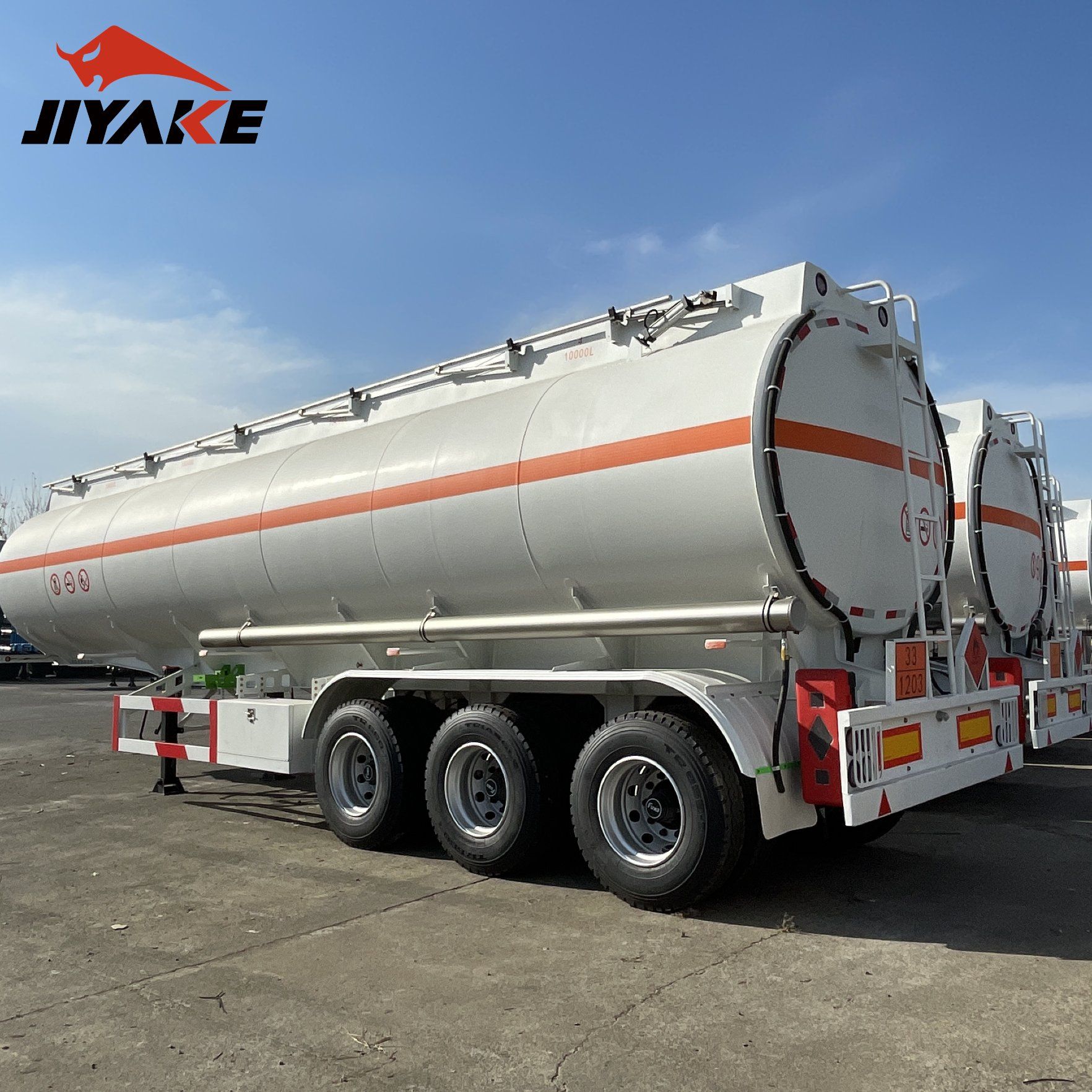
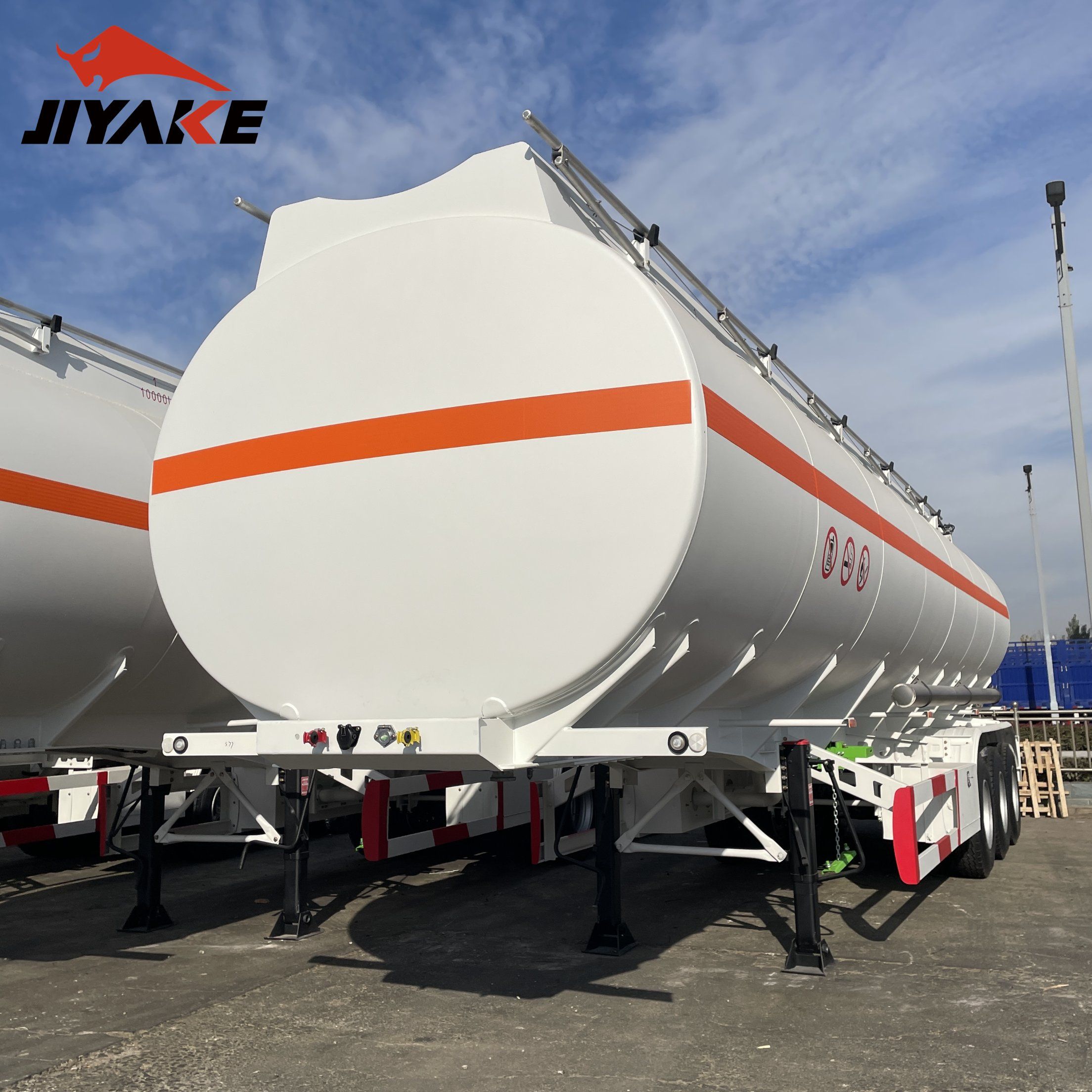

Fuel Tanker Trailer for Gasoline Transportation
Transporting gasoline safely and efficiently demands more than just a standard trailer—it requires purpose-built engineering that addresses volatility, weight distribution, structural integrity, and regulatory compliance. Operators in mining, construction, and logistics sectors often face unexpected challenges when their fuel transport setup lacks robustness or adaptability: inconsistent discharge timing, premature fatigue in side walls, or difficulty maintaining stability on uneven terrain during unloading. These issues don’t just slow operations—they increase maintenance frequency, raise safety risks, and compromise payload consistency over time.
The right solution starts with matching trailer design to real-world operational stress—not theoretical specs. For gasoline transport, tank geometry, material selection, and structural reinforcement must work in concert. While dedicated fuel tankers prioritize seamless cylindrical tanks and vapor recovery systems, many fleets also rely on versatile heavy-duty platforms capable of handling both liquid and bulk dry cargo—especially where infrastructure limits dedicated fleet segmentation. In such cases, a high-strength steel chassis built for extreme load cycles becomes critical, not optional.
A proven foundation is the 4 Axle dump semi-trailer, engineered for demanding environments where reliability under repeated high-payload cycles matters most. Its 11000×2500×3500 mm frame uses heavy-duty I-beam main girders and 3mm side walls—designed to resist deformation from both static load and dynamic torsion during side-tipping. Unlike lighter-duty variants, this model integrates ten hydraulic cylinders and leaf spring suspension, enabling stable, rapid side-tipping discharge even with payloads ranging from 30,000 kg to 100,000 kg. That range isn’t theoretical flexibility—it reflects actual field needs across quarry haulage, site fuel resupply, and inter-terminal logistics where payload variability is routine, not exceptional.
Why Structural Rigidity Matters More Than Tank Volume Alone
Gasoline transport trailers are often evaluated first by capacity—but volume without controlled discharge dynamics creates bottlenecks. A trailer with oversized tank volume but insufficient frame stiffness may suffer from delayed or uneven tipping, leading to residual product retention, inaccurate metering, or operator intervention mid-cycle. The 4 Axle dump semi-trailer avoids this by anchoring its tipping mechanism directly into a reinforced substructure. Its dual-speed 28-ton landing gear supports precise positioning before discharge, while the double-air-chamber braking system—paired with 40L air tanks—ensures consistent stopping power even when transitioning between loaded and empty states on gradients common in mining or rural fuel depots.
Material and Surface Integrity Under Real Conditions
Corrosion resistance isn’t only about chemical exposure—it’s about mechanical wear from repeated loading, road debris impact, and thermal cycling. Blast cleaning followed by one coat of primer and two coats of finish paint provides adhesion depth and UV resistance far beyond single-coat applications. This process, combined with high-strength steel throughout the frame and floor, reduces long-term surface degradation in humid or dusty regions—common across Southeast Asia, Central Asia, and African operating zones where Shandong Jiyake serves over 60 countries.
Operational Flexibility Without Compromise
Standardization helps with parts availability and training—but rigid uniformity hampers adaptation. That’s why side board height, rim size (9.00-22.5 standard, other sizes optional), and ABS integration are configurable without redesign. Optional ABS isn’t just a compliance checkbox; it actively stabilizes trailer yaw during emergency braking on wet or gravel surfaces—critical when hauling flammable liquids where skidding increases spill risk. Similarly, the 7-way, 24V LED lighting system ensures visibility during night refueling at remote sites, reducing reliance on auxiliary lighting setups.
No single trailer solves every gasoline transport scenario—but selecting one built for structural accountability, repeatable discharge performance, and environmental resilience cuts decision complexity significantly. When evaluating options, prioritize how the chassis handles load transfer during tipping, how surface treatment holds up after 12+ months in active service, and whether configurability aligns with your route profile—not just initial purchase price or nominal capacity.
Leave A Reply

First class quality service and professional after-sales team.
Get in Touch
*We respect your confidentiality and all information are protected.