




Recent Posts
 French Clients Visit JIYAKE Factory for Semi-Trailers and Used Trucks Inspection: Global Partners WelcomeOct 27, 2026
 Will a Fuel Tanker Trailer Fit Your Depot's Bottom-Loading System?Oct 15, 2026
- Aluminum vs. Carbon Steel Fuel Tanker Trailers: Which Should You Buy?Oct 15, 2026

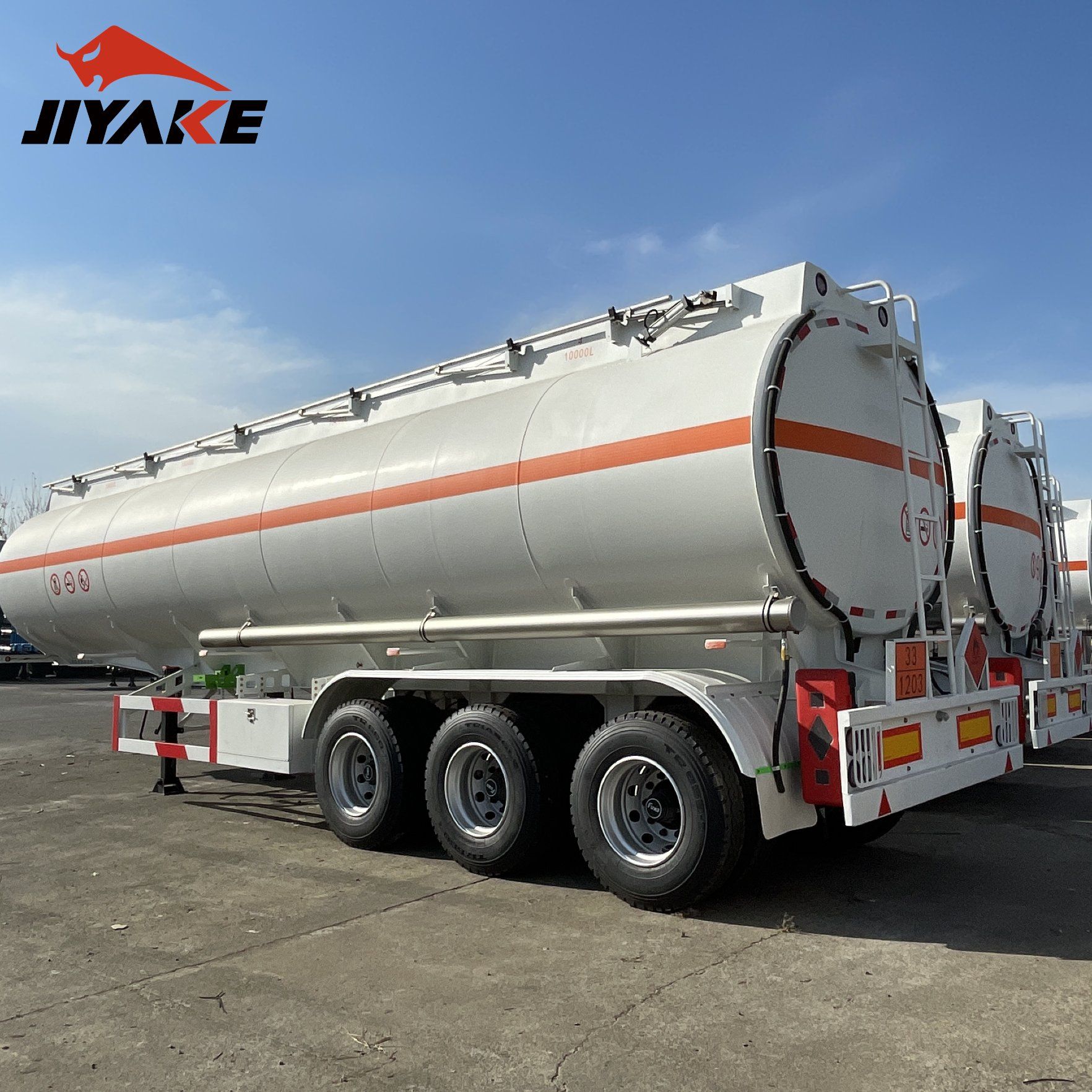
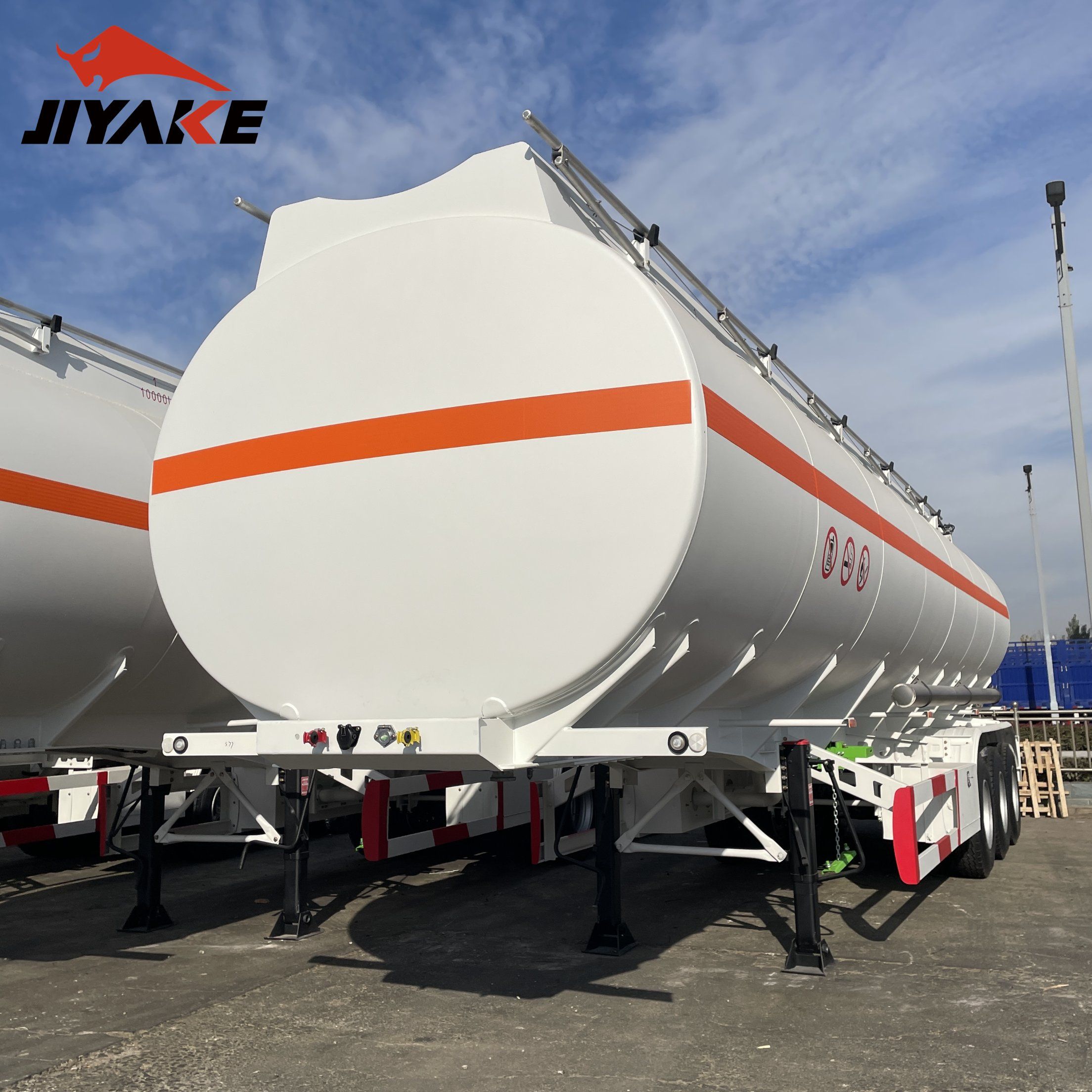

40ft Fuel Tanker Trailer Dimensions
When planning cross-border fuel transport in Southeast Asia, Africa, or Central Asia, precise dimensional compliance isn’t optional—it’s foundational. A 40ft fuel tanker trailer that exceeds local road width, height, or axle load limits risks detention at border checkpoints, unexpected fines, or forced offloading mid-route. Worse, incorrect dimensions compromise structural integrity during long-haul transit over uneven terrain or high-temperature conditions common in these regions. Operators often discover dimensional mismatches only after delivery—when retrofitting or re-certification becomes costly and time-consuming.
The standard external dimensions for a compliant 40ft fuel tanker trailer are approximately 12,192 mm (40 ft) in length, 2,490–2,500 mm (8 ft 2 in–8 ft 2.5 in) in width, and 3,700–3,950 mm (12 ft 2 in–13 ft) in overall height, depending on chassis configuration, tank diameter, and suspension type. Internal tank volume typically ranges from 25,000 to 32,000 liters—but actual payload capacity depends less on nominal length and more on axle spacing, ground clearance, and weight distribution across the frame. For example, a trailer with excessive overhang beyond the rear axle increases rollover risk on mountainous routes in Laos or steep gradients in Ethiopia, even if total length falls within 40ft.
Why Dimensional Consistency Starts With Frame Design
Dimensional accuracy begins not with measurement tapes, but with structural engineering. At Shandong Jiyake, 40ft fuel tanker trailers are built using CNC-cut Q345B carbon steel main beams—identical to those used in heavy-duty platforms like the 8 Axle Lowbed Semi Trailer. This ensures consistent beam height (500 mm), plate thicknesses (16 mm top, 18 mm bottom, 10 mm middle), and torsional rigidity across both product lines. Unlike bolted assemblies, fully automatic tank welding minimizes dimensional drift during fabrication—critical when tolerances must hold within ±3 mm across a 12-meter span.
Ground clearance is another non-negotiable variable: while fuel tankers typically require 1,000–1,300 mm for under-chassis protection, this directly affects center of gravity and legal height limits. Lower clearance improves stability but may violate minimum road clearance regulations in countries with unpaved access roads. Conversely, raising clearance to meet terrain demands can push overall height beyond national caps—requiring special permits or route restrictions.
How Axle Configuration Changes Effective Dimensions
A 40ft fuel tanker isn’t defined solely by its outer shell—it’s shaped by axle placement. A 3-axle setup spreads load but shortens usable wheelbase, limiting tank diameter and thus volume. A 4-axle configuration extends wheelbase, allowing larger-diameter tanks and higher volumetric efficiency—but adds length to the chassis structure itself, potentially pushing total length beyond 40ft unless overhangs are tightly controlled. FUWA axles, used across Jiyake’s trailer range, allow precise axle positioning within ±1.5 mm tolerance—enabling repeatable dimensional outcomes across batches.
Suspension choice further modifies effective dimensions. Mechanical suspension maintains fixed ride height; air suspension allows dynamic adjustment—but requires additional space for air bags and piping, subtly altering height profiles under load. This matters when verifying compliance against static regulatory thresholds, which most jurisdictions enforce.
Verification Steps Before Deployment
- Confirm local definitions: Some countries define “40ft” as internal tank length—not overall trailer length. Always verify whether regulation references chassis length, tank length, or total vehicle length including drawbar.
- Measure under load: Dimensions shift when sprung mass compresses suspension. Verify height and width at rated payload—not empty.
- Check coupling point impact: A 2″ or 3.5″ Jost traction pin changes hitch height and affects fore-aft weight transfer—altering effective front-to-rear dimension balance.
- Validate with real-world constraints: Clearance isn’t just about pavement. Account for overhead wires, tunnel arches, and low bridges—especially on secondary routes where GPS data may be outdated.
No single “universal” 40ft fuel tanker trailer exists. What works in Kenya’s highway network may fail inspection in Vietnam’s urban corridors—or exceed axle load limits in Kazakhstan’s remote energy zones. Dimensional compliance emerges from matching technical specs to operational context—not copying catalog numbers. That’s why structural consistency, weld integrity, and configurable axle layouts matter more than nominal length alone. When oversized cargo transport demands extreme precision—as with heavy equipment movement or infrastructure logistics—the same engineering discipline applied to 8 Axle Lowbed Semi Trailer standards informs fuel tanker dimensional reliability.
Leave A Reply

First class quality service and professional after-sales team.
Get in Touch
*We respect your confidentiality and all information are protected.