




Which tipping system suits clay loads from a dump trailer manufacturer?
Which Tipping System Suits Clay Loads from a Dump Trailer Manufacturer?
Clay is one of the materials that makes a dump trailer look simple on paper and difficult in daily work. Its weight changes with moisture, it can compact under its own mass, and it often clings to the body instead of sliding cleanly to the ground. For contractors moving excavated soil, brick-making clay, or wet material from site preparation, the right tipping system is not merely a convenience. It affects unloading speed, vehicle stability, cleanup time, and the chance of a dangerous rollover.
A capable Dump Trailer Manufacturer should begin with the unloading environment rather than recommending the same body configuration for every job. The useful questions are practical: Is the discharge point level and open? Is the clay wet and adhesive? Must the driver unload beside trenches, stockpiles, or walls? Are trips short and frequent, or does the trailer travel over rough roads before discharge? The answer usually points toward rear-end, side, or three-way tipping.
Why Clay Creates a Different Tipping Problem
Dry aggregate tends to flow once the body reaches a moderate angle. Clay may behave very differently. It can bridge near the tailgate, remain packed in the front half of the body, or release suddenly in one heavy mass. That uneven release changes the trailer’s center of gravity at exactly the moment when the raised body is least stable.
For this reason, body angle alone is not a complete answer. A high lift can help sticky material move, but a higher raised body also demands firmer, more level ground. The body floor condition matters as well. Worn surfaces, dents, unsealed joints, and dried clay deposits all give new loads more places to grip. In wet seasons, a clean body and a controlled unloading routine are often as important as cylinder capacity.
The operator should also avoid assuming that a load is evenly distributed because it was loaded by an excavator. One side can be substantially heavier, especially when the machine works from a fixed position. Raising a trailer with an off-center clay load on soft ground is a familiar risk pattern in earthmoving work.
Rear-End Tipping: Usually the Practical Choice for Clay
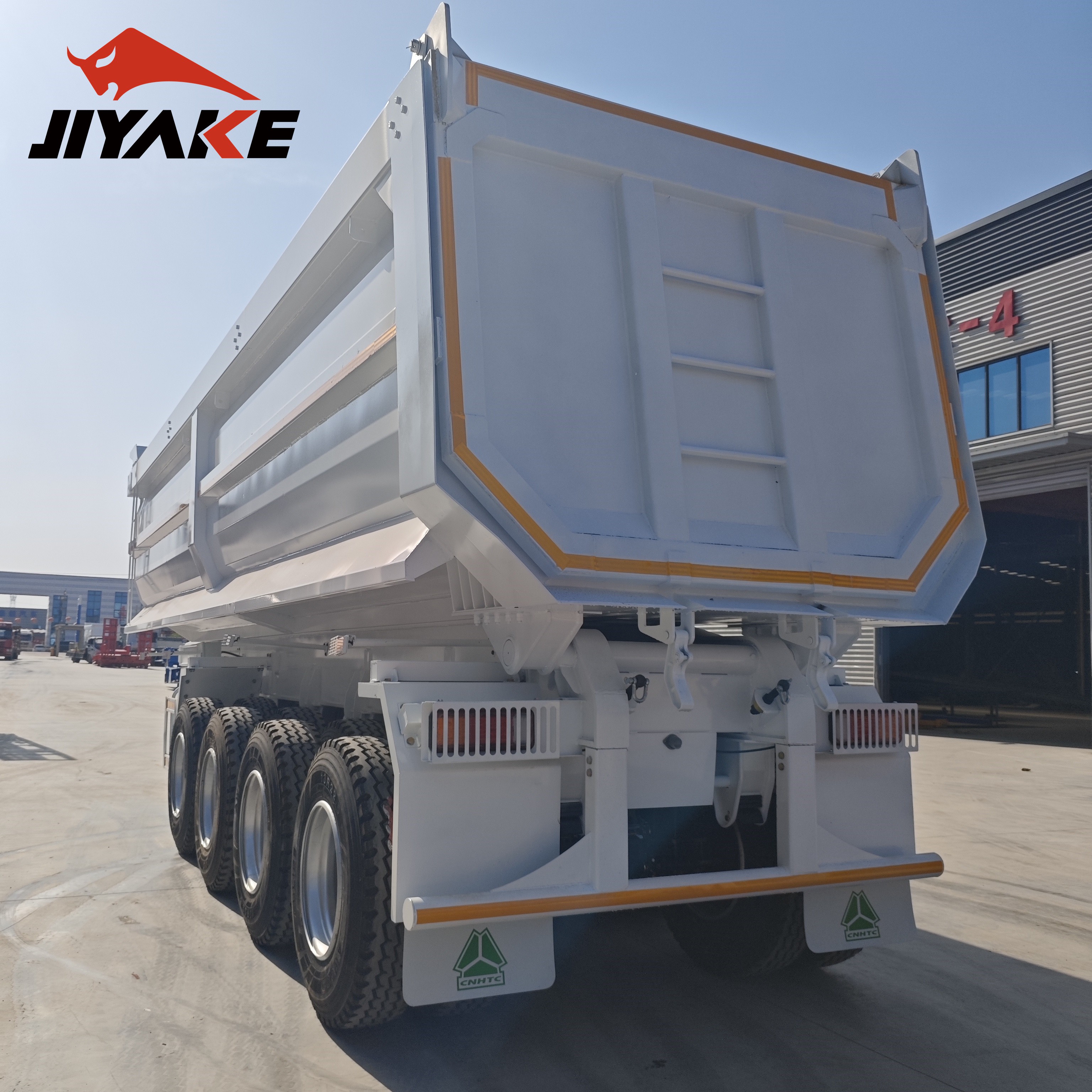
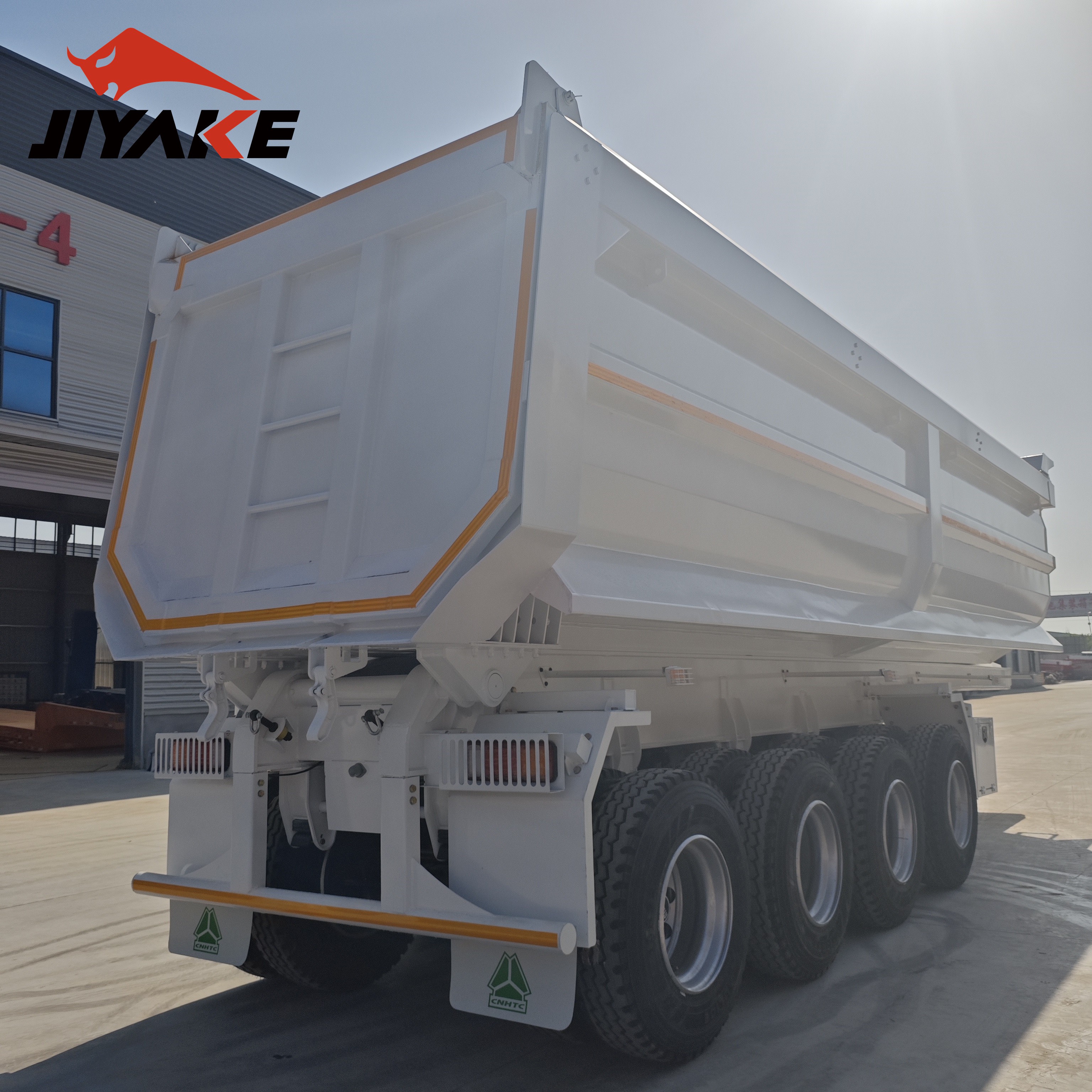
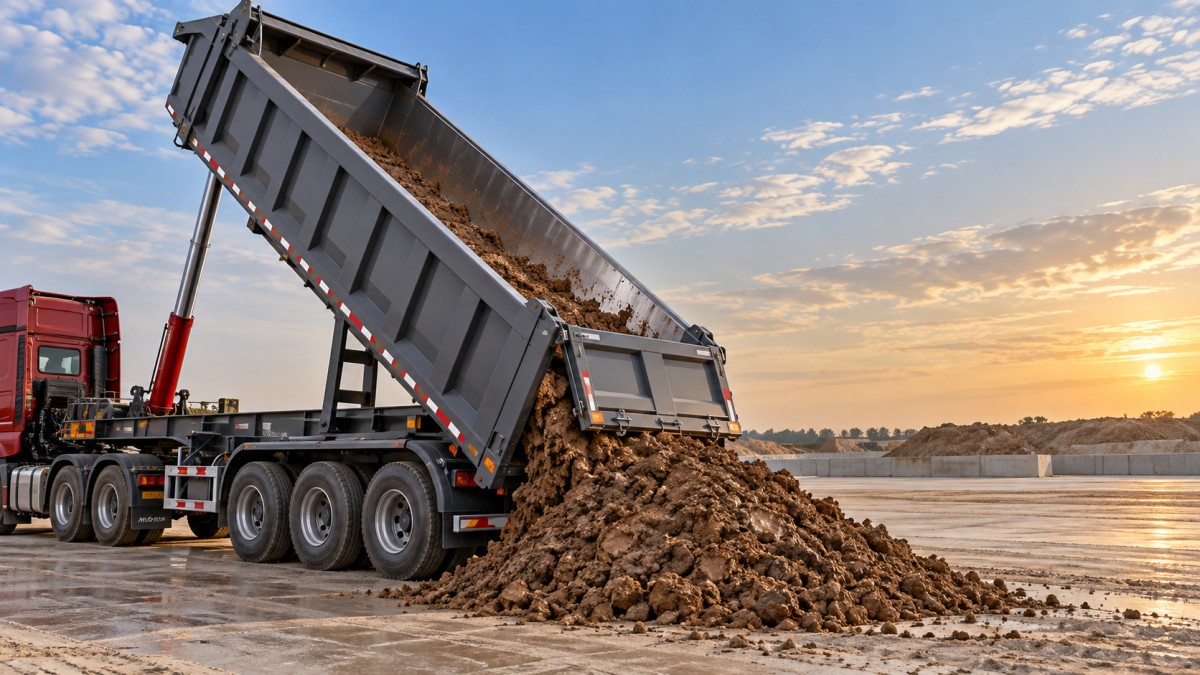
For most clay-hauling routes, rear-end tipping is the most straightforward and generally the most suitable arrangement. The trailer reverses to a designated discharge area, raises the front of the body, and releases material through the rear tailgate. It works well where there is adequate overhead clearance and a prepared, level tipping pad.
Rear tipping is particularly useful when clay is being deposited into a stockpile, spread along a fill area, or unloaded at a processing yard. The driver can place the load in a controlled direction, and the trailer body is built around a simple discharge path. A steep body angle, a well-designed tailgate opening, and a smooth interior are more relevant for sticky clay than an unusually large body volume.
Its limitation is space. The tractor and trailer need room to reverse and straighten before lifting. Rear tipping is also a poor choice under power lines, low roofs, trees, conveyors, or other overhead obstructions. If the site surface has side-to-side slope, loose fill, or deep wheel ruts, unloading should be postponed or moved to a safer location rather than relying on the tipping system to compensate.
When Side Tipping Makes More Sense
Side tipping can be valuable when the job requires material to be discharged alongside the travel route. Road construction, embankment work, and confined work zones may not leave enough room for a truck to reverse into position. A side tipper can place clay beside the vehicle, reducing maneuvering and helping the operation maintain a forward flow.
However, clay makes side tipping more demanding than side tipping dry sand or gravel. The load must be distributed carefully, and there must be enough clear width for the full discharge area. If sticky material releases in a lump, it can pull the body toward the discharge side. Ground firmness and cross-slope deserve close attention because the tipping direction is lateral rather than directly behind the trailer.
Choose a side-tipping system when directional placement and restricted reversing space are genuine operating needs—not simply because it appears more versatile. For a site with unpredictable ground conditions, conventional rear tipping is often easier to manage safely.
Three-Way Tipping Offers Flexibility, Not a Shortcut
A three-way tipper allows discharge to the rear and to either side. This flexibility can suit small construction sites, municipal projects, farms, and locations where the vehicle’s approach direction changes frequently. It can reduce repositioning when the unloading point is constrained by equipment, barriers, or site traffic.
For clay loads, though, a three-way system still requires disciplined use. The extra tipping options do not eliminate the need to inspect load distribution, ground level, tailgate operation, and discharge clearance. In fact, operators should be trained to select the safest direction for each load rather than treating every available direction as equally appropriate. If most loads will be dumped at one stable yard, the added complexity may not deliver a meaningful operational benefit.
The Specification Details That Matter More Than a Brochure
Before placing an order, ask the manufacturer to review the clay’s typical moisture condition, estimated payload, loading method, route quality, and unloading surface. These details influence body volume, steel thickness, hydraulic arrangement, suspension selection, and tailgate design. A body sized only for loose dry soil may be unsuitable if wet clay creates a much heavier load at the same volume.
Pay close attention to the following points:
- Hydraulic system: the cylinder and pump arrangement should be matched to body length, expected load, and required tipping angle.
- Body interior: smooth floors and sidewalls reduce material hang-up; regular cleaning prevents buildup from becoming permanent.
- Tailgate design: it must open reliably under load and provide a discharge opening appropriate for compacted material.
- Chassis and suspension: they need to tolerate repeated heavy loading and the uneven roads common around excavation sites.
- Safety equipment: working lights, braking condition, hydraulic hose protection, body prop arrangements, and warning procedures should be considered as part of the operating system.
A trailer is only one part of a mixed project fleet. Heavy equipment may need to reach the same infrastructure or energy site that generates the clay haulage work. In that setting, a low-deck transport solution such as the 2 Axle Lowbed Semi Trailer can serve a different but connected role, moving excavators or other indivisible equipment while tippers handle the material flow. Keeping those functions separate helps avoid using the wrong trailer for the wrong task.
Do Not Ignore the Tipping Ground
Many apparent trailer problems begin below the tires. A well-built rear tipper can still become unstable if one wheel sinks into soft ground or if the trailer is raised across a slope. Before tipping, the driver should confirm that the surface is firm, reasonably level, and clear of trenches, buried edges, overhead hazards, and people. The tractor and trailer should be aligned straight for rear discharge, with brakes applied according to the vehicle’s operating procedure.
If the clay does not release normally, repeatedly shaking, moving, or aggressively raising and lowering the body can make the situation worse. The safer response depends on the equipment design and site rules, but it generally begins with lowering the body, reassessing the ground and load condition, and removing material by an approved method if necessary. Nobody should enter beneath a raised body unless it is properly supported and the applicable maintenance procedure is followed.
A Better Way to Compare Manufacturers
When comparing a Dump Trailer Manufacturer, look beyond photographs and nominal payload claims. Ask how the proposed tipper configuration changes for wet clay versus ordinary construction aggregate. Request clear confirmation of the selected body dimensions, axle and suspension arrangement, hydraulic components, paint protection, spare-parts availability, and local road or registration requirements. These points should be confirmed against the destination market rather than assumed.
Shandong Jiyake Automobile Sales Co., Ltd. combines vehicle design, development, production, trade, and fittings operations across its affiliated businesses. Its product range includes tippers, semi-trailers, tankers, tractor trucks, concrete mixers, wreckers, timber trailers, and other special vehicles. With a 300,000 m² factory area, 500 employees, and equipment including CNC cutting, automatic welding, large bending, canning, and tank welding machinery, the company can discuss vehicle construction in relation to the intended work rather than treating all trailers as interchangeable. Its vehicles serve markets in Southeast Asia, Central Asia, and African countries, where route conditions and operating expectations can differ substantially.
For regular clay transport, rear-end tipping remains the sensible default when unloading areas are open, level, and prepared. Side tipping earns its place where lateral discharge is necessary, while three-way tipping is useful for genuinely variable sites. The final decision should be made from the load behavior and the tipping ground—not from the number of available tipping directions.
Leave A Reply

First class quality service and professional after-sales team.
Get in Touch
*We respect your confidentiality and all information are protected.