





Which skeletal trailer dimensions suit 45-foot container transport?
Which Skeletal Trailer Dimensions Suit 45-Foot Container Transport?
Choosing the right skeletal trailer dimensions for a 45-foot container is not simply a matter of ordering the longest chassis available. A 45-foot box is a nominal 45 feet long, but the trailer must also position the container correctly over the kingpin, axles, rear overhang, and twist-lock stations. Small specification errors can create loading difficulties, poor weight distribution, restricted turning clearance, or non-compliance with local road limits.
For procurement teams, the practical question is not “Can this trailer carry a 45-foot container?” It is “Can it carry our containers, on our routes, with our tractors, under our axle-load and overall-length restrictions?” The answer depends on the relationship between chassis length, lock layout, axle spacing, suspension, and the operating market.
Start with the Container, Not the Trailer
A standard 45-foot ISO container is approximately 13.7 metres long externally. However, the nominal container length alone is not enough to release a purchase order. Buyers should obtain the actual container drawings or confirm the bottom corner fitting positions from their shipping line, leasing provider, or cargo operator. The twist-lock centres on the skeletal chassis must align precisely with those lower corner castings.
This becomes more important when the fleet handles several container sizes. A fixed 45-foot skeletal trailer may be the cleanest choice for dedicated long-container work, while an extendable or multi-position chassis can provide greater flexibility for 20-, 40-, and 45-foot traffic. Flexibility is useful, but it introduces more moving parts, additional inspection points, and potentially more tare weight. A fleet with predictable 45-foot contracts may gain more from a robust fixed-frame design than from a universal solution.
The Dimensions That Actually Affect the Decision
The overall trailer length matters, but it should be evaluated together with the distance from kingpin to axle group and from axle group to the rear of the chassis. These dimensions control both handling and axle loading. A chassis that is technically long enough may still be unsuitable if it transfers excessive weight to the tractor drive axle or the trailer bogie when carrying a heavily loaded container.
There is no universally correct overall length for every 45-foot skeletal trailer. Different regions apply different limits to trailer dimensions, tractor-trailer combinations, axle loads, rear overhang, and turning circles. A design that operates efficiently in one market may require a different axle location or chassis arrangement in another. This is why country of operation should be part of the initial technical brief, not a late-stage paperwork issue.
Twist Locks Are a Layout Issue, Not an Accessory Choice
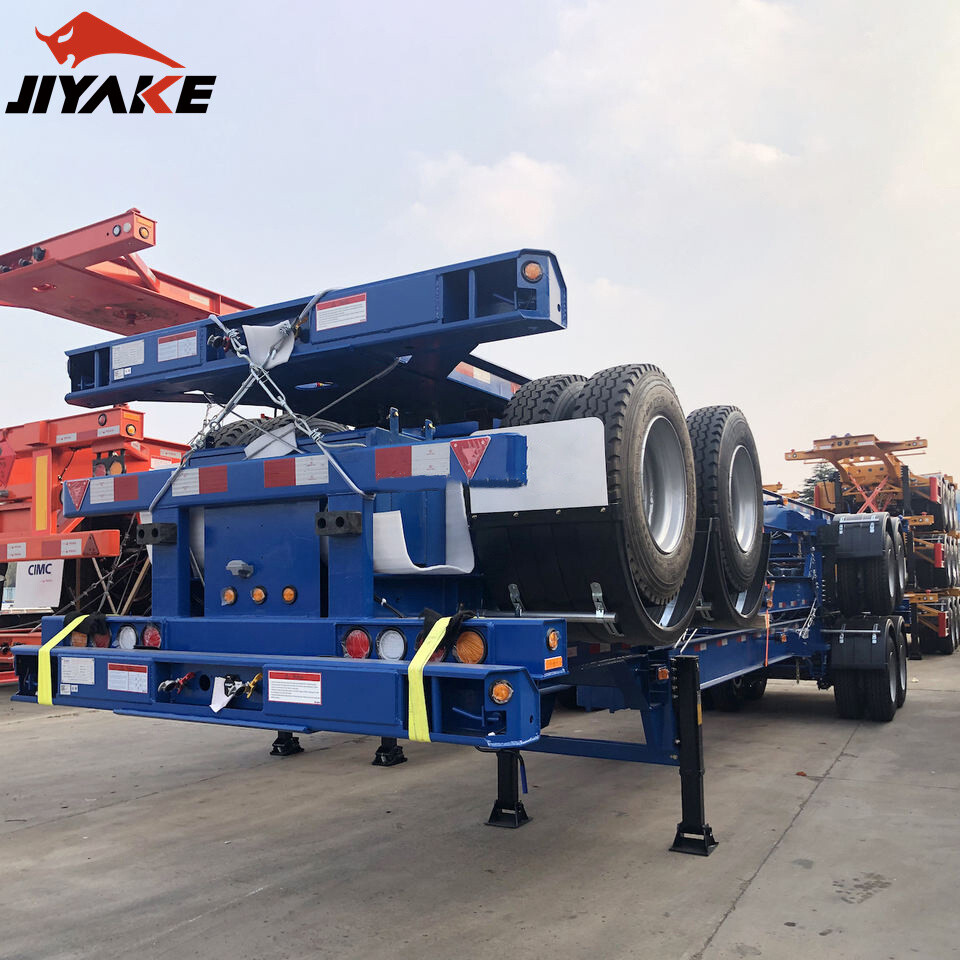
For a dedicated 45-foot chassis, four correctly positioned twist locks are the minimum functional interface. Yet procurement specifications should go further: ask whether the locks are fixed or retractable, whether their positions suit only 45-foot containers or multiple sizes, how they are protected from road debris, and how easily operators can inspect them.
Misaligned locks are an obvious loading problem. Less obvious is a chassis that has the correct lock spacing but poor access around the lock handles, inadequate visual confirmation of engagement, or deformation around lock mounting points after repeated use. Container securing components should be evaluated as part of the frame structure, especially in operations with frequent terminal handling and uneven yard surfaces.
If the trailer will also carry 40-foot containers, confirm whether a separate locking position is required and whether the unused locks sit safely below or clear of the container base. Never assume that “multi-size compatible” means every container type can be loaded without a configuration change.
Axles, Payload, and the Limits of a Longer Frame
A 45-foot container is often used where cargo volume is the priority, but some loads can still be dense enough to make axle distribution critical. The container’s gross weight rating, actual commodity weight, cargo placement, tractor axle ratings, and local legal limits all need to be reviewed together. The trailer’s rated capacity is only one part of the calculation.
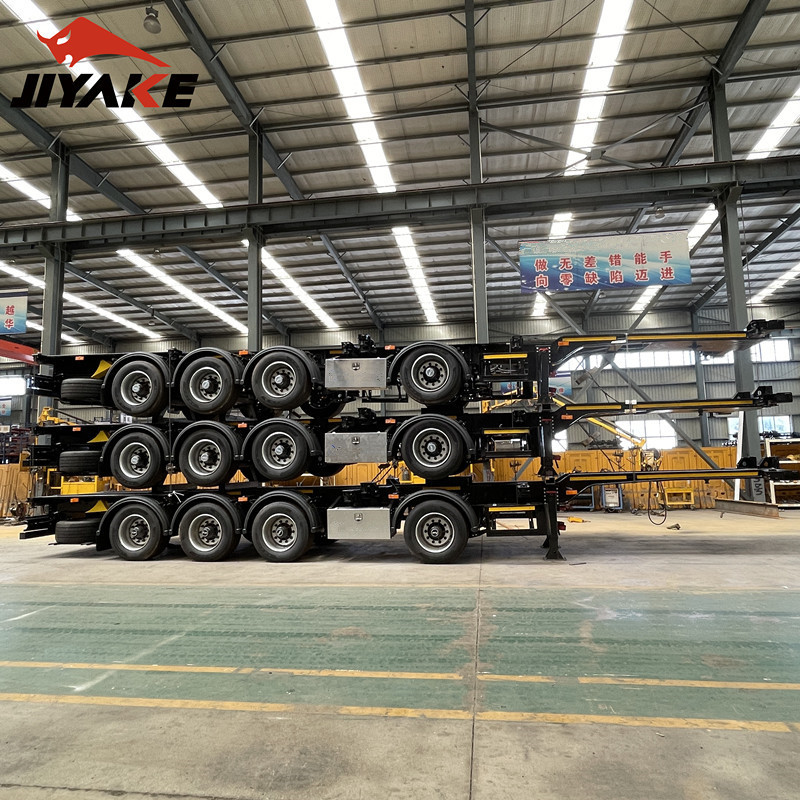
A tri-axle skeletal trailer may be considered where higher legal gross weights or demanding road conditions justify it. A tandem axle layout can reduce complexity and may suit routes with lower payloads or tighter operating constraints. Neither should be selected from a catalogue image. The preferred arrangement depends on how loaded containers are weighed, where they travel, and whether the operator faces frequent urban turns, ramps, or unpaved loading areas.
The chassis frame also deserves attention. Cross-member placement, main beam design, landing gear support, and rear bumper structure affect durability under repeated container drops and torsional loads. A light chassis may improve payload potential, but excessive weight reduction can be a false economy where roads are rough or loading practices are severe.
Specify the Operating Environment Clearly
The best procurement documents describe the route as well as the trailer. Port-to-warehouse work, cross-border road transport, and inland distribution create different demands. For example, frequent port handling may justify reinforced rear structures, durable lock assemblies, and corrosion protection. Long-distance operations may place more emphasis on tyre availability, suspension choice, brake-system compatibility, and practical maintenance access.
This broader fleet view also matters when sourcing other specialised equipment. A logistics operator moving containerised goods may separately require tank transport for chemicals, foodstuffs, or bulk liquid supply chains. In those applications, lightweight construction and corrosion resistance can be commercially relevant; an Aluminum Tanker Trailer using high-strength aluminium alloy addresses a different transport task while following the same procurement principle: match structure, payload, and operating conditions rather than buying on headline specifications alone.
Questions Worth Sending to the Manufacturer
Before finalising a 45-foot chassis, request a dimensional drawing showing the kingpin, axle centres, rear end, container support areas, and every twist-lock location. Ask for the proposed unladen mass, axle ratings, suspension details, tyre and wheel specification, brake-system configuration, landing gear capacity, and coating system. These details make comparison between quotations much more meaningful than comparing price and nominal capacity alone.
It is also sensible to clarify which elements can be adapted for the destination market. Shandong Jiyake Automobile Sales Co., Ltd. combines vehicle design, production, sales, and parts-related capabilities across a broad heavy-truck range, including semi-trailers and specialised transport equipment. Its manufacturing base covers 300,000 square metres and uses CNC cutting, automated welding, large bending, and tank-welding equipment. For a buyer, the relevant point is not the equipment list itself, but whether the manufacturer can translate a route-specific dimensional brief into a buildable, inspectable chassis configuration.
The right skeletal trailer dimensions are therefore the dimensions that secure the actual 45-foot container, distribute its real operating weight acceptably, and fit the roads and terminals where the vehicle will work. Confirm those three conditions on a drawing before production begins. It is the simplest way to avoid receiving a trailer that is technically 45-foot capable but operationally wrong for the fleet.
Leave A Reply

First class quality service and professional after-sales team.
Get in Touch
*We respect your confidentiality and all information are protected.