





Tipper Trailers for Mining: Features That Withstand Abrasive Heavy Loads
Mining Tipper Trailers Must Be Designed for Wear Before Payload
A mining tipper trailer can have an impressive rated payload and still become the weak point in a haul cycle. Abrasive ore, crushed rock, overburden, and wet aggregate do more than add weight: they grind the body floor, strike the front wall during loading, concentrate stress around the tipping hinge, and expose poor welds or inadequate reinforcement quickly. For a technical evaluator, the useful question is not simply how many tonnes the trailer can carry. It is whether the body, chassis, hydraulic system, and maintenance arrangement can continue carrying that material through the intended cycle without unacceptable downtime or structural repair.
For most mining applications, a well-specified trailer is worth the additional engineering effort when the route includes repeated loading, uneven haul roads, impact loading from an excavator or loader, and high-discharge-frequency operation. A basic construction tipper may appear suitable on paper, particularly where nominal capacity is similar, but it may wear through faster or develop fatigue issues when exposed to sharp, dense material and constant off-road vibration.
The selection process should therefore begin with the material and duty cycle, then move into body construction, lifting stability, running gear, and repair access. Capacity remains important, but it should be checked as part of the whole operating condition rather than treated as a standalone figure.
Start With the Material, Not the Brochure Payload
“Mining material” is too broad to support a reliable specification. Fine coal, damp clay, iron ore, blasted granite, laterite, copper concentrate, and crushed limestone create very different loading and wear patterns. A trailer hauling relatively fine material on maintained roads may prioritize payload efficiency and discharge speed. A trailer receiving large, angular rock directly from a loader needs much stronger protection against impact and abrasion.
Technical teams should establish several operating facts before evaluating a tipper trailer for mining:
- Material density, particle size, moisture content, and whether the load contains sharp or oversized fragments.
- Loading method, including bucket size, loading height, and whether the operator can control drop height.
- Expected payload range rather than only the legal or nominal maximum payload.
- Number of loading and discharge cycles per shift.
- Haul-road condition, slope, side camber, turning radius, and the probability of tyre or suspension shock loads.
- Discharge location conditions, particularly levelness, clearance, and the risk of material sticking inside the body.
These points influence nearly every important design choice. For example, a body floor that performs adequately with sand can lose service life rapidly under high-impact rock loading. Likewise, a hydraulic arrangement that raises a body smoothly on a level paved surface may be unsuitable where dumping must occasionally occur on rutted or uneven ground.
Material density also affects the useful body volume. A large box is not automatically an advantage. Dense ore can reach axle or gross combination limits long before the body is full. In that case, extra body volume adds steel weight and may encourage overloading without improving productive tonnes per cycle. The appropriate body geometry should match the density and loading practice of the mine.
Body Steel Needs a Wear Strategy, Not Just a Strength Grade
The tipper body is where mining duty becomes visible first. Abrasion generally concentrates on the floor, lower sidewalls, front bulkhead, tailgate area, and points where material changes direction during discharge. The correct approach is to evaluate both the base material and the areas receiving local reinforcement.
High-strength structural steel can reduce dead weight and provide good resistance to deformation, but strength alone does not guarantee abrasion life. A hard, wear-resistant liner can be appropriate in high-impact zones, especially where angular rock is loaded repeatedly. However, lining every surface without considering the payload penalty, attachment method, and repair process can create a heavy body with new stress concentrations.
A practical specification usually distinguishes between structural members and sacrificial wear surfaces. The body shell needs sufficient rigidity to retain its shape under load. The floor and selected impact areas may need replaceable or repairable protection. The front wall is particularly important because material dropped from a loader bucket often strikes it with substantial force before settling in the body.
Ask suppliers to explain the body cross-section rather than simply state plate thickness. A thicker floor may help, but its value depends on support spacing below the floor, the shape and depth of side ribs, the connection between the floor and sidewalls, and whether reinforcement creates pockets where material can lodge. Excessively rigid local reinforcements can shift fatigue stress to adjacent thinner plate or weld toes.
Body shape should also support clean discharge. A trailer that retains wet fines in corners or along the front of the box gradually loses effective capacity and may require manual intervention. Smooth internal transitions, adequate tipping angle, appropriate tailgate design, and a body profile suited to the material can reduce carryback. This is an operating-cost issue as much as a productivity issue, because residual material adds unproductive weight on every return trip.
Where Weld Quality Becomes a Mining Reliability Issue
Mining trailers experience repeated dynamic loading, so weld quality deserves the same level of scrutiny as steel selection. Cracks often begin near hinge brackets, front-wall connections, crossmember terminations, tailgate supports, cylinder mounts, and abrupt stiffness changes in the chassis. A visually large weld is not automatically a strong weld; poor joint preparation, inconsistent penetration, undercut, or poorly controlled transitions can shorten fatigue life.
Evaluation should cover weld layout as well as welding process. Continuous welds may be necessary in some critical areas, while intermittent weld patterns can be suitable elsewhere if engineered correctly. The objective is to avoid crack initiation points and to make future inspection practical. Areas hidden behind permanent covers or densely packed reinforcements may be difficult to examine before a small crack becomes a costly structural repair.
Surface preparation and corrosion protection also matter, especially when the trailer operates in wet material, coastal regions, or chemically active soils. Blast preparation before primer and a coherent paint system help protect the chassis and external surfaces, but coating should not be used to conceal poor fabrication. Inspect the underlying steelwork, drainage provisions, and access to zones where mud and water can accumulate.
The Chassis Must Control Torsion Without Making the Trailer Unrepairable
A mining trailer body cannot be assessed separately from its chassis. During loading and travel, the frame receives vertical load, longitudinal braking force, twisting from uneven ground, and concentrated force during tipping. The chassis needs enough stiffness to maintain alignment and support the body, yet it also needs an arrangement that can be inspected and repaired without dismantling major assemblies.
Look closely at the main beam profile, crossmember spacing, suspension mounting zones, kingpin structure, and the way the tipping subframe transfers load into the chassis. Reinforcement should be concentrated where loads enter the frame: near the landing gear, suspension brackets, hoist mounts, hinge area, and front body support. A specification based only on overall beam depth or plate thickness misses these local load paths.
Off-road mining routes increase torsional demand. Deep ruts, uneven loading areas, and sloped turning points can cause one axle group or one side of the trailer to see substantially different loads from the other. A frame that is overly light for this condition may crack around suspension mounts or lose alignment. Conversely, a frame built with unnecessary mass reduces payload and fuel efficiency. The target is duty-matched reinforcement, supported by a clear explanation of how the intended axle configuration, suspension, and chassis work together.
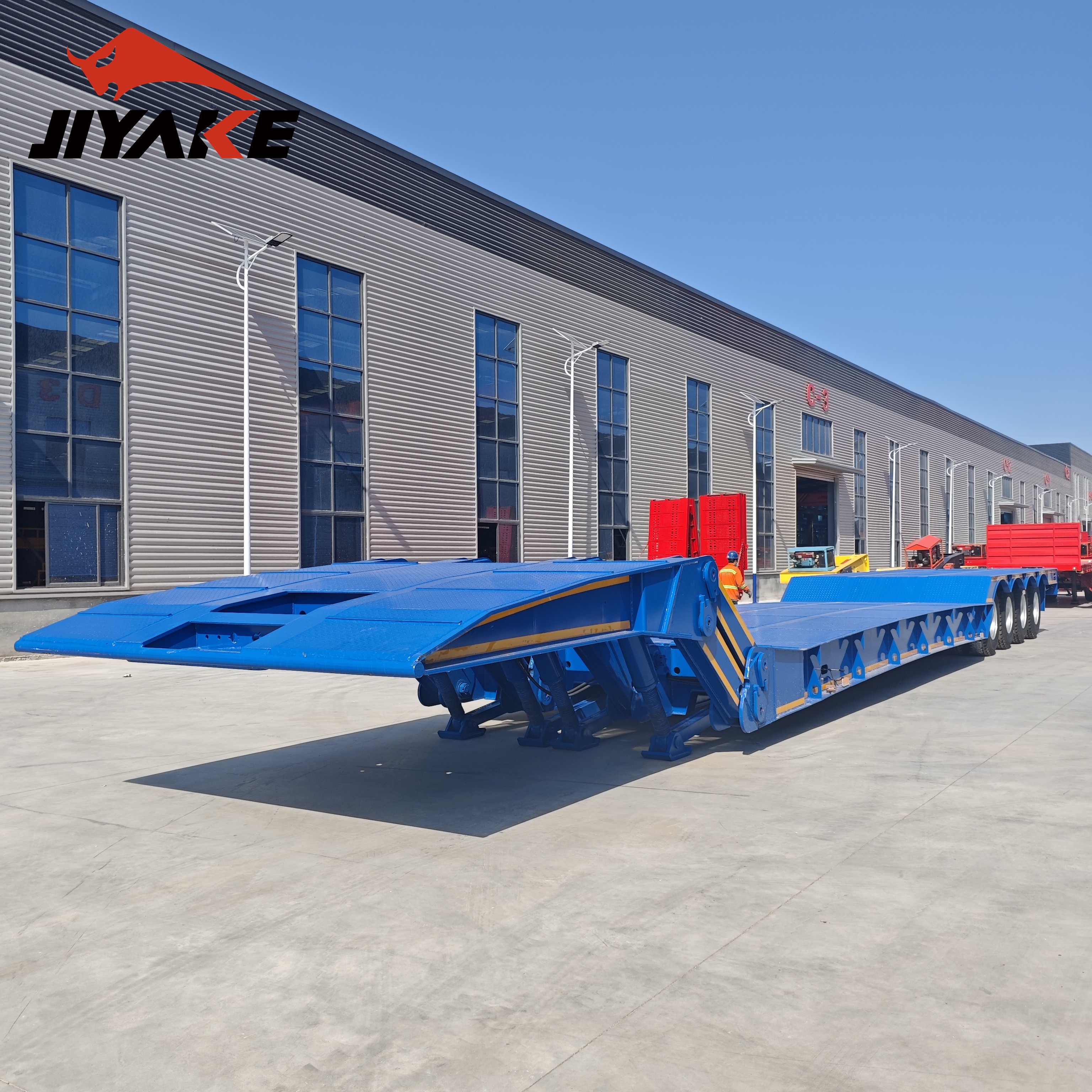
For fleets that move mining equipment in addition to bulk material, it is useful to keep trailer roles separate. A tipper body is intended for loose material and controlled discharge. Oversized or indivisible equipment requires a low-deck platform with suitable axle distribution, securement points, ground clearance, and loading access. A configuration such as an 8 Axle Lowbed Semi Trailer may be relevant for moving heavy support equipment between infrastructure or energy-project locations, but it is not a substitute for a mining tipper in abrasive bulk-haul duty. Treating these as separate transport tasks helps prevent the common mistake of forcing one trailer type into incompatible work.
Hydraulic Lifting Performance Is Mainly a Stability Question
The tipping system is frequently evaluated by cylinder capacity or stated lifting angle, but stable and repeatable discharge depends on a wider set of conditions. The cylinder, hydraulic pump, hoses, mounting geometry, body pivot, rear hinge, and trailer stance must function as a system. Failure in any one area can produce slow discharge, uneven lifting, excessive side loading, or unsafe tipping behavior.
A front-mounted telescopic cylinder is common for high-angle tipping applications, but its suitability depends on body length, loaded center of gravity, cylinder mounting structure, and expected material behavior. The hoist mounting area requires substantial reinforcement because it receives concentrated compressive force during the lift. Rear hinge brackets require equal attention: they carry the body load at maximum elevation and must resist repeated shock when the body returns to the chassis.
Technical evaluation should include the following questions:
- What is the specified maximum body angle with the intended body length and material type?
- How is lateral stability managed during tipping, particularly on imperfectly level ground?
- Are hydraulic hoses protected from rock strike, heat, abrasion, and accidental snagging?
- Can operators inspect pins, bushes, cylinder mounts, hose connections, and hydraulic components without unsafe climbing or extensive disassembly?
- What prevents the body from being raised when the trailer is parked on unsuitable ground or while a tailgate issue is present?
No trailer design can make dumping safe on an unstable surface. Site procedures remain essential: assess ground bearing condition, avoid side slopes, keep people clear of the discharge area, control sticking material, and lower the body before moving. A technically sound trailer supports these procedures through stable geometry, accessible inspection points, reliable brakes, and clear operating limits.
Axles, Suspension, and Brakes Are Exposed to More Than Gross Weight
Axles and suspension must be selected for the actual road profile, not only the anticipated static load. On rough haul roads, impacts can multiply forces at suspension brackets, equalizers, wheel ends, and tyres. Mechanical suspension can be robust and straightforward to service in demanding environments, while air suspension may offer ride and load-management benefits in applications where road condition and operating control support it. Neither choice is universally better; maintenance capability, route severity, axle loads, and required stability during loading and tipping should decide the selection.
Brake-system suitability also deserves close review. Repeated loaded descents generate heat, and contaminated or poorly maintained pneumatic components create a direct safety risk. Confirm that the brake configuration, air storage, chambers, lines, and relay-valve arrangement match the tractor and the operating environment. Low-temperature operation, dust ingress, water exposure, and the availability of service parts can all affect the preferred setup.
Tyres should be considered part of the suspension decision. The wrong tyre construction or insufficient reserve capacity can lead to frequent failures, particularly where sharp rock, heat, and high axle loads combine. Wheel and tyre choices must also allow practical replacement in the mine’s maintenance environment. A highly specialized fitment may look attractive in a specification sheet but create long downtime if replacement stock is difficult to obtain.
Evaluate Lifecycle Cost Through Inspection and Repair Time
The lowest acquisition price rarely identifies the lowest-cost mining trailer. Abrasion parts, body repairs, tyre wear, hydraulic failures, and lost cycles during maintenance often dominate the difference between two apparently similar designs. The most useful comparison is not a generic lifecycle-cost claim; it is a structured review of which components will wear first, how they can be inspected, and what work is needed to restore serviceability.
Before placing an order, request a detailed technical drawing package or an equivalent engineering review that identifies body plate materials, wear zones, main-frame construction, axle and suspension ratings, hydraulic layout, hinge design, and major bought-in components. Check whether wear plates, hinge bushes, pins, tailgate hardware, hoses, lamps, brake components, and landing gear can be replaced using accessible parts and normal workshop equipment.
It is also sensible to define acceptance checks around the risks that matter for the intended duty. These may include dimensional alignment, weld inspection, hydraulic lift operation, brake-system function, body-to-chassis clearance, tailgate operation, and coating condition. The purpose is to establish a trailer baseline before it enters a punishing haul cycle, not to turn pre-delivery inspection into a paperwork exercise.
A capable mining tipper is therefore defined by how deliberately it handles abrasive loading, frame stress, controlled tipping, and repair access. When the material, loading method, route condition, and maintenance resources are specified clearly, the resulting trailer can be engineered around real failure modes instead of a headline payload figure. That is the point at which a tipper trailer becomes a productive mining asset rather than a recurring source of body repairs and lost haul cycles.
Leave A Reply

First class quality service and professional after-sales team.
Get in Touch
*We respect your confidentiality and all information are protected.