




Recent Posts
 Thailand Clients Visit JIYAKE to Inspect Brand-New Semi-Trailers and Reach Cooperation AgreementNov 21, 2026
 Guinea Clients Visit JIYAKE to Inspect Brand-New SINOTRUK Vehicles and Reach Strategic CooperationNov 21, 2026
 When can an electric dump truck work on a fixed site?Oct 30, 2026

When is an articulated dump truck better for soft ground?
An articulated dump truck is often the better choice when a haul route is soft, uneven and difficult to improve quickly, especially if trucks must keep moving after rain. For a project manager comparing a dump truck for sale, the decision is less about whether the ground looks muddy and more about whether the loaded vehicle can travel, turn and tip consistently without excessive road repairs or recovery delays.
Articulated trucks can offer better traction and mobility than conventional road-going tipper trucks on rough temporary routes. They are not, however, a substitute for a stable haul road: even an articulated machine can sink, lose traction or become unstable if the ground is too weak.
Where an articulated truck earns its place
The strongest case is a site where soft ground is combined with uneven terrain. Earthmoving projects, borrow pits, road construction and wet excavation sites may have changing grades, rutted approaches and loading areas that move as the work progresses. In those conditions, a truck that can negotiate rough ground with less interruption may keep the excavator and the rest of the haul cycle working more consistently.
An articulated dump truck has a pivoting joint between its front and rear sections, allowing it to steer through articulation. Its off-road design, suspension and drivetrain also help it travel over uneven surfaces. Many models offer driven axles and differential-lock features that can help maintain traction when wheel grip varies. The exact drivetrain and operating limits depend on the machine, so the features of the proposed model matter.
Consider a haul from a wet excavation to a fill area across a temporary road. If conventional tippers repeatedly need assistance on the approach or cannot reach the loading point without extensive road preparation, an articulated truck may reduce interruptions. That advantage is most valuable when difficult conditions affect a substantial part of the working day, not just a short section that could be repaired quickly.
Soft ground is not one condition
A damp surface over firm subgrade is different from deep mud over weak soil. A truck may cross the first with suitable tires and a maintained running surface, while the second can deform under repeated passes until even an off-road vehicle becomes stuck. Standing water can also conceal deep ruts, soft edges or abrupt changes in ground level.
Check the route in both directions and under loaded conditions. The truck may reach the loading point empty but struggle on the return trip, particularly where a loaded climb begins immediately after a turn. Pay attention to transitions onto temporary roads, low areas where water collects, and the ground around the loader and tipping point. These locations often deteriorate faster than the main haul road because vehicles repeatedly brake, turn and queue there.
Traction and ground support are related but different problems. Driven axles can help a truck move when grip is limited; they cannot prevent weak ground from failing under its weight. Tire selection, inflation within the manufacturer’s specified range, payload and road construction all affect how the vehicle interacts with the surface. Reducing payload may help in some conditions, but it also changes the number of trips needed and must remain within the truck’s operating guidance.
Compare the entire haul cycle, not just payload
A road-going tipper or a rigid-frame off-highway truck can be the more economical choice when the route is firm, maintained and suited to that vehicle. The comparison depends on the type of rigid truck: a highway tipper is built for a different duty from a rigid mining truck, and neither should be treated as interchangeable with an articulated machine.
On a prepared route, a suitable rigid truck may move material efficiently without the added cost of an articulated fleet. On a rough, wet route, nominal payload can be misleading if trucks spend time waiting for recovery, taking detours or running partly loaded. Compare the amount of material delivered over a working shift with the road maintenance, fuel, tire wear, equipment availability and support each option requires.
Haul distance also changes the calculation. An articulated truck’s off-road capability may be useful near the excavation, while a long, firm road section may favor a different vehicle. Where there is room and equipment for rehandling, a project can use off-road trucks to reach a transfer area and road-capable trucks for the longer leg. The extra loading step needs to be included in the comparison.
Grades, turning and tipping need separate checks
A truck that can climb a grade in dry weather may struggle when the surface becomes slick. Assess the steepest loaded climb and descent, available traction, braking arrangements and the manufacturer’s limits for the selected machine. Avoid assuming that a published grade capability applies to a wet, rutted haul road. Where conditions demand it, improve drainage and the running surface, adjust the route or stop hauling until it is safe.
Turning areas deserve attention because steering while loaded can disturb a weak surface and create ruts. Allow enough space for the selected truck to maneuver without forcing tight turns at the edge of an excavation or embankment. Repeated passes through the same track can progressively weaken the road, so inspection and maintenance must continue throughout the shift.
The tipping area is a separate stability concern. Provide firm, level ground for raising the body, keep clear of unsupported edges and follow the truck manufacturer’s tipping instructions. Material that sticks in the body can increase instability as it is raised; uneven ground and side slopes add risk. An articulated truck’s mobility on the approach does not make a soft or sloping dump point acceptable.
When another solution makes more sense
If the weak section is short and the project has time to install drainage, strengthen the subgrade or add a suitable running layer, improving the road may be more effective than changing the entire fleet. A prepared route can benefit every vehicle using it, including water trucks and service equipment.
At the other extreme, very weak ground may require a different construction method, temporary working platforms or specialized equipment before any loaded truck can operate reliably. Sending an articulated truck onto ground that cannot support it can turn a mobility problem into a recovery and safety problem.
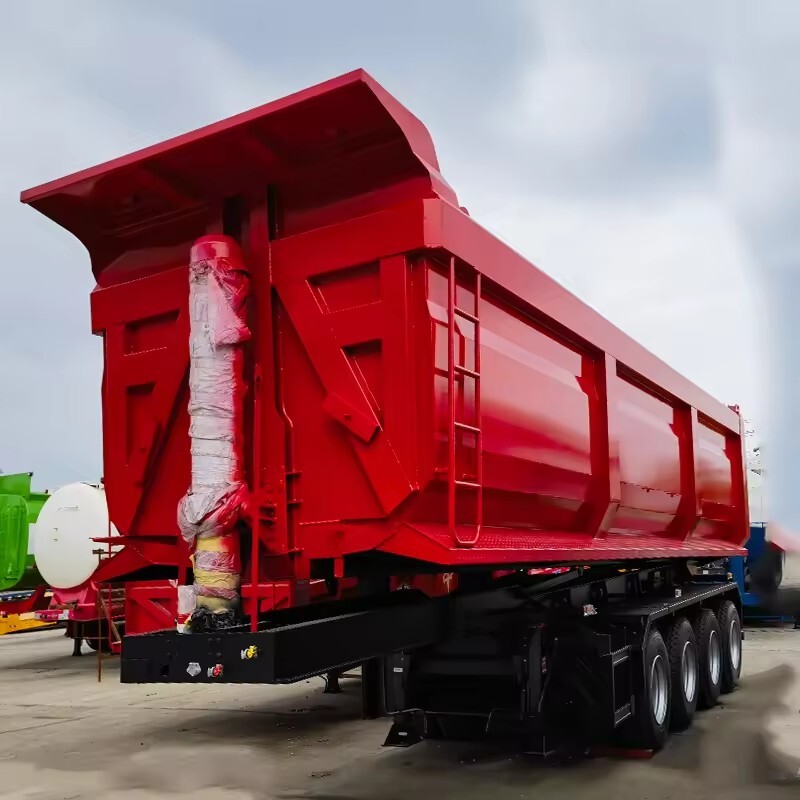
Equipment delivery is also a separate task from moving excavated material. For machinery carried over an appropriate transport route, an open-deck 4 Axle Flatbed Trailer is an example of a vehicle used to transport construction equipment and other heavy or irregular cargo. It is not a replacement for a dump truck on a soft-ground haul route.
What to establish before choosing a truck
Start with the actual route and material, then match the vehicle to the work. A useful comparison should establish:
- Ground conditions: Where are the weak sections, and how are they likely to change after rain or repeated passes?
- Haul profile: What are the loaded and empty distances, steepest grades, turning constraints and tipping conditions?
- Production requirement: How much material must reach the destination per shift, allowing for loading, travel, queuing and dumping?
- Truck compatibility: Does the proposed payload suit the loader, the material, the route and the available tipping area?
- Operating support: What road maintenance, tire care, recovery arrangements, operator training and service support will the fleet need?
Use those conditions to compare the proposed trucks on expected completed cycles, not brochure capacity alone. If the route is likely to remain rough and wet, and the ground can support the machine, an articulated dump truck can be a practical way to maintain production. If a stable road can be built and maintained economically, the better investment may be the road itself.
Leave A Reply

First class quality service and professional after-sales team.
Get in Touch
*We respect your confidentiality and all information are protected.