




Recent Posts
 Thailand Clients Visit JIYAKE to Inspect Brand-New Semi-Trailers and Reach Cooperation AgreementNov 21, 2026
 Guinea Clients Visit JIYAKE to Inspect Brand-New SINOTRUK Vehicles and Reach Strategic CooperationNov 21, 2026
 When can an electric dump truck work on a fixed site?Oct 30, 2026

What determines fuel tanker trailer price when capacity is the same?
Equal tank capacity does not create equal tanker value. Two fuel tanker trailers with the same nominal volume can differ materially in purchase cost because capacity describes only the space inside the tank. It says little about the tank's mass, wall design, compartment arrangement, running gear, discharge equipment, safety package, fabrication quality, or the documents supplied with the vehicle.
A low quotation can therefore be valid for a simpler specification, while a higher quotation may reflect equipment that is necessary for the intended route, fuel type, loading method, and local approval process. The useful comparison is a line-by-line technical comparison of the complete trailer rather than a comparison of litres alone.
Tank shell material changes both cost and operating limits
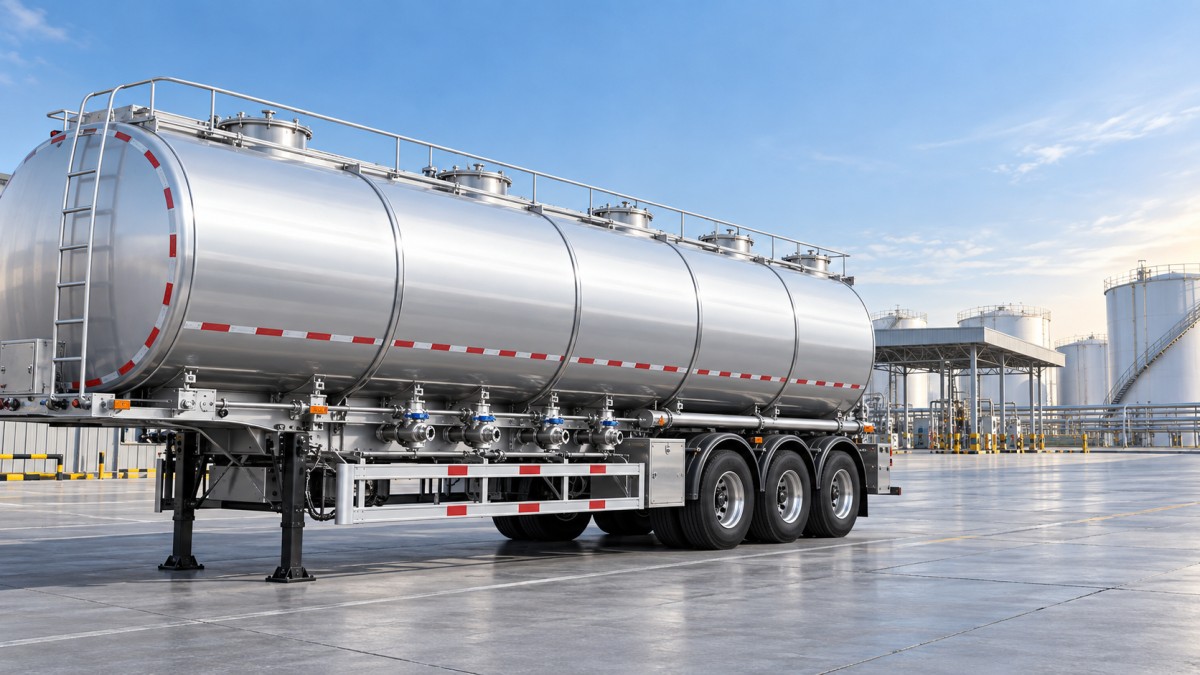
Carbon steel, aluminium alloy, and stainless steel tanks can all be built at the same capacity, yet their material behavior is different. Carbon steel is commonly selected where robust construction and straightforward repair are priorities. Its corrosion protection, surface preparation, and coating system deserve close attention because the external environment and the product carried both affect long-term condition.
Aluminium alloy can reduce tare weight, which may improve usable payload under applicable gross-weight limits. That benefit depends on the full vehicle configuration: a lighter shell does not automatically produce a lighter trailer if heavy suspension, equipment, or reinforcement is specified elsewhere. Aluminium fabrication also requires suitable welding control and repair capability. A quote should identify the alloy grade, shell thickness, baffle thickness, reinforcement details, and whether fittings use compatible materials to avoid corrosion issues at interfaces.
Stainless steel may be chosen where product purity, corrosion resistance, or cleaning requirements justify it. It should not be treated as a universal upgrade. The correct material follows the fuel grade, expected cleaning procedure, exposure conditions, and maintenance resources. Comparing only the stated material name without thickness and construction details can hide a major difference in actual specification.
Same volume, different tank geometry
Capacity can be distributed through one compartment or multiple compartments. A multi-compartment tanker needs internal bulkheads, manholes, valves, piping branches, and controls for each product section. These items add fabrication work and complexity, but they allow separate fuel grades to be transported in one trip. The number of compartments alone is still incomplete information; compartment capacities, internal access, valve layout, and cross-contamination control should be shown on the drawing.
Cross-section shape also affects cost. Cylindrical, elliptical, and other profiles require different forming operations and reinforcement arrangements. The tank must be matched to chassis height, stability requirements, road conditions, and the installed axle group. A higher tank body may offer the same volume with a different footprint, but the center of gravity and rollover behavior need review alongside the operating route.
Internal baffles are another frequently overlooked item. They limit liquid surge during braking, cornering, and acceleration. Their number, position, opening design, and welding quality influence both vehicle behavior and fabrication time. A quotation that lists capacity but omits baffle details is not fully comparable with one that documents the internal layout.
Running gear is a major source of price variation
The axle, suspension, wheel-end, brake, and tyre configuration often explains a substantial part of the gap between similarly sized tanks. A trailer intended for paved long-distance routes may use a different suspension arrangement from one expected to work on uneven access roads or repeated terminal loading cycles. Mechanical leaf suspension, air suspension, and other configurations have different initial costs, ride characteristics, maintenance demands, and load-transfer behavior.
Axle ratings should be reviewed together with the intended gross combination weight, tank tare weight, kingpin load, axle spacing, tyre specification, and local axle-load limits. A nominal axle rating alone does not prove that the trailer is correctly balanced. Poor load distribution can create tyre wear, brake stress, and operational restrictions even when the tank capacity is appropriate.
Brake equipment deserves the same level of detail. Ask whether the quotation includes the specified brake type, parking brake arrangement, compatible couplings, anti-lock provisions where required, and the associated electrical connection. Substituting a lower-cost component in this area may not be obvious from a short commercial description.
Safety equipment must be defined, not assumed
Fuel tanker trailers require a configuration suited to flammable-liquid transport. The price will change with the selection of bottom loading or top loading equipment, emergency shut-off valves, vapour recovery connections, grounding points, pressure-vacuum venting, spill-control provisions, ladders, walkways, handrails, fire extinguisher brackets, and protective guards.
These components should be compared by function and construction, not merely by the presence of a label such as “complete safety system.” For example, a bottom-discharge arrangement may include different valve types, actuation methods, outlet sizes, protective housings, and manifold layouts. Each choice affects loading speed, cleaning access, hose connection, failure isolation, and repair work. The best arrangement is tied to the loading rack, unloading points, and product-handling procedures already in use.
Electrical scope is another common quotation gap. Side markers, rear lamps, wiring harnesses, socket type, protective conduit, and grounding continuity may be listed broadly while the actual supplied configuration remains unclear. A detailed bill of materials prevents late changes when the trailer is prepared for registration or connected to a tractor unit.
Fabrication quality is visible in the specification trail
Tank manufacturing involves plate cutting, rolling or pressing, fit-up, welding, leak testing, and finishing. The quoted price reflects not only labour time but also the control applied at each stage. CNC cutting can improve repeatability of shell and baffle parts; automated longitudinal welding may support consistent seams when properly set up; careful alignment reduces stress at flanges, manholes, and pipe connections.
Rather than relying on generic statements about workmanship, request the tank drawing, material list, weld procedure scope, testing sequence, calibration method where applicable, and inspection records included at delivery. The aim is to establish which items are included in the base unit and which are treated as options. A lower price may exclude calibration, pressure testing documentation, paint system details, spare fittings, or pre-delivery inspection.
Exterior finishing should be assessed as a system. Surface preparation, primer type, topcoat, coating thickness target, decals, reflective markings, and underbody protection affect the delivered price and later refurbishment effort. This is especially relevant where trailers operate in coastal, humid, dusty, or chemically exposed environments.
Certification and market-entry requirements alter the delivered cost
Fuel transport rules vary by destination and by operating permit. The trailer may need specific markings, approved components, pressure testing, inspection documentation, or a layout that conforms to local dimensions and weight rules. These requirements should be stated before fabrication begins. Retrofitting a tank after completion can involve disassembly, rewelding, repainting, repeat testing, and schedule delays.
Freight and delivery terms also need separation from the trailer base price. Export packing, port handling, inland delivery, documentation, inspection attendance, and destination modifications can otherwise appear later as unrelated charges. A comparable quotation distinguishes the ex-works trailer specification from logistics and market-entry items.
Customization affects price when it changes the engineering scope
Colour, decals, and minor accessory choices are usually straightforward. Custom chassis length, unusual compartment splits, special pipe routing, non-standard outlet positions, hose trays, pump integration, remote controls, or modified kingpin location can require revised drawings and production setup. The commercial effect depends on whether the requested feature uses established components or requires a one-off arrangement.
Tractor compatibility belongs in the same discussion. Fifth-wheel height, electrical connector type, air-line connections, turning clearance, and loaded combination dimensions must align with the intended prime mover. Where a fleet includes vehicles such as a Foton Truck with a 6x4 driveline, the tractor's axle layout, coupling height, and operating weight should be confirmed against the tanker drawing rather than inferred from vehicle category.
Compare quotations on an equivalent basis
Place the offered trailers beside one another using the approved tank drawing and a component schedule. Record material grade and thickness, compartment layout, baffles, chassis construction, axles, suspension, tyres, braking equipment, valves, piping, safety fittings, paint system, tests, documents, delivery scope, and exclusions. Any blank field should be resolved before price comparison.
The resulting Fuel Tanker Trailer Price comparison becomes much clearer: the question is no longer why equal capacity has different prices, but whether each quoted trailer carries the same engineering, equipment, compliance, and service-life assumptions. That distinction prevents a nominally cheaper tank from becoming the more expensive asset after delivery.
Leave A Reply

First class quality service and professional after-sales team.
Get in Touch
*We respect your confidentiality and all information are protected.