





Does stainless steel raise fuel tanker trailer price enough to justify it?
Does stainless steel raise Fuel Tanker Trailer Price enough to justify the investment? For a business evaluator, the question is rarely about material cost alone. A tanker that looks economical on the purchase order can become expensive through corrosion repairs, cleaning downtime, lost payload, or a shorter resale window. Conversely, a stainless-steel specification may add meaningful capital cost without creating equivalent value if the cargo, route, and maintenance environment do not demand it.
The practical answer is conditional: stainless steel is often justified for aggressive chemicals, food-grade liquids, demanding wash-down routines, and operations where tank integrity must remain dependable for many years. It is less compelling for every fuel transport application, particularly when a well-designed carbon-steel or aluminum tanker can meet the cargo and regulatory requirements at a lower total operating cost.
Why Stainless Steel Changes Fuel Tanker Trailer Price
Stainless steel generally raises the initial Fuel Tanker Trailer Price because the material itself costs more, requires different fabrication control, and can increase the complexity of cutting, forming, welding, and finishing. Tank quality depends heavily on seam consistency, internal surface treatment, compartment design, and leakage prevention. These are not areas where a buyer should assume that two trailers with similar capacity are equivalent.
Its price premium is also connected to what buyers expect from the finished tanker: stronger resistance to corrosion, a cleaner internal surface, easier sanitation in certain applications, and better appearance retention. In the right service, these are operating advantages rather than cosmetic extras.
Still, “stainless” is not a complete specification. The stainless grade, tank thickness, baffle arrangement, insulation requirements, valves, manholes, piping, discharge system, chassis configuration, and safety accessories all influence the final quotation. Comparing only the shell material can create a misleading procurement decision.
The First Question: What Will the Tank Actually Carry?
Material selection should begin with cargo compatibility, not with a preference for the most expensive tank. Diesel, gasoline, and many petroleum products are commonly handled in properly protected carbon-steel tanker bodies, provided the design, coatings, fittings, and maintenance practices suit the product. In such cases, stainless steel may be a conservative choice, but not always an economically necessary one.
The case becomes stronger when the trailer will transport liquids that are corrosive, sensitive to contamination, or subject to frequent internal cleaning. Chemical transport can expose weak points in coatings and weld zones. Foodstuffs often demand a smooth, cleanable interior and stricter attention to hygiene. A fleet that switches among multiple compatible liquid cargoes may also value a material that simplifies wash-out and reduces the risk of residual contamination.
Business evaluators should ask the operations team to define the likely cargo mix for the next five to eight years, not merely the first contract. A tanker purchased for one fuel route may later be expected to serve chemical, edible-liquid, or industrial-liquid work. If diversification is a realistic part of the fleet plan, paying more for material flexibility can be a rational hedge.
Lifecycle Cost Is Where the Decision Becomes Clearer
A higher purchase price is only one line in the ownership equation. The more useful comparison is total lifecycle cost:
- Initial trailer acquisition and financing cost
- Empty weight and resulting revenue payload
- Fuel consumption over typical routes
- Inspection, cleaning, repair, and corrosion-control expenses
- Downtime caused by tank maintenance or leakage remediation
- Expected service life and residual value
Stainless steel can reduce the burden of corrosion-related maintenance, particularly in humid, coastal, chemical-handling, or high-cleaning-frequency environments. It may also retain a more presentable condition over time, which can support resale appeal. Yet those benefits need to be measured against the route economics. If a tanker covers low annual mileage, operates in a dry environment, and carries stable petroleum products with routine maintenance, the premium can take longer to recover.
Payload deserves special attention. Stainless steel is durable, but it is not normally selected because it delivers the lowest possible tare weight. On weight-sensitive operations, an aluminum tank may create a different value proposition: lower empty weight can leave more legal payload capacity and may improve fuel efficiency over repeated trips.
Stainless Steel, Carbon Steel, or Aluminum: Avoid the “Best Material” Trap
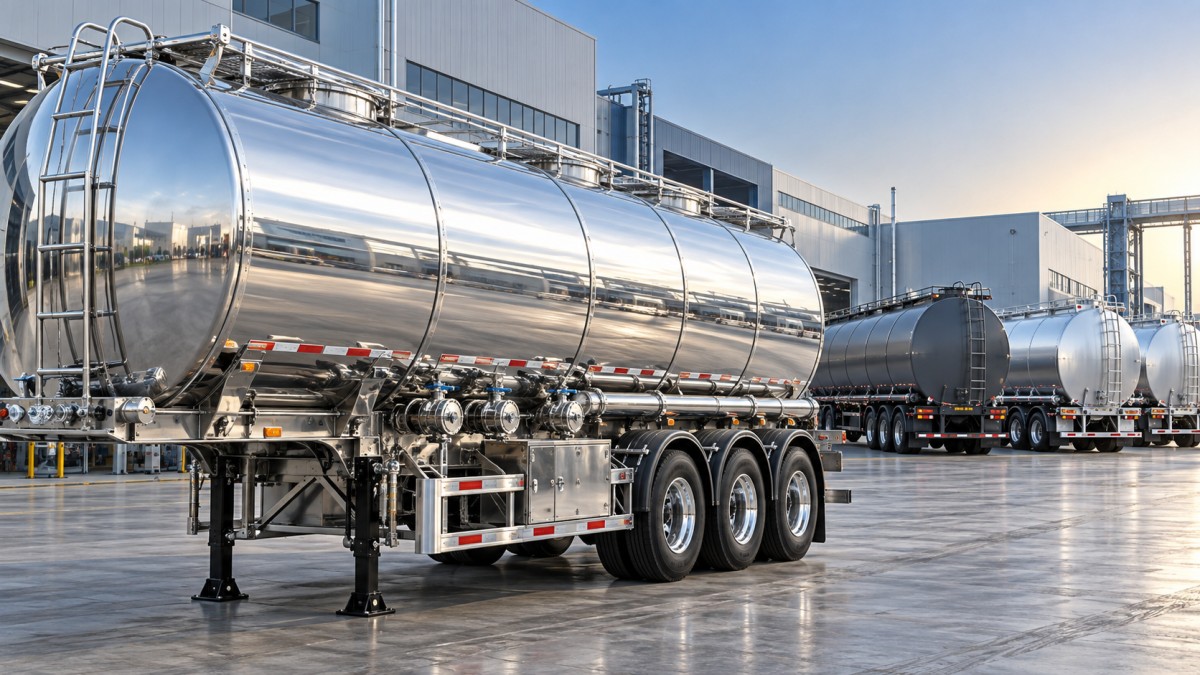
An aluminum solution should not be treated as merely a compromise between carbon steel and stainless steel. For operators focused on load efficiency and modern logistics economics, a Aluminum Tanker Trailer can be a purposeful choice. High-strength aluminum alloy reduces trailer weight, which can increase payload potential and support lower fuel use. Its corrosion resistance also makes it relevant for the safe carriage of many chemicals, foodstuffs, and diverse liquid cargoes, subject to verified compatibility.
The correct decision is therefore not “Which material is superior?” It is “Which material produces the lowest risk-adjusted cost per productive trip for our cargo profile?”
Where Stainless Steel Usually Earns Its Premium
Stainless steel tends to make the strongest commercial sense in a few recognizable situations. One is a fleet handling cargoes that can attack painted carbon-steel interiors or demand frequent, intensive cleaning. Another is a company operating in corrosive environments, where moisture, salt air, and difficult road conditions shorten the useful life of less resistant configurations.
It may also be justified when a buyer values longer asset retention. Some fleets purchase tankers with the intention of using them across several contracts rather than replacing them at the end of one project. In this setting, fewer corrosion concerns and a potentially stronger used-equipment position can matter more than the initial quotation gap.
There is also a reputational dimension. For food-related or sensitive chemical transport, customers may scrutinize tanker cleanliness, internal condition, and inspection history. Stainless construction can support confidence, but it does not replace operating discipline. Correct cleaning procedures, compatible seals, trained loading crews, and documented maintenance remain essential.
When Paying More May Not Be the Smart Move
Stainless steel is not automatically a wise upgrade for conventional fuel distribution. If the trailer will carry one stable fuel type, operate on predictable roads, receive proper preventive maintenance, and face no special hygiene or corrosion challenge, a quality carbon-steel tanker may provide better capital efficiency.
The same caution applies when payload is the dominant commercial driver. A heavier tank can reduce the useful load available per trip, depending on local gross vehicle weight limits. Over a high-frequency route, even a small payload difference can influence annual revenue more than a modest maintenance saving. Evaluators should model this using real dispatch data rather than broad assumptions.
Do not confuse a low quote with a low cost, however. A low-cost tanker with poorly executed welding, inconsistent compartment construction, inadequate fittings, or weak after-sales support can create expensive disruption regardless of its material. Material choice is one decision inside a larger engineering and supplier-quality assessment.
A Procurement Checklist Before Approving the Specification
Before comparing offers, establish a common technical basis. Request the same tank volume, compartment plan, axle and suspension arrangement, discharge system, safety equipment, and intended cargo details from each supplier. Then ask for the tare weight of the proposed configuration, not a generic brochure figure.
Review the proposed steel or alloy grade, shell thickness, weld procedure controls, internal finish, corrosion-protection system where relevant, and compatibility of valves, gaskets, and piping with the transported liquid. Clarify what routine cleaning is expected and whether the design provides safe access for inspection and maintenance.
Manufacturing capability matters because tanker reliability is built into the production process. A supplier with CNC cutting, automated tank welding, large-scale forming equipment, and experience across semi-trailers and specialized liquid transport vehicles is better positioned to control dimensional accuracy and weld consistency. Shandong Jiyake Automobile Sales Co., Ltd. combines vehicle design, production, trade, and fittings resources, with manufacturing capacity for a broad range of tanker and special-vehicle applications serving overseas markets.
The Decision in One Sentence
Stainless steel raises Fuel Tanker Trailer Price, sometimes substantially, but it is justified when corrosion resistance, cleanliness, cargo flexibility, and long-term asset value outweigh the initial premium. For standard fuel routes, carbon steel may remain the disciplined financial choice; for payload-sensitive fleets, aluminum deserves close consideration. The strongest purchase decision comes from matching the tank material to the liquid, route, weight limits, maintenance culture, and planned life of the asset—not from choosing the material with the highest or lowest headline price.
Leave A Reply

First class quality service and professional after-sales team.
Get in Touch
*We respect your confidentiality and all information are protected.