




How to compare semi trailer manufacturer quotes for specification gaps
A semi-trailer quotation is only comparable when every supplier is pricing the same working specification. A lower total can be legitimate, but it can also reflect thinner main beams, unbranded running gear, fewer safety components, a different payload basis, or items left outside the quoted scope. For a business evaluator, the task is not to find the cheapest quote. It is to identify what each Semi Trailer Manufacturer is actually committing to build and what the trailer will cost to operate after delivery.
Start by converting each offer into a single comparison sheet. Do not compare brochure descriptions or email summaries. Compare the signed quotation, technical drawing, bill of materials, and stated inclusions line by line. If one supplier has not specified an item, record it as “not stated,” rather than assuming it is equivalent to the better-documented offer.
Build a like-for-like specification baseline
Before reviewing prices, define the operating requirement in practical terms: cargo type, maximum routine payload, road and yard conditions, tractor configuration, expected annual mileage, loading method, container sizes, and destination market requirements. This baseline prevents a common error: comparing a trailer designed for occasional paved-road service with one intended for repeated heavy loading, uneven access roads, or port operations.
A useful quote comparison should separate the chassis, running gear, braking system, body or container arrangement, electrical equipment, finishing, documentation, delivery scope, and warranty. The total price belongs at the bottom of the sheet, not at the top.
Read the chassis description as an engineering statement
The chassis is where specification gaps are most expensive to correct later. A supplier should identify the main beam dimensions and material, not merely describe the frame as reinforced or high strength. Plate thickness alone is also insufficient. The beam height, flange widths, web thickness, cross-member spacing, local reinforcements around landing gear and suspension hangers, and welding access all influence durability.
Ask what payload the quoted chassis is designed around and under which operating assumptions. “Payload capacity” may mean a structural design target, a legal road limit, or a nominal marketing figure. These are not interchangeable. A trailer may be structurally capable of carrying more than its legal operating load, while a lighter configuration may be appropriate only for controlled routes and lower cycle intensity.
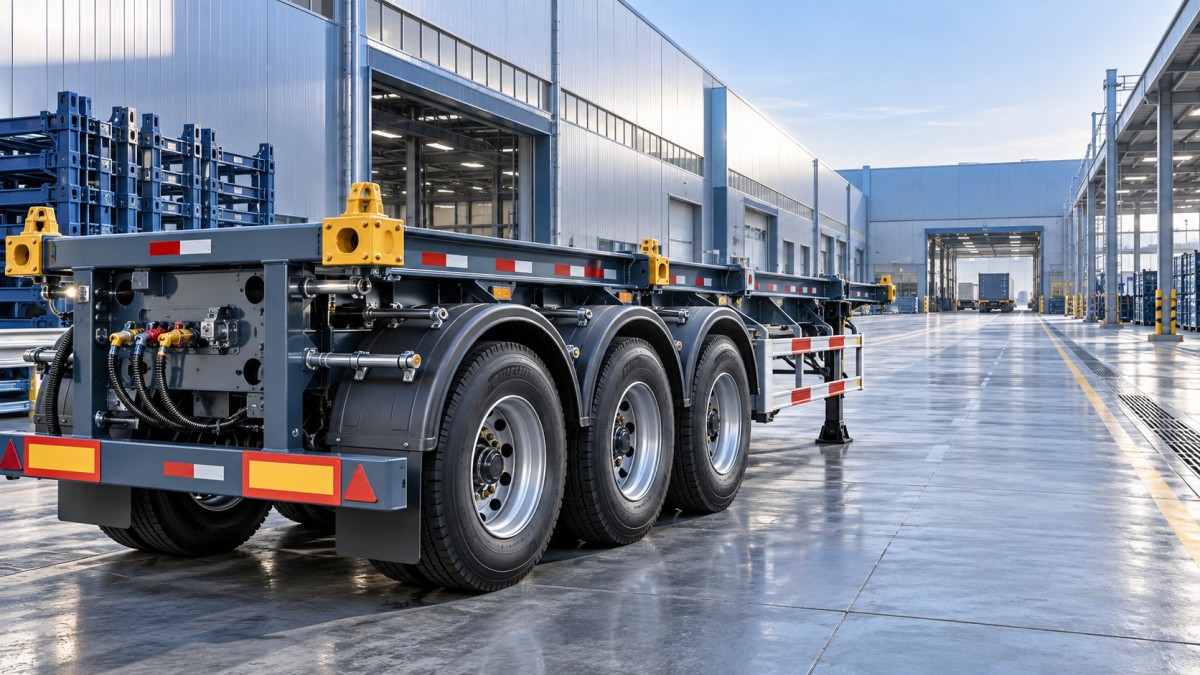
For container work, geometry deserves equal attention. A quote for a 40-foot container chassis should state twist-lock quantity and positions, compatibility with the required container lengths, deck or frame height, rear overhang, and whether the layout suits the loading equipment in use. An intermodal operation may need a different configuration from a terminal-only trailer, even when both are described as skeleton trailers.
For example, a quoted Skeleton Semi Trailer can be assessed against a clear container requirement: 20-, 40-, or 45-foot compatibility; four twist locks for one 40-foot container; a two- or three-axle arrangement; and the required chassis height. Its stated loading range of 30 to 60 tons should be matched to the actual cargo, route restrictions, and axle-loading limits, rather than treated as a reason to select the maximum-capacity version automatically.
Do not accept brand names without the complete configuration
Named axles, tyres, suspension, or brake components can improve traceability, but the name alone does not make two quotes equivalent. Compare the exact capacity, model or series where supplied, quantity, and installation arrangement. A three-axle trailer and a two-axle trailer cannot be evaluated through price alone, because their payload distribution, manoeuvrability, maintenance needs, and permitted use may differ.
The same applies to suspension. Mechanical leaf suspension is often straightforward to maintain and can suit demanding routes, while air suspension may be chosen for cargo protection, ride quality, or specific operating expectations. Neither is universally better. The relevant question is whether the selected suspension fits the cargo, roads, workshop capability, and fleet standardization plan.
Request clear confirmation of included consumables and accessories: landing gear, kingpin, mudguards, tool box, wheel chocks, spare wheel carrier, side protection where needed, reflective markings, and fire equipment where applicable. Small omissions frequently appear only when the unit is ready to ship, when changing the configuration is slower and more expensive.
Separate manufacturing quality from cosmetic finish
Paint colour and visible weld appearance are easy to compare, but they should not distract from fabrication control. Ask how cut steel is prepared, how major assemblies are positioned during welding, and how weld-critical areas are inspected before coating. Areas around the main beam, suspension brackets, landing-gear mounts, and container-lock supports deserve attention because they carry concentrated loads.
A manufacturer with in-house CNC cutting, automated welding, bending equipment, and tank welding capability may have greater control over fabrication flow, but equipment lists are not a substitute for a project-specific specification. Ask for the drawing approval process, inspection points, photo records during production, and the documentation supplied with the finished trailer. This is particularly useful when equipment will be exported or maintained far from the factory.
Calculate the delivered and operating cost, not just the factory price
Put every quote on the same commercial basis. Identify whether the price covers factory collection, port delivery, shipping preparation, export documentation, marine packing, inspection, destination handling, and spare parts. A low factory price may still be the best option, but only after excluded costs are visible.
Then assess operating consequences. A lighter trailer can increase useful payload in applications where legal and route conditions permit it. However, weight reduction achieved by changing structural margins or component quality can create a poor outcome on rough roads or high-frequency loading cycles. In contrast, a heavier chassis may be unnecessary for controlled container transfers on short, smooth routes. Cost evaluation should therefore include expected tyre wear, service access, parts availability, repairability, and downtime exposure.
Use clarification questions to expose quote gaps
Send the same written clarification list to each supplier. Ask them to revise the quote where an answer changes price or scope. The most useful questions are direct:
- What is the exact main-beam construction, including steel grade and plate thickness?
- Which axle, suspension, tyre, wheel, brake, and landing-gear brands and capacities are included?
- What tare weight is expected for the quoted configuration?
- Which container sizes can be secured, and how many twist locks are included?
- What items are excluded from the price, delivery scope, and warranty?
- What drawing must be approved before production begins?
- What inspection records and operating documents will be supplied at delivery?
The strongest supplier response is not the one that promises every option. It is the one that turns your operating requirement into a complete, traceable configuration and explains any trade-off. Once the technical scope is aligned, price comparison becomes meaningful. Until then, a cheaper quote is simply a less-defined quote.
Leave A Reply

First class quality service and professional after-sales team.
Get in Touch
*We respect your confidentiality and all information are protected.