




Recent Posts
 Thailand Clients Visit JIYAKE to Inspect Brand-New Semi-Trailers and Reach Cooperation AgreementNov 21, 2026
 Guinea Clients Visit JIYAKE to Inspect Brand-New SINOTRUK Vehicles and Reach Strategic CooperationNov 21, 2026
 When can an electric dump truck work on a fixed site?Oct 30, 2026

Choosing a bulk cement trailer tank size for the route
Choose a bulk cement trailer tank size by starting with the maximum cement mass the complete vehicle can carry on its most restrictive route, then convert that mass into the volume needed for the actual material. A larger tank only increases useful payload when vehicle weight limits, axle loading, road access and unloading arrangements allow it to be filled and delivered efficiently.
When comparing a bulk cement trailer for sale, request both tank volume and the empty weight of the proposed tractor-trailer combination. A tank that appears ideal on a capacity chart can become an oversized purchase if the route forces it to travel partially filled or prevents it from reaching the receiving silo.
Convert the permitted payload into tank volume
Begin with the lowest applicable loaded vehicle weight limit across the planned route. Subtract the actual empty weight of the tractor and trailer, along with fuel, driver, equipment and other items carried during the trip. The remainder is a preliminary payload limit. Then consider axle and axle-group limits: a combination can be below its overall weight limit while still overloading an individual axle group.
Convert the usable payload into a material volume using the bulk density of the cement being transported:
Required material volume = usable cement payload ÷ cement bulk density.
Use consistent units: tonnes divided by tonnes per cubic metre gives cubic metres. Bulk density describes the mass of cement occupying a given bulk volume, including the spaces between particles. It is not the density of the cement particles themselves. Aeration, settling and material characteristics affect the bulk volume, so the density used for sizing should reflect the loading and transport conditions rather than a theoretical particle-density figure.
For illustration, a usable payload of 30 tonnes at an assumed bulk density of 1.2 tonnes per cubic metre occupies approximately 25 cubic metres. This is an arithmetic example, not a specification for a particular cement or route. Confirm the material data and the trailer's usable filling capacity before selecting a nominal tank size. Filling arrangements, internal geometry and required operating space can prevent the entire advertised volume from being available for cement.
Consider the route before increasing capacity
Long, open routes with consistent loading and a receiving site that accepts full loads tend to favour carrying more cement per trip. The calculation changes when the route includes weak bridges, narrow roads, tight turns or a steep final approach. A larger tank often sits on a longer or heavier combination, and the extra empty weight reduces the payload available under the same gross limit.
Assess the complete journey, including the cement plant entrance, weighbridge, public road, site gate and final position beside the silo. The limiting point may be a short access road rather than the main highway. Turning space matters both when entering and when leaving: a vehicle that can reach the unloading point may still need an impractical reversing manoeuvre to get out.
Where deliveries cross jurisdictions, confirm the applicable gross and axle limits for the actual vehicle configuration along the full route. Bridge restrictions, seasonal road controls and site-specific weight limits can be more restrictive than the general road limit. A payload based solely on the tractor's rating or the trailer's advertised capacity does not establish that the loaded combination is compliant.
Also consider how the load is distributed as the tank is filled. Axle spacing, fifth-wheel position, tank layout and fill level all affect axle loads. Ask for a loading calculation for the proposed tractor and trailer, and verify the loaded combination on a suitable scale before relying on the result for regular dispatches.
Match the tank to the delivery pattern
A tank sized for the largest possible load is useful only when that load can be accepted at the destination. If a site silo has limited available space, a full trailer may have to wait, split its delivery or return with cement remaining on board. Frequent small orders can make a smaller tank or a trailer with suitable compartment arrangements more practical, although compartmentation adds weight and requires its own loading and discharge plan.
Compare the amount normally ordered per delivery with both the legal payload and the receiving silo's free capacity at the expected arrival time. Silo level at dispatch is not necessarily silo level at arrival: consumption during transit, other incoming deliveries and unexpected delays can change the available space.
Route length affects the trade-off. On a long haul, reducing the number of journeys can be valuable if each larger load is consistently usable. On a short shuttle between a plant and a constrained site, loading queues, unloading time and access restrictions may dominate the cycle. Compare complete trip times and delivered tonnes per shift rather than tank volume alone.
Unloading capacity sets a separate limit
Bulk cement trailers commonly use compressed air and fluidization to discharge material through a pipeline into a receiving silo. Tank volume does not by itself determine how quickly the load can be discharged. Air supply, discharge equipment, pipeline length and elevation, hose connections, material condition and the receiving system all influence the result.
Before committing to a larger load, establish whether the site can receive it in one operation. Confirm the silo inlet connection, hose routing, available air supply and the condition and capacity of the silo's venting or dust-collection equipment. A longer hose or a higher delivery point can change discharge behaviour; the proposed arrangement should be reviewed against the trailer and receiving equipment specifications.
Allow sufficient space to position the vehicle and route hoses without blocking traffic or creating sharp bends. A nominally faster, larger delivery can lose its advantage if the trailer waits for a silo to clear or if the site cannot accommodate the discharge setup. Follow the equipment's pressure limits and depressurization procedures; never open a pressurized tank or connection.
Separate cement tankers from other bulk-material trailers
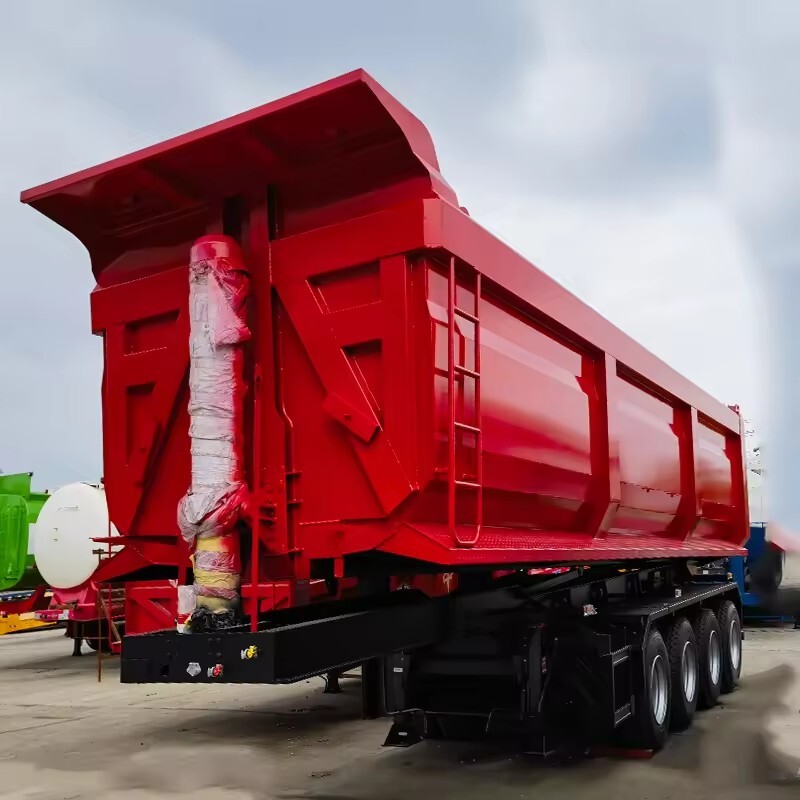
Construction routes can carry both cement and aggregates, but the equipment requirements differ. A 4 Axle dump semi-trailer is intended for tipping bulk materials in applications such as construction and mining. Its side-tipping discharge does not replace the enclosed pneumatic system required to transfer bulk cement to a silo. Comparing its stated payload with a cement tanker's volume alone would therefore produce a misleading equipment choice.
Request comparable specifications
For each proposed tank size, obtain the nominal and usable tank volume, estimated empty trailer weight, axle configuration, overall dimensions and discharge arrangement. Pair those figures with the intended tractor's actual weight and axle ratings. A quoted payload range without the corresponding empty vehicle weight and route limits is insufficient to determine how much cement can legally be carried.
Use the same cement density, route restrictions and delivery quantity when comparing options. Then calculate the expected loaded mass and assess the site access and receiving capacity for each. If the larger tank reaches the weight limit well before it is full, the unused volume should have a clear operational purpose, such as accommodating a lower-density material within the trailer's intended service.
Finally, leave room in the dispatch plan for variation in actual weights and delivery conditions. The selected capacity should work with the material loaded that day and the receiving space available on arrival, not only with an ideal load on an unrestricted route.
Leave A Reply

First class quality service and professional after-sales team.
Get in Touch
*We respect your confidentiality and all information are protected.