





Can a skeletal semi trailer handle both 20-foot and 40-foot containers?
Can a Skeletal Semi Trailer Handle Both 20-Foot and 40-Foot Containers?
Can a skeletal semi trailer handle both 20-foot and 40-foot containers efficiently? For procurement teams, this versatility can reduce fleet complexity and improve asset utilization.
This guide explains how locking positions, chassis design, payload requirements, and manufacturing quality determine whether one trailer can safely accommodate multiple container sizes.
What Buyers Really Need to Confirm First
Yes, a skeletal semi trailer can handle both 20-foot and 40-foot containers when it is designed with correctly positioned twist locks and adequate structural strength.
However, not every container chassis offers true dual-size capability. Some units are configured only for 40-foot containers, while others require removable locking devices or extensions.
Procurement decisions should therefore focus on the trailer's locking layout, rated payload, axle configuration, frame material, and compatibility with local container transport regulations.
The most practical option is usually a 20/40-foot skeletal semi trailer with multiple fixed or adjustable twist-lock stations along the main frame.
This configuration allows operators to secure a 20-foot container in the correct central or rear position while still supporting a standard 40-foot box.
For fleets serving ports, inland depots, warehouses, and cross-border routes, a flexible chassis can reduce idle equipment and simplify dispatching decisions.
How Twist-Lock Positions Determine Container Compatibility
Twist locks are the central safety feature of a skeletal semi trailer. They engage with the container corner castings and prevent movement during transport.
A standard 40-foot container requires four locking points spaced to match its corner castings. A 20-foot container requires a shorter locking distance and different positions.
Dual-purpose trailers commonly include eight or more locking positions. These locations allow the operator to select the correct set for each container length.
Buyers should ask the manufacturer for a locking-position drawing instead of relying only on a general statement that the trailer is “20ft and 40ft compatible.”
The drawing should identify the exact center-to-center distances between lock stations and show whether the 20-foot container is carried centrally or at the rear.
A centrally positioned 20-foot container often improves weight distribution, especially when the cargo is dense and the tractor-trailer combination operates on uneven roads.
Rear-mounted 20-foot loading can also be suitable, but it must meet axle-loading limits and avoid excessive kingpin load on the tractor.
Why Chassis Strength Matters More Than Container Length
Container length alone does not determine whether a skeletal semi trailer is appropriate. The actual issue is the combined weight of the container, cargo, and trailer structure.
A 20-foot container can sometimes carry heavier cargo than a 40-foot container. Dense materials, machinery, metal products, and bagged goods create demanding axle loads.
Procurement teams should compare the gross vehicle weight rating with the maximum expected transport weight, rather than assuming shorter containers create lower operating stress.
The main beam must resist bending, twisting, and repeated fatigue over long-term service. High-strength steel construction and reliable welding quality are therefore essential.
Frame reinforcement is especially important for operations involving rough access roads, overloaded containers, frequent port handling, or long-distance transport across multiple countries.
Ask suppliers about main beam dimensions, flange thickness, web thickness, steel grade, welding processes, and quality inspection procedures before approving a purchase order.
Manufacturers with CNC cutting, automatic welding, and controlled assembly processes can generally provide more consistent frame alignment and structural repeatability.
Choosing the Right Axles, Suspension, and Tires
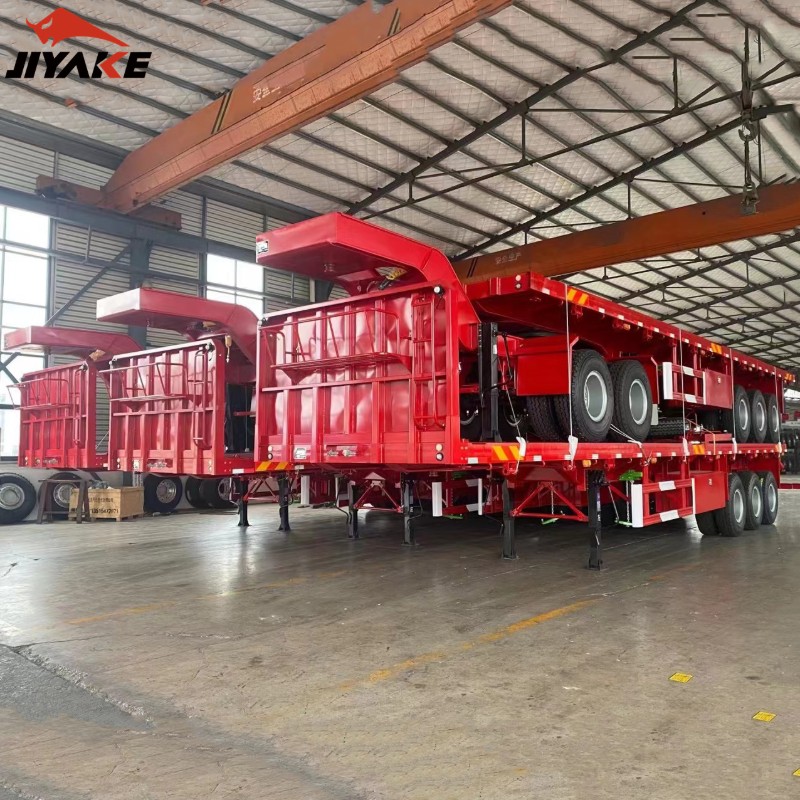
A three-axle skeletal semi trailer is a common choice for carrying loaded 20-foot and 40-foot containers, particularly where higher payload capacity is required.
Three axles distribute cargo weight more effectively and can help operators meet road restrictions, although final compliance depends on local legal limits and tractor specifications.
Leaf spring suspension remains popular because it is durable, easy to service, and suitable for demanding logistics environments with limited workshop infrastructure.
Air suspension may offer improved ride quality and cargo protection, but it can increase purchase cost and maintenance requirements in some operating regions.
Tire selection should match the expected payload, pavement conditions, and available service network. Buyers should also confirm spare-part availability before standardizing fleet specifications.
Reliable braking equipment is equally important. Large brake chambers, quality valves, properly sized air tanks, and compatible tractor connections reduce operational safety risks.
Can One Trailer Improve Fleet Economics?
A dual-size skeletal semi trailer can improve utilization when a fleet regularly handles both 20-foot and 40-foot containers but cannot predict the daily container mix.
Instead of assigning separate chassis types to each container length, dispatchers can use a shared pool of flexible trailers across routes and customers.
This approach may reduce the total number of trailers required, lower storage pressure, and make it easier to respond to seasonal fluctuations in import and export volumes.
The financial benefit depends on actual operating patterns. A versatile chassis is most valuable when both container sizes are used frequently and interchangeably across the same network.
If the business mainly transports 40-foot containers, a dedicated 40-foot chassis may be simpler, lighter, and more cost-effective than a multi-lock configuration.
Similarly, operations focused on heavy 20-foot containers may require specialized axle layouts or reinforced chassis designs rather than a standard general-purpose trailer.
Procurement managers should examine historical shipment records by container size, cargo density, route type, and loading frequency before defining fleet specifications.
Questions to Ask a Skeletal Semi Trailer Supplier
Before selecting a supplier, request a detailed technical quotation that clearly states supported container sizes, payload rating, overall dimensions, axle capacity, and twist-lock quantity.
Confirm whether the locks are fixed, retractable, removable, or adjustable. Each design affects loading convenience, maintenance needs, and the chance of operator error.
Ask whether the chassis supports ISO standard 20-foot and 40-foot containers only, or whether it can also carry 40-foot high-cube or other configurations.
Documentation should include chassis drawings, material specifications, weld inspection procedures, brake-system details, paint standards, and warranty terms for key components.
It is also sensible to verify the manufacturer’s export experience, available service support, packaging method, and ability to supply replacement locks, axles, suspension parts, and landing gear.
For buyers managing several vehicle categories, supplier capability across specialized transport equipment can simplify sourcing and long-term parts coordination across the fleet.
When a Skeletal Trailer Is Not the Best Choice
A skeletal semi trailer is designed for ISO containers, not loose bulk cargo. It should not be selected simply because a business transports several different material types.
For example, dry bulk cement requires a sealed pressure vessel, pneumatic discharge system, and dedicated piping rather than an open container chassis.
For batching plants and large construction projects, a Cement Bulker Trailer provides purpose-built bulk powder transport and controlled unloading directly into storage silos.
Specialized equipment may involve a higher initial investment, but it can reduce product loss, unloading time, contamination risk, and manual handling requirements for suitable cargoes.
The correct procurement decision starts with the cargo format. Containerized freight, dry bulk powder, liquid cargo, timber, and machinery each require different vehicle structures.
Making a Practical Purchase Decision
For most container transport companies, a properly specified 20/40-foot skeletal semi trailer is a practical and commercially useful fleet asset.
It can carry both sizes safely when its twist-lock positions match ISO container corner castings and its chassis, axles, brakes, and suspension suit planned payloads.
The strongest purchasing approach is to define operating conditions before comparing quotations. Include container sizes, cargo weights, road conditions, annual mileage, and service expectations.
Do not evaluate skeletal semi trailer offers based on price alone. A lower-cost chassis may create higher lifetime costs through poor alignment, weak welding, lock failures, tire wear, or downtime.
Choose a supplier that can provide clear technical specifications, proven manufacturing controls, export-ready support, and a configuration tailored to your actual container transport requirements.
In summary, one skeletal semi trailer can efficiently handle both 20-foot and 40-foot containers, but only when its locking system and structural design are specified for that purpose.
Leave A Reply

First class quality service and professional after-sales team.
Get in Touch
*We respect your confidentiality and all information are protected.