




Why Equal-Length 40ft Flatbed Trailers Can Carry Different Price Tags
Two 40ft flatbed trailers can look almost identical in a quotation: similar length, an open deck, and a stated load capacity. Yet their purchase prices—and the costs they create after delivery—may be very different. For procurement teams comparing a 40ft Flatbed Trailer Price, dimensions alone are not enough to establish value.
The difference may reflect stronger engineering, better components, or more complete export preparation. It may also come from different quotation scopes rather than different trailers. Before negotiating the price, establish what each supplier is actually offering and whether it matches the work your fleet will perform.
Same length does not mean the same working specification
“40ft” describes a size category, not a complete technical specification. One trailer may be intended mainly for evenly distributed cargo; another may need to accommodate machinery with concentrated wheel loads. Both can have similar deck lengths while requiring different crossmembers, deck reinforcement, and load-distribution arrangements.
Even the dimensions need checking. A trailer intended to transport a 40ft container does not necessarily have an overall length of exactly 40ft. Confirm overall length, usable deck dimensions, deck height, and container-lock positions against an approved drawing.
Before requesting comparable offers, give suppliers a short duty profile:
- Cargo: containers, packaged materials, machinery, or other loads, including their dimensions and support points.
- Operating weight: typical payload, maximum intended payload, and loading distribution.
- Routes: paved highways, construction access roads, gradients, and rough sections.
- Tractor compatibility: fifth-wheel height, kingpin requirements, and braking connections.
- Destination rules: allowable dimensions, axle loads, gross combination weight, and required safety equipment.
Without this baseline, a lower quotation may simply describe a lighter-duty trailer.
Where the price difference usually comes from
The frame: steel grade matters, but design matters just as much
Main-beam construction, crossmember spacing, reinforcement, and weld quality all influence chassis cost. Higher-strength steel may allow a lighter structure when properly engineered, but the material label alone does not prove that a trailer will carry more or last longer.
Ask for the specified steel grade, beam dimensions, and the loading conditions behind the capacity claim. A uniformly distributed 40-ton payload is not equivalent to a machine placing much of its weight over a small section of deck. Steel coils also require suitable supports and securement arrangements; a general flat deck should not automatically be treated as coil-ready.
More steel is not always better. An unnecessarily heavy chassis can reduce legal payload and increase fuel use. The purchasing objective is a structure suited to the duty cycle—not the highest empty weight or the most impressive capacity number.
Axles, suspension, tires, and brakes change the economics
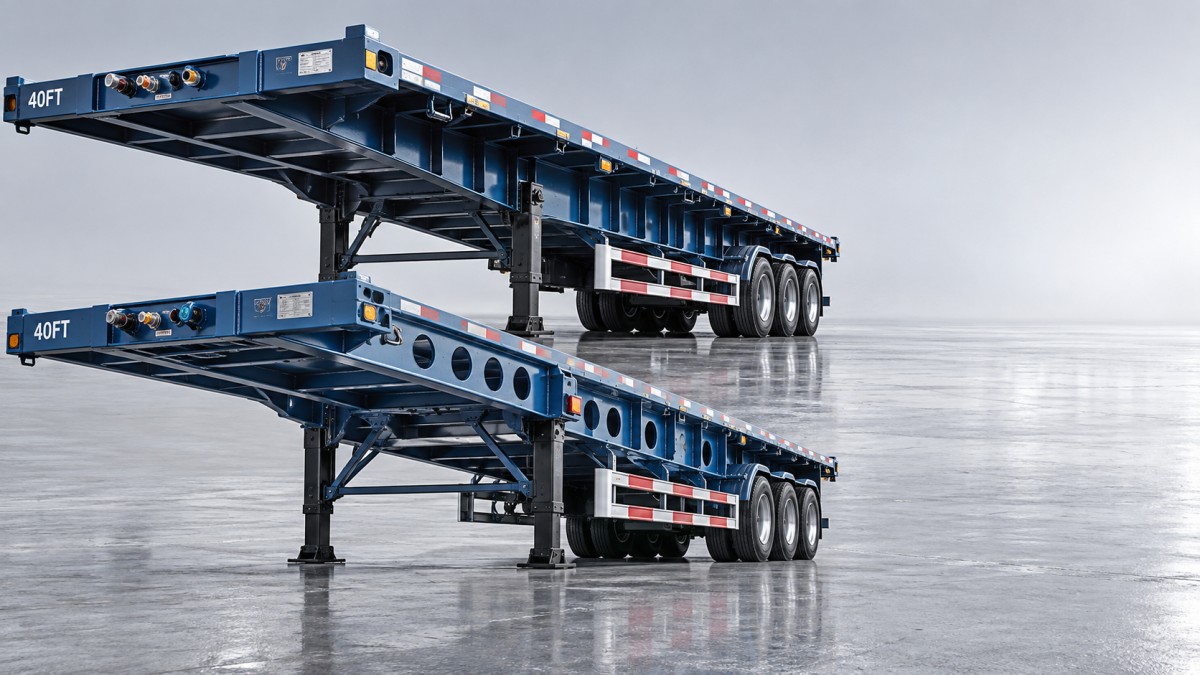
Axle count and component ratings affect both the quotation and maintenance planning. Compare axle brands and models, suspension specifications, tire ratings, and wheel arrangements rather than accepting a broad description such as “heavy-duty running gear.”
Leaf-spring suspension may suit buyers prioritizing straightforward maintenance and local parts availability. Air suspension may be worth considering where cargo protection, operating conditions, or fleet requirements justify the additional cost. Neither is automatically the right choice for every route.
Braking deserves particular attention. “Standard brakes” does not identify the system layout, brake type, ABS configuration, or compatibility with destination requirements. Ask for an itemized specification. Similarly, total axle component ratings do not establish legal payload: chassis limits, tires, kingpin load, tractor capability, and road regulations must all be considered.
Production quality is less visible than paint
A fresh finish can make two trailers appear equally well built. It reveals little about frame alignment, weld consistency, dimensional control, or surface preparation underneath the coating.
Request inspection records or agreed inspection checkpoints covering critical welds, chassis dimensions, running-gear installation, and coating preparation. CNC cutting and automatic welding equipment can support consistent production, but equipment ownership is not a substitute for documented quality control.
A specification mismatch can make a cheap quote impossible to compare
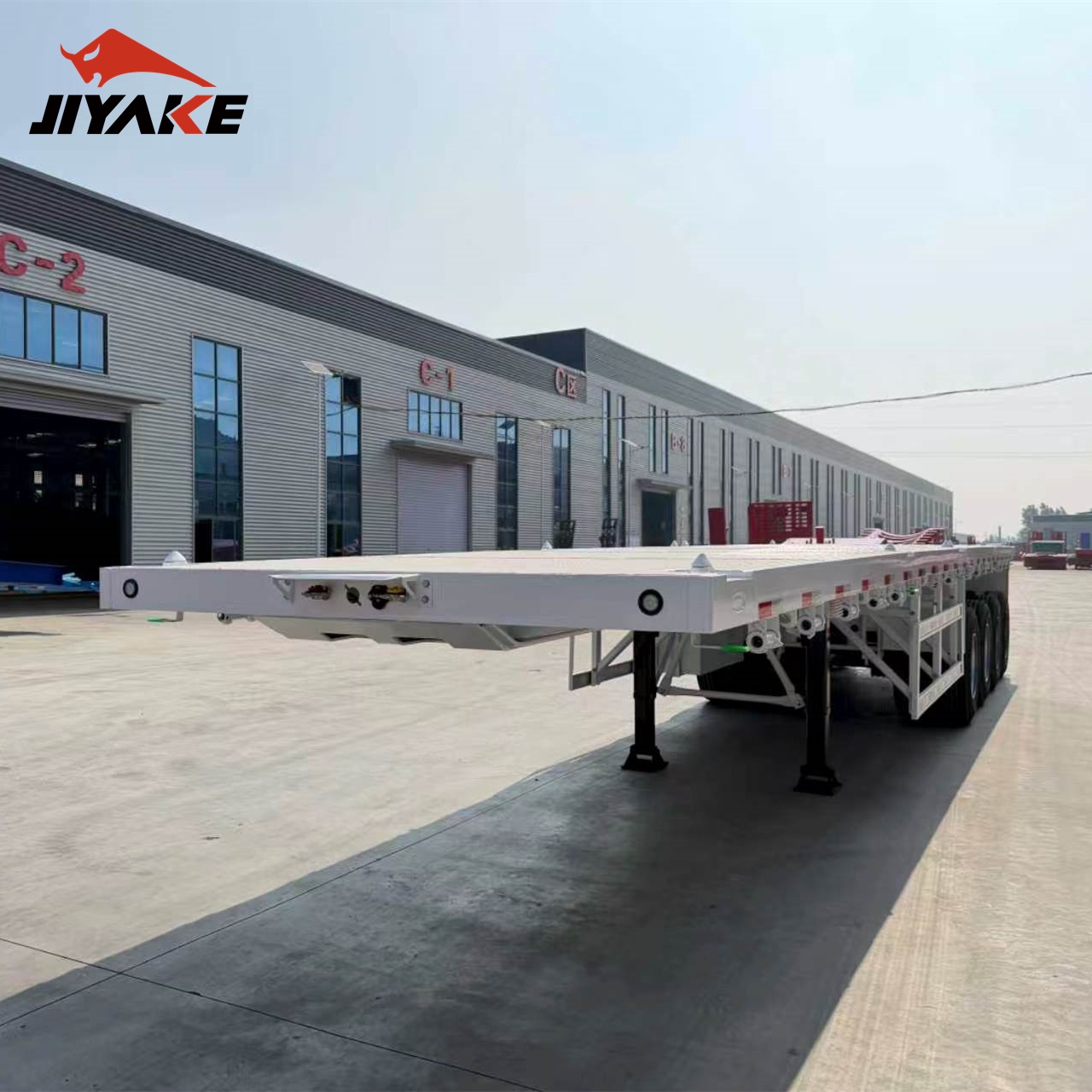
Product listings are useful starting points, but they should not replace a signed technical schedule. For example, the 4 Axle Flatbed Trailer listing includes a stated 40-ton loading capacity, dimensions of 12,500 × 2,500 × 1,600 mm, leaf-spring suspension, and 12 container locks. However, its parameter sheet also lists “3 × 13 Ton FUWA” axles and 12 tires.
That discrepancy needs clarification before purchase. The product name and listed running gear do not establish the same axle configuration. Ask the supplier to confirm the actual axle count, tire quantity, wheelbase, capacity basis, and final drawing in writing. Also confirm what the stated overall height represents rather than assuming it is the loading height.
This is not just a catalog-editing issue. An unresolved configuration difference can affect price, registration, spare-parts planning, and suitability for the intended work. Treat inconsistent specifications as questions to resolve before comparing totals.
Compare the 40ft Flatbed Trailer Price on one commercial basis
A factory quotation and a delivered-cost estimate are different numbers. One offer may exclude inland transport and export handling, while another includes freight to a named destination port. Neither is necessarily misleading, but they cannot be compared directly.
Export documentation also deserves early attention. Confirm destination requirements before production, especially where lighting, braking, dimensions, or vehicle approval rules differ from the supplier’s usual specification. A trailer that needs modification after arrival can lose its initial price advantage quickly.
Pay more only where the extra cost has a job to do
A higher purchase price can be justified by reinforcement for concentrated loads, components supported by local repair networks, more thorough corrosion protection, or inspection requirements that reduce acceptance risk. The value depends on your operation.
By contrast, paying for unused capacity or unsuitable accessories ties up capital without improving transport performance. Standard flatbeds, extendable trailers, and lowboys address different cargo envelopes; a standard-length flatbed is not automatically suitable for unusually long or tall equipment simply because its nominal capacity appears sufficient.
A practical comparison is:
Expected ownership cost = landed purchase cost + maintenance and repairs + downtime cost + operating-cost differences − residual value.
Use your own maintenance records and route data wherever possible. Avoid accepting precise fuel-saving or service-life claims without evidence relevant to the proposed configuration.
Turn the shortlist into an auditable purchase decision
Shandong Jiyake Automobile Sales Co., Ltd. supplies semi-trailers and other commercial vehicles to markets across Southeast Asia, Central Asia, and Africa. For buyers discussing a configuration with Jiyake—or any exporter—the useful next step is a destination-specific specification review, not simply another request for a lower price.
Ask shortlisted suppliers to return the same specification sheet with deviations clearly marked. Attach the agreed drawing, component schedule, inspection criteria, and commercial scope to the purchase agreement. Any substitutions should require written approval.
The best-value trailer is not necessarily the cheapest or the most heavily specified. It is the one whose structure, components, legal compatibility, and support arrangements fit the work—and whose quotation makes those commitments clear before payment.
Leave A Reply

First class quality service and professional after-sales team.
Get in Touch
*We respect your confidentiality and all information are protected.