




How Steel Grade and Frame Design Affect 40ft Flatbed Trailer Prices
A lower 40ft Flatbed Trailer Price is meaningful only when the quotations describe the same loading duty and structural requirements. Steel grade affects resistance to yielding, while frame geometry controls how loads travel through the trailer. Neither a higher steel grade nor a heavier chassis, considered alone, establishes better structural performance.
A useful comparison connects material certificates, beam dimensions, loading assumptions, weld details, and finished tare weight. Differences in these items explain whether a price premium pays for usable capacity, reduced mass, more demanding fabrication, or reinforcement that the intended service actually requires.
Steel strength and frame stiffness are different properties
Yield strength describes the stress at which steel begins to deform permanently. Higher-strength steel permits a smaller cross-section where yielding governs the design. This creates an opportunity to reduce frame mass, but the opportunity has limits: deflection, local buckling, fatigue, and connection strength still require separate assessment.
The elastic modulus of common structural steels remains broadly similar across strength grades. Replacing a conventional grade with higher-strength steel while keeping the same geometry therefore produces little change in elastic bending stiffness. Reducing plate thickness to exploit the higher yield strength lowers the section’s stiffness unless other dimensions compensate.
This distinction explains why a lighter, higher-grade frame can meet a strength calculation yet show more deck deflection under the same load. Where cargo alignment, container support, or deck clearance limits movement, stiffness can determine the required section before yield strength does.
A quotation stating only “high-strength steel” leaves important questions unanswered. The specification needs an identifiable grade, governing material standard, thickness range, and delivery condition. Yield properties can vary with thickness. Impact toughness also matters where low temperatures and abrupt loading increase the consequences of brittle fracture. Material certificates should be traceable to the plates used in the main structural members.
Main-beam dimensions explain more than overall depth
In a fabricated I-section main beam, the flanges carry much of the bending stress, while the web transfers shear and keeps the flanges separated. Increasing beam depth generally improves bending efficiency, but a deeper, thinner web requires assessment for buckling and concentrated load effects.
Overall beam height is therefore an incomplete specification. Two beams with the same depth can have substantially different section properties because their flange widths, flange thicknesses, and web thicknesses differ. Comparing nominal height alone can conceal a material reduction in the parts that resist bending.
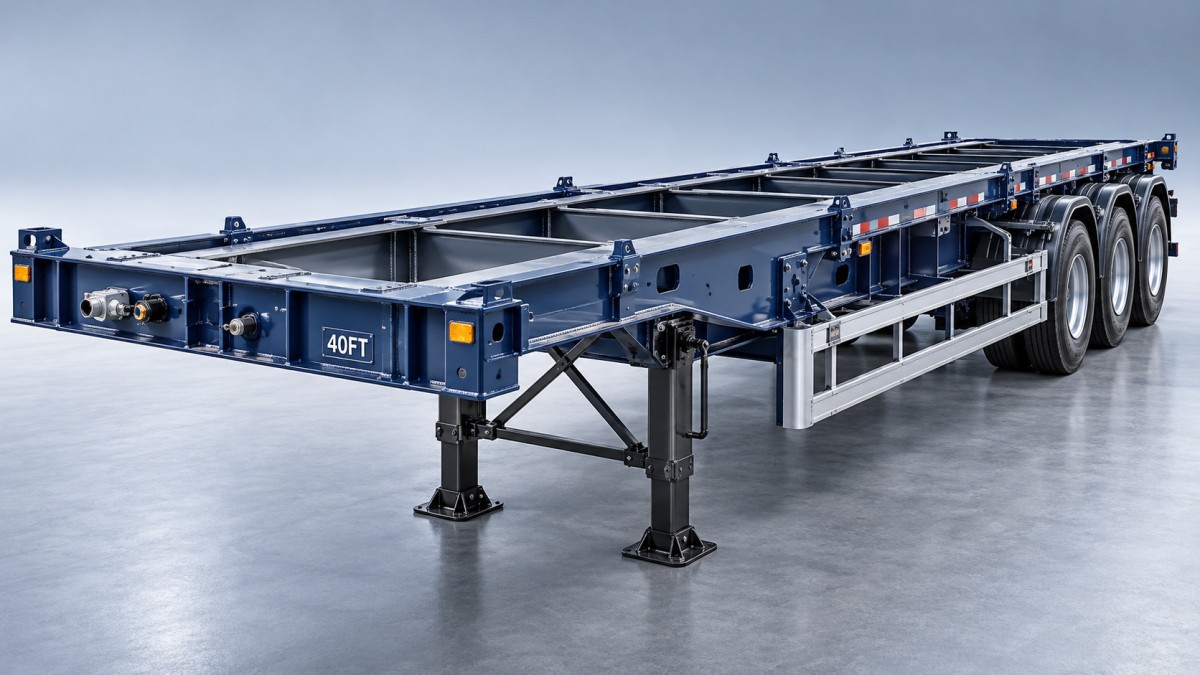
A useful frame drawing identifies the upper and lower flanges, web, stiffeners, cross-member connections, and changes in section along the chassis. Gooseneck transitions and suspension attachment zones deserve particular attention because geometry and load transfer change there. An abrupt reinforcement termination can create a fatigue-sensitive detail even when the surrounding plate is thick.
The loading pattern changes the required frame
A nominal payload does not describe where that payload acts. Evenly distributed bagged goods, machinery resting on narrow supports, and containers supported at their corner fittings impose different demands. A frame designed around a distributed load cannot automatically accept the same total mass concentrated near the middle of the deck.
For machinery transport, support footprint and longitudinal position affect local deck bending, cross-member loading, and main-beam bending. Wheel loads during loading also matter: a machine travelling onto the deck creates a moving load case that differs from its final parked position. Deck plate thickness alone does not establish resistance if the supporting members are too widely spaced.
Container service requires defined load paths from the fittings into the chassis. Support locations, fitting attachments, and nearby reinforcement must agree with the container configurations included in the design. Adding fittings to a general-purpose deck does not establish the capacity of the surrounding structure.
Construction service also illustrates why vehicle capacity labels cannot be transferred between applications. An 8X4 400HP Dump Truck handles bulk materials through a tipping body and lifting system; a flatbed carrying construction equipment receives loads through wheels, tracks, or supports. Both involve demanding service, but their structural load paths require different evaluation.
Welding quality determines whether the steel premium is useful
Higher-strength plate introduces welding requirements that follow its composition, thickness, delivery condition, and joint restraint. Consumable selection, heat input, preheat where required, and welding sequence affect the resulting joint. Uncontrolled heat input can alter properties in the heat-affected zone or increase distortion.
Continuous welds and larger weld beads are not automatic evidence of a better frame. Weld size and continuity need to match the joint’s load transfer requirements. Excess weld metal adds heat and production time, while an undersized or poorly fused joint leaves the intended load path incomplete.
Fatigue performance deserves separate treatment from static strength. Repeated road inputs create stress cycles, especially around attachments, section changes, and weld terminations. Higher base-metal yield strength does not automatically improve the fatigue resistance of a welded detail. Weld profile, undercut, alignment, and local stress range remain influential.
These requirements explain part of the fabrication price difference. Controlled fit-up, suitable welding procedures, dimensional inspection, and appropriately selected nondestructive examination consume production resources. A smooth painted surface cannot demonstrate internal weld soundness, and the examination scope should identify the joints and acceptance criteria covered.
Weight savings need a defined operating boundary
A lighter chassis increases available payload only where the permitted gross combination mass and axle-load distribution allow it. It offers little practical advantage if cargo volume limits the load first. The tare comparison also needs identical equipment: deck specification, fittings, suspension, landing gear, and accessories all affect finished mass.
Thinner high-strength members require particular attention where dents, abrasion, or corrosion reduce the effective section. Strength does not replace lost thickness. A weight-saving design intended for controlled highway service needs reassessment before use on uneven access roads with frequent twisting and impact loads.
Torsional behavior also requires balance. Diagonal wheel movement twists the chassis, and excessive local restraint can raise stress at connections. Adding bracing indiscriminately changes those load paths; its value depends on the overall frame arrangement and the service conditions used in the design.
What makes two quotations technically comparable
A defensible price comparison starts with a shared design basis: cargo arrangement, support footprints, loading method, operating surfaces, and allowable deflection. Each quotation should identify the material grades, main-beam sections, cross-member arrangement, reinforcement details, and tare-weight basis associated with that duty.
Where calculations or structural analysis support a capacity claim, their assumptions matter as much as the reported result. Support conditions, load positions, dynamic allowances, and connection representation must reflect the proposed trailer. An analysis showing acceptable stress under a distributed load does not resolve a concentrated machinery load or fatigue at a welded attachment.
When a price difference remains, an itemized explanation can connect it to material grade, steel mass, fabrication work, inspection scope, or verified weight reduction. That connection makes the quoted specification assessable: the additional cost pays for an identifiable structural requirement rather than an unsupported claim of a “stronger frame.”
Leave A Reply

First class quality service and professional after-sales team.
Get in Touch
*We respect your confidentiality and all information are protected.