




When a detachable-gooseneck lowbed trailer fits oversized loads
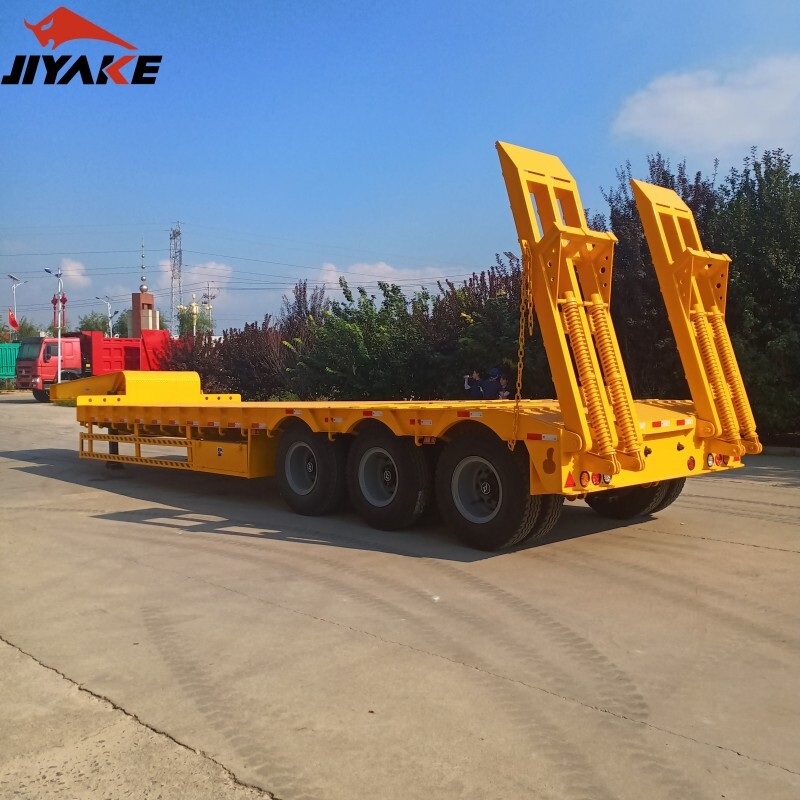
A detachable-gooseneck (DGN) lowbed trailer earns its place when the load is not merely heavy, but difficult to load, too tall for a conventional deck, or too valuable to accept improvised loading methods. Its defining advantage is a removable front gooseneck that allows equipment to be driven or winched directly onto the deck at ground level. That changes the operating model: loading can be safer and faster for tracked machinery, wheeled equipment, and large industrial units that cannot reasonably climb ramps.
For a business assessing a Lowbed Trailer For Sale, the key question is not whether a DGN offers the lowest deck height. It is whether its loading method, axle configuration, route profile, tractor compatibility, and utilization rate justify a more specialized trailer than a fixed-neck lowboy, ramp lowbed, or modular transporter.
The loads that justify a detachable gooseneck
A DGN lowbed is most suitable where one or more transport constraints overlap. Typical loads include excavators, bulldozers, pavers, drilling rigs, cranes with removable components, agricultural machinery, mining equipment, transformers, and fabricated industrial modules. These loads often have substantial dead weight, wide track or tire contact areas, high center-of-gravity risks, or limited ability to negotiate steep loading angles.
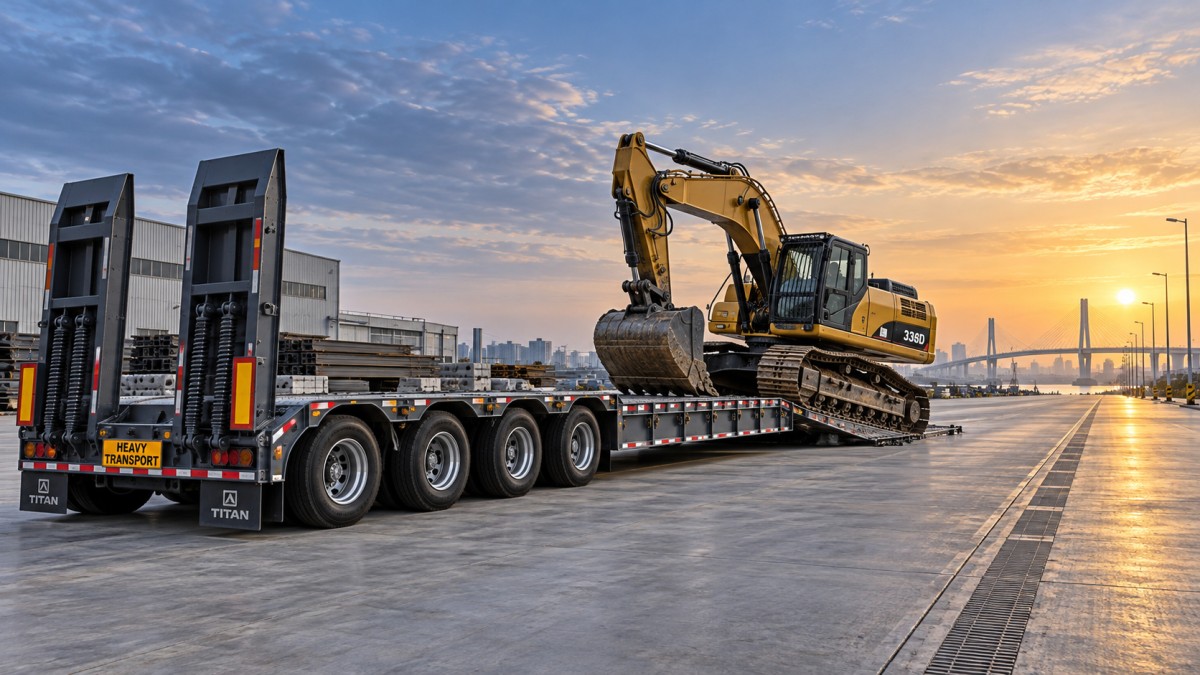
Ground-level loading is especially relevant for tracked equipment. A tracked excavator can move onto a detachable deck without relying on long rear ramps, reducing the transition angle and avoiding the abrupt breakover point that may damage undercarriage components or interfere with low ground-clearance machines. For wheeled machinery, the same layout can simplify loading where site space is constrained or loading ramps cannot be safely deployed.
Height is the second major reason to select this configuration. A lower deck can create needed vertical clearance under bridges, utility lines, gantries, tunnel portals, and site access structures. However, a low deck alone does not guarantee a compliant move. Total transport height must include the loaded machine’s highest fixed point, suspension behavior, tire deflection, route surface variation, and any temporary protection or securing equipment added above the deck.
The DGN becomes commercially rational when these conditions are recurring rather than exceptional. A contractor or logistics operator moving one oversized unit annually may find permit coordination and specialist rental more economical. An operation repeatedly mobilizing heavy plant between construction, quarry, infrastructure, or industrial sites has a stronger case for owning equipment designed around repeatable loading and route requirements.
Deck height is useful only when measured against the complete transport envelope
Lowbed selection often starts with a headline deck height, but decision quality improves when that figure is treated as one element of the full transport envelope. A lower deck may reduce overall loaded height, yet the gooseneck structure, wheel wells, deck transitions, and rear section can impose separate limitations on load placement.
The practical measurement is not simply the machine’s published height. It is the height of the machine in its transport configuration. Booms, exhaust stacks, cabs, counterweights, handrails, hydraulic attachments, and removable accessories all affect the envelope. Some loads can be partially dismantled to reduce height or length, but that introduces labor, handling equipment, reassembly time, and the risk of damage or missing components. If dismantling is required on every trip, the apparent benefit of a lower trailer may be offset by operating friction.
Length needs similar scrutiny. A long machine can fit within the deck’s nominal usable length but still create excessive front or rear overhang, poor axle loading, or turning conflicts. The load must be positioned to maintain the tractor’s required kingpin load, keep axle groups within permitted limits, and preserve enough clearance through turns and uneven ground. A trailer that accommodates a load in a static yard measurement may still be unsuitable on real access roads.
Axle count is not a payload answer by itself
Oversized transport decisions are sometimes reduced to a simple comparison of trailer axle numbers. That is inadequate. Legal and safe payload depend on the gross combination weight, axle spacing, axle group ratings, tire specifications, suspension type, tractor configuration, fifth-wheel capacity, and the weight distribution produced by the actual load position.
A three-axle detachable lowbed and a four-axle model may appear similar in broad product categories, yet their operational capacity can differ materially once local axle-load rules and bridge formulas are applied. Wider axle spacing can improve legal distribution in some jurisdictions, while closely grouped axles may be more practical on tight construction sites. Additional axles can reduce load per axle but add tare weight, tire and brake maintenance, turning resistance, and possible route restrictions.
The correct exercise is a loaded axle-weight calculation for the heaviest and most frequent cargoes, not a decision based on maximum advertised capacity. This calculation should include the tractor, detachable gooseneck, deck, load, accessories, chains or binders, blocking material, and any removable components traveling with the machine. It should also test several plausible load positions. A trailer may be technically rated for the cargo but unable to place it in a legally balanced configuration.
Loading efficiency must be weighed against site conditions
A detachable neck provides a direct approach onto the deck, but it does not eliminate the need for suitable loading ground. Detaching and reconnecting the gooseneck requires firm, reasonably level terrain with enough space for tractor maneuvering. Soft soil, deep ruts, pronounced cross-slopes, or congested urban work zones can complicate the process.
The detachment system itself should be evaluated as an operating system rather than a catalogue feature. Hydraulic cylinders, locking mechanisms, controls, hoses, electrical connections, landing gear, and alignment points need to be accessible and maintainable. The supplier should clearly identify the detachment sequence, required ground conditions, inspection points, and procedures for incomplete or misaligned coupling. A loading method that saves time under ideal conditions can introduce delays if field crews cannot reliably reconnect the neck on uneven sites.
For equipment that cannot self-propel, the selection question shifts toward winch capacity, anchor locations, deck surface friction, and the ability to create a controlled pull without side loading. The winch should not be treated as a generic accessory: line pull changes with drum layers, cable condition, reeving arrangement, and loading angle. Securement planning must be integrated with loading planning, because a machine positioned solely for easy loading may not have accessible rated tie-down points once it reaches its final transport location.
Route feasibility can override trailer preference
A DGN lowbed is often selected to solve vertical clearance, but oversized transport is governed by the least forgiving point on the route. Bridge restrictions, turning radii, roundabouts, narrow shoulders, pavement capacity, overhead cables, lane closures, escort requirements, and access permissions can determine whether the move is feasible at all.
Route review should be completed before committing to a trailer configuration, particularly for cross-border operations where rules differ by country and sometimes by regional authority. Permit thresholds, maximum axle loads, escort requirements, travel windows, lighting and marking rules, and load overhang provisions are not uniform. A trailer built for one market’s road environment may require a different axle layout, braking specification, lighting arrangement, or width-extension design for another.
Width extensions deserve careful attention. Extending the deck may accommodate a wide machine, but the resulting load can trigger escort, permit, or route restrictions even when weight and height remain acceptable. The extension mechanism should also provide structural rigidity and secure load support rather than functioning as a nominal width feature with limited practical bearing area.
When another trailer type is the better decision
A detachable-gooseneck lowbed is not automatically the best choice for every heavy load. A fixed-neck lowboy can be a more economical option where machinery is loaded by crane, has sufficient ramp capability, or moves infrequently. A rear-ramp lowbed may suit fleets handling a broad mix of moderate-weight construction equipment where lower acquisition cost and simpler operation matter more than the lowest possible loading angle.
For exceptionally heavy, very long, or highly concentrated loads, a modular platform trailer or multi-axle hydraulic system may be more appropriate. Those systems offer greater flexibility in axle-line configuration and load distribution, but their operational complexity, support requirements, and capital cost are materially different. Conversely, a standard dump truck should remain dedicated to bulk materials rather than being treated as a substitute for machinery transport. On mixed construction and mining projects, separating those roles helps preserve equipment availability; a 6x4 Ushape Dump Truck is designed around material hauling and controlled unloading, while a lowbed must be selected around securement, geometry, and legal transport mass.
Specification details that affect long-term usability
The most useful DGN specification is one built around the company’s actual load list and operating environment. Deck length, loaded deck height, well depth, axle spacing, suspension, tire size, extension arrangement, ramp or loading approach, winch provision, and gooseneck detachment design should all be assessed together.
Structural material and fabrication quality matter, but “high-strength steel” is not a complete quality assessment. The relevant questions concern structural design, weld procedure control, fatigue-prone transition areas, corrosion protection, repairability, and the availability of replacement parts for axles, suspension, hydraulic components, electrical systems, and locking assemblies. For international deployment, spare-parts lead time and service documentation can be as consequential as the initial trailer specification.
A detachable-gooseneck lowbed fits oversized loads when it solves a recurring combination of low-clearance transport and ground-level loading without creating unmanageable axle, route, or site-access problems. The strongest decision is based on verified transport envelopes and loaded axle calculations—not on nominal payload, deck height, or the assumption that a detachable neck makes any large machine easy to move.
Leave A Reply

First class quality service and professional after-sales team.
Get in Touch
*We respect your confidentiality and all information are protected.