






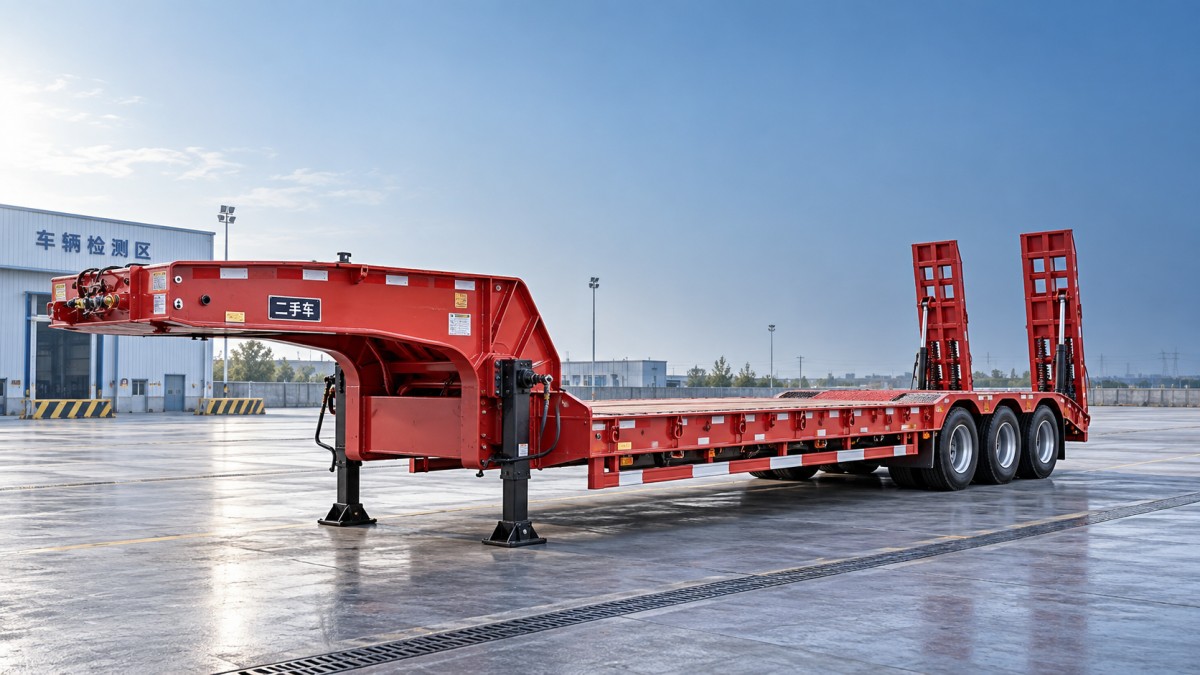
What to inspect before buying a used lowbed trailer for sale
A used lowbed trailer should be judged by the load path from the cargo deck to the tires, not by fresh paint, recent tires, or a low asking price. The trailer may appear serviceable while fatigue, corrosion, poor repairs, or mismatched components have already reduced its ability to carry excavators, loaders, transformers, or other concentrated heavy loads. Begin the inspection on level ground with the trailer unloaded, then repeat selected checks after it is coupled and, where possible, under realistic loading conditions.
Start with the main frame and neck
The frame is the first place where a repair decision becomes expensive. Examine the gooseneck, main I-beams, cross-members, drop deck transition, rear bridge, and all areas around suspension hangers. Dirt and undercoating often hide defects, so look closely at weld toes, flange edges, and the underside of the beams rather than relying on a general walk-around.
Hairline cracks near the neck-to-deck transition deserve more attention than superficial scratches on the deck. This area receives repeated bending forces during braking, turning, and loading. A crack that has been stop-drilled or covered by a small reinforcement plate is not automatically unacceptable, but its cause must be understood. Reinforcement can be a sound repair when it restores the intended load path; randomly added plates, uneven welds, or several repairs in the same zone can indicate repeated overload or poor previous work.
Check whether both main beams remain straight when viewed from the side and rear. A permanent downward bow, a twisted deck, or unequal beam height at matching points can suggest prior overloading. Measure rather than judge only by eye when the trailer is expected to carry machinery with concentrated axle loads. A trailer may have an adequate stated gross capacity yet still be unsuitable when one machine track, wheel group, or outrigger concentrates force over a small section of deck.
Separate deck wear from structural damage
A worn timber deck is often replaceable. Rot, loose planks, broken steel deck sections, and missing fasteners still affect safe loading because ramps and tracks place high point loads near the rear. Probe suspect wood around wheel paths, tie-down pockets, and the transition from upper deck to lower deck. Soft timber can retain water against steel cross-members, accelerating corrosion where it is difficult to see.
Steel deck plates require a different reading. Local dents from tracked equipment are common, but broad rippling across several cross-members can point to inadequate support beneath the plate. Look under the deck for cracked cross-member welds, crushed members, or repairs that have reduced ground clearance. Also inspect lashing rings, D-rings, stake pockets, and chain slots. Their mounting plates should not be bent, torn, or excessively corroded. A sound deck does not compensate for tie-down points that can no longer transfer restraint forces into the chassis.
Axles, suspension, and alignment reveal how the trailer has been worked
Tire condition alone is a weak indicator. New tires fitted to a misaligned running gear will wear quickly and can conceal the evidence of a previous problem. Compare tread depth across each tire and across the axle group. Feathered tread commonly points to toe misalignment, while wear concentrated on one shoulder can result from camber changes, worn bushings, bent axles, or a damaged suspension hanger. Different causes require different repairs, so the axle beam, wheel hubs, and hanger brackets all need inspection.
Look for fresh welds on axle seats, suspension brackets, equalizer beams, and spring hangers. A professionally executed repair may be acceptable, but it should not leave the axle position uncertain. Measure the axle centerlines from a common reference point, such as the kingpin or a repeatable chassis location, and compare diagonal dimensions. Small visual differences become significant when tires scrub during long-distance hauling.
On mechanical suspension, inspect leaf springs for broken leaves, shifted center bolts, loose U-bolts, and worn equalizer pivots. On air suspension, listen for leaks, check air bags for rubbing or cracking, and observe whether the trailer reaches a consistent ride height. A trailer leaning at rest may have a simple valve issue, but it can also reflect a damaged hanger, weak spring, or distorted frame. Do not assume an air bag replacement solves the underlying reason for an uneven stance.
Brakes and air lines need a functional test
Inspect brake chambers, slack adjusters, hoses, reservoirs, and fittings for corrosion, damage, air leakage, or signs of oil contamination. A visual inspection should be followed by an applied-brake test. With the braking system charged, listen for leaks and confirm that each brake applies and releases without delay. Dragging brakes generate heat and accelerate lining and drum wear; brakes that release slowly can be caused by restricted hoses, faulty valves, or neglected adjustment.
Where brake drums are accessible, look for heat discoloration, cracks, scoring, and oil around the hub seal area. Oil on brake components is not a minor cleanliness issue. It can reduce braking performance and usually requires attention to both the seal failure and the contaminated friction components. Confirm that parking-brake operation is stable and that emergency supply line connections are intact. Couplers should not be cracked, heavily corroded, or loose in their mounting plates.
Inspect ramps, hydraulic equipment, and load approach angles
Lowbed trailers are often damaged during loading rather than road travel. Raise and lower ramps through their full movement if the design allows it. Watch for twisted ramp frames, cracked hinges, bent pins, uneven travel, and poor ramp seating when stowed. A ramp can still move while its pivot structure is failing. The condition of the ramp surface matters as well: smooth, oil-covered, or badly worn traction areas increase the chance of track slip during loading.
For hydraulic detachable goosenecks, hydraulic ramps, steering axles, or lifting mechanisms, inspect cylinders for pitting and wetness around seals. Check hoses where they pass near moving components and frame edges. Abrasion may be more serious than a light surface stain because a hose failure during loading can leave the trailer partly supported or unable to reconnect. Ask for a full operating demonstration, including coupling and uncoupling procedures where relevant. A system that works only when warm, fully unloaded, or repeatedly reset needs further diagnosis before purchase.
Match the trailer geometry to the intended load
Deck length, loaded deck height, neck clearance, ramp angle, axle spacing, and kingpin location all affect whether a trailer fits the intended equipment and tractor configuration. A low deck reduces transport height, yet it may create clearance problems on uneven job sites, ferry ramps, loading yards, or access roads with abrupt grade changes. Verify the actual deck height and ground clearance rather than relying on an old specification sheet, especially after suspension changes, tire substitutions, or frame repairs.
Payload is also not a single number. Compare the expected machine weight with the trailer's axle arrangement, tire ratings, deck support, and the likely center of gravity. An unevenly distributed load can overload one axle group while the total load appears acceptable. The tractor's fifth-wheel position and axle loading must also be considered, because moving a machine forward to improve rear clearance may transfer excessive weight to the tractor.
Where the transport task is containers rather than low-clearance machinery, a purpose-built chassis may be more appropriate than adapting a lowbed. A 2 Axle Skeleton Semi Trailer uses container twist locks and can be configured around 20-foot, 40-foot, or 45-foot container dimensions. That layout serves a different load restraint method and should not be treated as interchangeable with a lowbed deck built for tracked or wheeled equipment.
Read the maintenance history against the physical evidence
Maintenance records are useful when they connect to identifiable work: brake relines, bearing service, tire replacement, suspension bushing work, hydraulic repairs, and structural welding. Missing records do not automatically rule out a trailer, but they increase the need for a closer physical assessment. Compare invoices or service notes with component dates, visible repairs, and current wear. A claimed recent brake overhaul does not align with severely worn slack adjusters, leaking chambers, or heat-marked drums.
Confirm the trailer identification details and ensure they match the available documentation. Look for altered, obscured, or damaged identification markings. Ask why major repairs were performed and whether the trailer was used for repeated overload, off-road movement, demolition work, or corrosive environments. These operating conditions leave different patterns: off-road work often affects suspension and deck edges, while road-salt or coastal exposure tends to attack wiring, air fittings, fasteners, and hidden steel interfaces.
Before finalizing the purchase, list defects by their effect on safe operation rather than by appearance. Structural cracks, axle misalignment, weak braking, compromised suspension mounts, and hydraulic faults require resolution before the trailer enters service. Cosmetic corrosion, worn deck boards, or minor lighting repairs may be manageable when the frame, running gear, load restraints, and operating geometry have been verified.
Leave A Reply

First class quality service and professional after-sales team.
Get in Touch
*We respect your confidentiality and all information are protected.