





What export certifications should a semi trailer manufacturer provide?
What Export Certifications Should a Semi Trailer Manufacturer Provide?
When evaluating a Semi Trailer Manufacturer for export supply, a specification sheet is only the starting point. A trailer can look correct on paper—three axles, heavy-duty suspension, a stated payload, LED lamps—and still create problems at port, during registration, or after a safety inspection if its documents do not match the destination market.
The practical question is not simply, “Does the factory have a certificate?” It is: “Which approvals, production records, and component documents are required for this trailer, in this country, for this operating use?” A side-wall cargo trailer headed to a private fleet in one market may face very different requirements from a tanker intended for regulated dangerous-goods transport or a trailer entering the European type-approval system.
Quality and safety teams should therefore request a certification matrix before placing the order. It should identify the destination country, trailer category, axle configuration, brake system, lighting arrangement, intended payload, and any special cargo requirement. The manufacturer should then show which documents apply, which are factory-level records, and which must be issued by an approved third party.
Start with market access, not generic certificates
A valid export document package begins with the importing country’s vehicle rules. For EU markets, trailers generally need to meet the applicable framework under Regulation (EU) 2018/858, often through whole-vehicle type approval, national individual approval, or another route accepted by the receiving authority. The exact route depends on the trailer category, whether it is a series production vehicle, and the national registration process. Where whole-vehicle approval applies, a Certificate of Conformity is typically part of the registration trail.
UNECE regulations are also highly relevant in many markets, but they should not be treated as a one-document solution. A buyer may need evidence related to braking, coupling devices, lighting installation, rear marking, tyres, or other regulated components. Commonly referenced areas include UNECE Regulation No. 13 for braking, No. 55 for mechanical couplings, and No. 48 for installation of lighting and light-signalling devices. The applicable version and approval scope must be checked against the destination market.
For other regions, conformity may be demonstrated through local vehicle approval, pre-export verification programs, customs conformity documents, or inspection certificates. Requirements can change, particularly where governments operate product-conformity schemes. A reliable supplier should not casually promise “global certification”; it should ask where the unit will be registered and verify the current requirement with the importer or local authority.
One common misunderstanding deserves attention: CE marking is not a universal road-vehicle approval. It may be relevant to certain separate equipment or machinery, but it does not by itself make a semi-trailer legal for road registration in Europe.
Factory management certificates are useful—but they are not vehicle approvals
ISO 9001 certification is usually the first management-system document procurement teams ask for. It can provide useful confidence that the manufacturer has documented controls for purchasing, production, inspection, nonconforming product handling, and corrective action. However, ISO 9001 does not certify the legal compliance, braking performance, payload rating, or roadworthiness of any particular trailer.
For a serious fabrication supplier, quality teams should go beyond the certificate itself. Ask for its scope, issuing body, validity dates, and whether trailer manufacturing is explicitly included. Then look at the working evidence: incoming material inspection records, weld inspection reports, final inspection checklists, calibration records for measuring tools, and traceability procedures for major structural and safety-related parts.
Manufacturing capability matters because paperwork cannot correct poor process control. A facility with CNC cutting, automatic welding, bending equipment, and defined tank-welding capability may have a stronger basis for repeatability, but the buyer should still confirm how those processes are controlled on the actual production line. Shandong Jiyake Automobile Sales Co., Ltd., for example, operates across vehicle production, trade, and fittings supply, with a stated 300,000 m² factory and automated fabrication equipment. For an export project, the relevant verification is whether the assigned plant, subcontractors, and inspection process are all covered by the submitted documentation.
Welding and material traceability should be visible in the export file
The chassis and load-bearing frame are where a trailer’s long-term safety is decided. A certificate on the wall is less useful than a traceable record connecting the delivered unit to its steel, welding procedures, and inspection results.
Depending on contract requirements and destination standards, buyers may request welding quality management evidence aligned with ISO 3834, qualified welding procedure specifications (WPS), procedure qualification records (PQR/WPQR), and welder qualification records. The exact qualification standard should be agreed in the purchase specification; ISO and AWS systems are not interchangeable simply because both address welding quality.
For high-strength steel components, request mill test certificates where material traceability is required. EN 10204 Type 3.1 inspection certificates are commonly requested in international industrial procurement, although the purchase order should define the needed material standard, grade, thickness range, and inspection level. It is worth checking that heat numbers on the certificates can be linked to the material used in the main beam, cross-members, kingpin area, and other critical structure—not merely to a general steel purchase.
A sensible final dossier may also include dimensional inspection records, visual weld inspection results, non-destructive test reports where specified, paint thickness records, and photographs of chassis identification markings. Not every cargo trailer needs every test, but the supplier should be able to explain the inspection plan rather than supply a stack of unrelated documents.
Safety-critical components need their own evidence
Axles, braking systems, landing gear, kingpins, tyres, suspension, lights, and reflectors should be reviewed as controlled components. Their brand names alone are not sufficient. Request manufacturer datasheets, applicable approval markings, batch or serial-number traceability when available, and confirmation that the installed parts match the approved bill of materials.
This matters when a trailer is configured for heavier work. Consider a Side Wall Semi Trailer built with high-strength steel, a 12,500 × 2,500 × 2,700 mm overall envelope, 600 mm side guards, three 13-ton axles, mechanical leaf-spring suspension, and a stated 40,000 kg loading weight. The buyer should verify that the axle rating, tyre load capability, brake design, kingpin selection, and local gross-combination limits work together. A stated loading weight is not automatically the lawful road payload in the importing country.
For side-wall and fence trailers, also inspect side-panel retention, hinge and latch workmanship, underrun protection where required, conspicuity markings, side marker lamps, mudguards, and spare-wheel bracket security. These are routine details, but they are often where a unit fails a local inspection or becomes difficult to maintain in service.
Tankers require a separate, stricter review
Fuel tankers, liquid bitumen tankers, bulk cement tankers, and other pressure or hazardous-cargo equipment cannot be assessed using the same document list as a general freight trailer. If the tanker will carry dangerous goods in ADR contracting countries, the relevant ADR tank and vehicle provisions must be evaluated for the intended substance, tank code, fittings, testing, inspection intervals, and certification route.
For these projects, ask early whether the tank is atmospheric, pressure-rated, insulated, heated, lined, or divided into compartments. Confirm whether pressure test reports, leak test reports, material certificates, safety-valve documentation, calibration documents, and third-party inspection are required. A tanker body may also fall under local pressure-equipment rules independent of road-vehicle approval. This is not an area for a generic “tank certificate.”
A practical pre-shipment document checklist
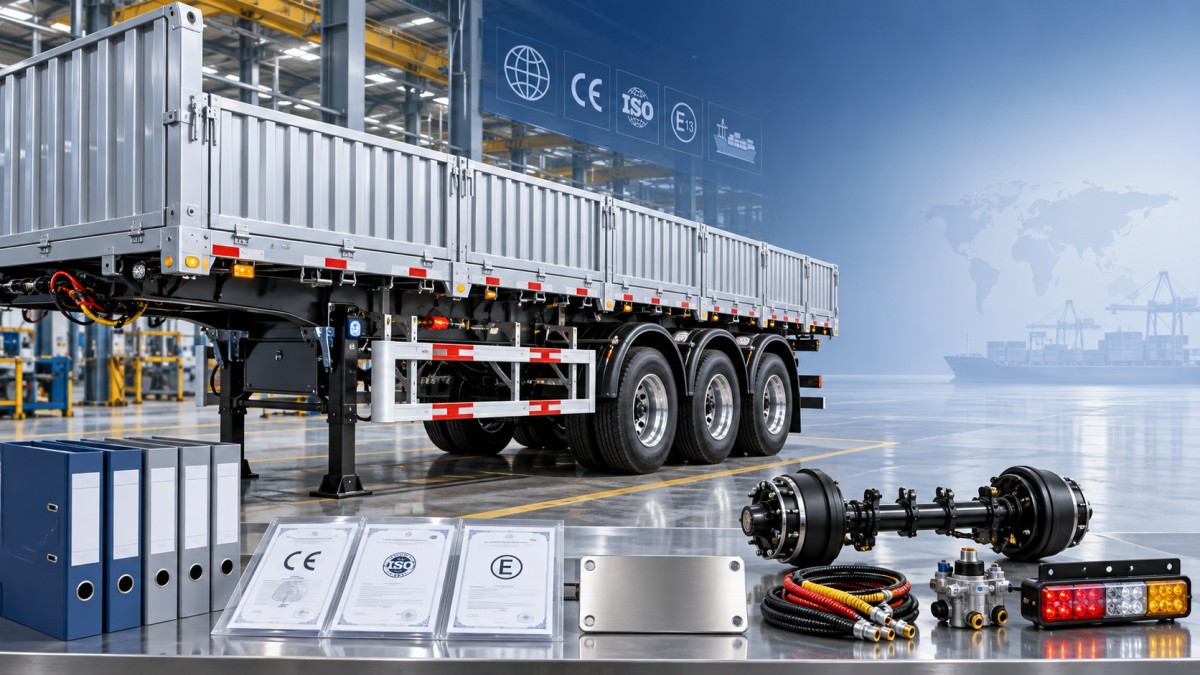
- Destination-market vehicle approval documents or a written confirmation of the applicable approval route.
- Certificate of Conformity or equivalent registration documentation where required.
- ISO 9001 certificate and its manufacturing scope, supported by relevant inspection records.
- Material certificates and welding documentation required by the contract or local standard.
- Component approvals and datasheets for brakes, axles, coupling devices, lights, tyres, and other safety-critical items.
- Vehicle identification number, nameplate details, final inspection report, packing list, commercial invoice, and certificate of origin where needed.
- For regulated tanks, the applicable test, inspection, and dangerous-goods documentation.
The most dependable Semi Trailer Manufacturer does not present every certificate as universally applicable. It separates factory capability, component compliance, vehicle approval, and shipment documents—and flags gaps before production is complete. That approach gives safety teams time to resolve a brake approval, nameplate format, axle-load issue, or tank inspection requirement while changes are still possible, rather than after the trailer has reached the destination port.
Leave A Reply

First class quality service and professional after-sales team.
Get in Touch
*We respect your confidentiality and all information are protected.