




Recent Posts
 Thailand Clients Visit JIYAKE to Inspect Brand-New Semi-Trailers and Reach Cooperation AgreementNov 21, 2026
 Guinea Clients Visit JIYAKE to Inspect Brand-New SINOTRUK Vehicles and Reach Strategic CooperationNov 21, 2026
 When can an electric dump truck work on a fixed site?Oct 30, 2026


How does dump truck body shape affect material discharge?
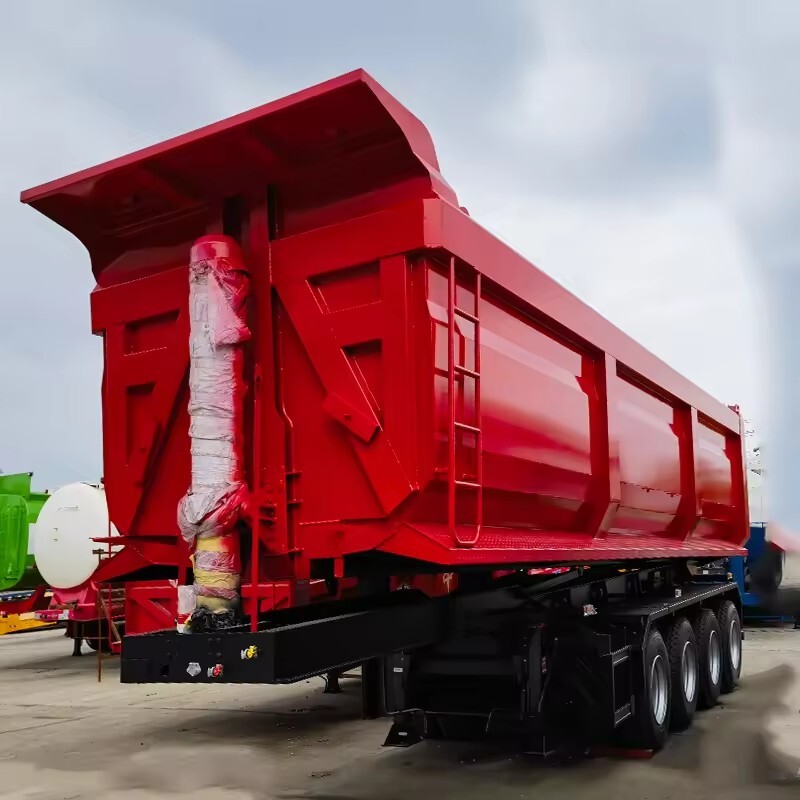
Dump truck body shape affects discharge by controlling how a load moves toward the tailgate as the body rises. A smooth, unobstructed floor and a widening discharge path generally favor continuous flow, while corners, abrupt transitions and narrow outlets create places where material can lodge. The best profile depends on the load: dry aggregate that flows freely behaves very differently from wet clay that sticks to steel or compacted soil that holds together.
When comparing a dump truck for sale, discharge performance should be assessed as a combination of body geometry, material properties, tipping angle and tailgate clearance. A steep body alone does not guarantee a clean dump if material bridges across the outlet or adheres to the floor.
Floor geometry and the start of flow
During rear tipping, gravity pulls the load along the inclined floor toward the tailgate. Increasing the angle raises the component of gravity acting down the floor, but the load will not necessarily slide as a single mass. Friction at the floor, cohesion within the material and pressure from the load above all influence when movement starts.
A long, flat floor gives material a direct path to the rear, particularly when its surface is smooth and the transition to the tailgate is unobstructed. However, a large area of wet, adhesive material in contact with the floor can resist movement until the body has risen substantially. Once that material breaks free, it can move suddenly, producing a rapid change in load distribution.
Floor condition matters as much as the original profile. Worn liners, raised welds, dents and repairs can interrupt flow or trap fines. A liner selected for low adhesion or abrasion resistance can improve discharge for a particular load, but its effect should be assessed with the actual material: a surface that releases damp soil well is not automatically the most durable choice for sharp rock.
Sidewalls, corners and cross-section
Conventional rectangular bodies make efficient use of width and offer a straightforward load space. Their junctions between the floor and vertical sidewalls, however, form corners where sticky material can remain after the main load has discharged. Reinforcing members or other projections inside the body can add further retention points.
Rounded-bottom and half-round profiles reduce sharp floor-to-wall corners. This gives cohesive material fewer abrupt surfaces to collect against and can make residual deposits easier to remove. The curved floor also changes load distribution and usable cross-section, so an apparent improvement in clean-out should be considered alongside payload volume, loading equipment and the body's structural design.
Sloping sidewalls can direct material toward the floor and reduce ledges where it accumulates. Yet the direction of taper matters. A body that becomes narrower toward the discharge opening can compress a cohesive load as it moves rearward, encouraging bridging. A shape that opens toward the tailgate provides a less restrictive path, provided the gate and rear frame offer comparable clearance.
Large rock introduces a different constraint. Oversize pieces can interlock or become trapped at a narrow rear opening even when the body surface is clean. For such loads, the smallest clear passage through the rear structure is often more informative than the nominal internal width measured farther forward.
The tailgate sets the effective outlet
Body shape cannot be judged independently of the tailgate. A top-hinged gate that opens under load must have enough clearance for the material to exit; sticky material or a large lump can restrict its movement. Gate geometry, hinge position, locks and any spreading chains affect the size and shape of the opening during discharge.
For loose granular loads, a restricted opening can be useful when controlled spreading is required. The same restriction can cause blockage when unloading large aggregate or cohesive soil. A gate that opens fully for bulk tipping offers a different discharge path from one held partly closed for spreading, even on an otherwise identical body.
Inspect the threshold and rear crossmember as well. A raised lip, recessed floor or damaged rear edge can retain a thin layer after the main load leaves. Persistent material at the tail does not automatically indicate insufficient tipping angle; it can point to a local obstruction at the final exit.
Material behavior changes the result
Dry sand and clean gravel tend to flow readily, although particle size and grading still affect how the load settles. Wet clay, fine soil and some mixed demolition loads are more likely to adhere, compact or bridge. Moisture is especially important: the same soil can discharge freely when relatively dry and remain attached to the body after rain.
Loading method also changes the test. Material dropped from height can compact against the floor, while uneven loading can leave more weight on one side. A body that empties well with a shallow load may retain material when filled more deeply, because the lower layers experience greater pressure. Comparisons are most useful when load depth, moisture, particle size and loading method are recorded alongside the body dimensions.
Residual material on both sides of the floor suggests a different mechanism from a single pile at the tailgate. Side deposits often point to corner geometry, surface adhesion or uneven wear; a rear blockage directs attention to gate clearance, oversize pieces or a narrowing outlet. These patterns are diagnostic clues, not proof, because several restrictions can occur together.
Tipping geometry and stability
The hoist determines how the body reaches its discharge position, while body shape and load behavior determine what happens during that movement. Maximum tipping angle is useful only when read with floor length, pivot location and the angle at which the material actually begins to slide. A body that releases at a lower angle can reduce the time spent with the load elevated, but a low measured angle is not a substitute for observing the complete unloading cycle.
Uneven retention matters. If one side releases while the other remains stuck, the raised body can be subjected to an uneven load. Soft or sloping ground, wind and an off-center load add to that concern. Discharge should take place on suitable level, firm ground, with adequate overhead clearance; a stuck load should not be freed by driving or jerking the truck with the body raised.
Hoist, hinge and tailgate condition also affect the intended discharge path. Excessive wear or damage can interfere with alignment and gate movement. Replacement Parts must match the relevant vehicle and component specifications so that the body and gate operate as designed.
Comparing body profiles under a representative load
A useful comparison records the internal floor length and width, sidewall profile, corner shape, rear opening and maximum body angle, together with the liner and tailgate arrangement. Nominal capacity alone does not describe the shape through which material must flow. Likewise, a larger maximum angle says little about whether the gate opens freely or whether the last layer clears the floor.
Where a demonstration is possible, use a representative material and observe when movement begins, whether the flow is steady or abrupt, and where residue remains after the body has reached its permitted raised position. Record the ground conditions and whether the gate was fully open. Repeat observations under comparable conditions before attributing a difference to body shape, since moisture or load compaction can change the outcome substantially.
For a truck carrying several materials, the preferred body is a compromise. A rounded profile may simplify clean-out of sticky soil, while a wider, less obstructed rear opening may matter more for coarse rock. The relevant choice is the geometry that releases the intended loads reliably within the vehicle's operating limits, rather than the profile with the steepest floor or the largest stated volume.
Leave A Reply

First class quality service and professional after-sales team.
Get in Touch
*We respect your confidentiality and all information are protected.