




Fixed vs. Extendable Skeleton Semi-Trailers for Mixed Container Fleets
A fixed skeleton semi-trailer is usually the better choice when container sizes, loading patterns, and routes stay consistent. An extendable chassis earns its additional cost when changing container lengths regularly creates dispatch problems, empty repositioning, or demand for extra trailers. The decision depends on how often that flexibility will be used and whether each configuration can carry the required weight legally.
A mixed container fleet does not automatically need an entirely extendable trailer fleet. Fixed chassis can support predictable work, while extendable units cover changing assignments. Before comparing quotations, establish which container combinations actually need to share the same trailer.
Start with container positions, not just container lengths
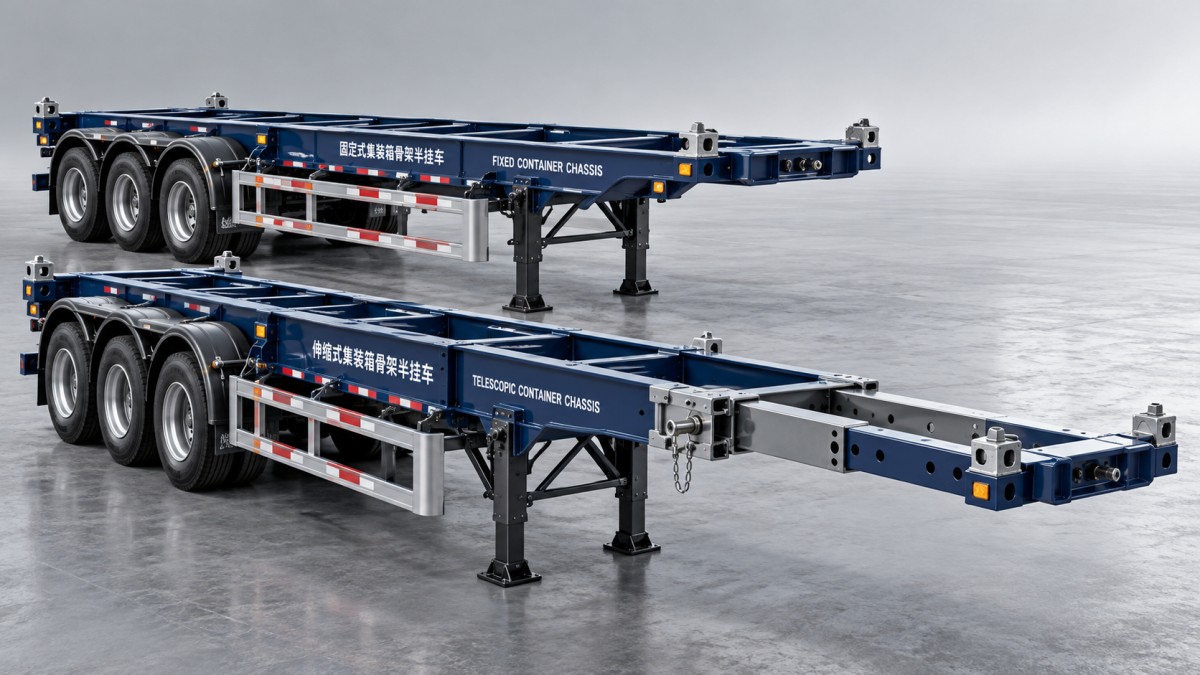
A fixed chassis has a fixed main frame length, but that does not necessarily restrict it to one container size. Depending on its design, it may have twistlock positions for different container arrangements. An extendable chassis changes its frame length through a sliding mechanism, with locking positions for specified configurations.
Neither description proves that a particular trailer can handle every container in your operation. A chassis advertised for 20-foot and 40-foot containers may support only certain loading positions. Carrying one heavy 20-foot container is a different requirement from carrying a longer, lighter container or two shorter containers together.
Ask for a configuration drawing showing container support points, twistlock locations, axle positions, and permitted loads in each arrangement. Include 45-foot containers only where the proposed chassis explicitly supports them. Length compatibility alone does not establish suitable support, clearance, or weight distribution.
A container can fit while the axle loading fails
The most consequential comparison is often weight distribution. Container position determines how much load reaches the tractor through the kingpin and how much reaches the trailer axle group. A short, dense container can create an unsuitable axle load even when the trailer’s overall structural capacity appears sufficient.
For example, placing a loaded 20-foot container at the rear of a long chassis can put excessive load on the trailer axles and leave insufficient load on the tractor’s drive axle. A suitable central position may improve distribution, but it must be part of the trailer’s designed loading arrangement.
Extending the frame does not automatically solve this problem. Designs differ: some change the relationship between the container and axle group, while others offer a different adjustment arrangement. Compare load distribution drawings for the actual tractor wheelbase, fifth-wheel position, container gross mass, and chassis setting.
Usable payload is constrained by the complete combination. Tractor and trailer ratings, axle limits, tires, coupling capacity, and route restrictions all matter. Container gross mass includes the container itself; it is not the same as cargo payload.
An extendable model may have a higher tare weight because of overlapping frame sections and adjustment components, but this should be checked against the specific fixed alternative. When vehicle mass is the limiting factor, additional tare reduces cargo capacity. When loads reach their volume limit first, that weight difference may have little commercial effect.
When flexibility changes daily operating costs
Extendable chassis offer the clearest value when the same equipment must switch between different container lengths during normal dispatch. This can reduce occasions when an available trailer cannot take the next job, particularly where return loads are unpredictable.
Consider a hypothetical operation that delivers a longer container and then collects a shorter one nearby. A compatible extendable chassis may complete both assignments without a trailer exchange. The saving comes from avoiding repositioning or waiting, provided the second container’s weight and loading position are also acceptable.
That advantage becomes smaller when separate routes already use dedicated equipment. If one group of trailers consistently carries loaded 20-foot containers and another handles 40-foot containers, a fixed fleet may provide adequate coverage with simpler daily checks.
Adjustment also consumes working time. The operating procedure may require a suitable surface, space to move the tractor, and a particular loading condition. Do not assume a chassis can be extended or retracted with a loaded container aboard. The manufacturer’s procedure should define when and how adjustment is permitted.
Destination access deserves equal attention. The chassis setting affects overall length, turning behavior, and rear overhang. Check the proposed combination against depot entrances, loading areas, and unloading arrangements. A container position that distributes weight well may place its doors away from the trailer rear, affecting access at some receiving sites.
Maintenance depends on the mechanism and the working environment
Fixed chassis remove one maintenance task: keeping a telescoping frame operating correctly. Their twistlocks, frame welds, brakes, suspension, landing gear, and running gear still require inspection.
On an extendable skeleton semi-trailer, sliding surfaces and locking mechanisms add inspection points. Dirt, corrosion, wear, or impact damage can make adjustment difficult or prevent positive engagement. Coastal exposure, muddy yards, and infrequent adjustment can make cleaning and protection especially relevant.
During an equipment demonstration, inspect how the operator confirms that every required extension lock has engaged. The mechanism should provide a practical way to check its condition. Also review access for cleaning, lubrication where specified, and replacement of wear components.
Parts support can outweigh a small purchase-price difference. Ask which pins, guides, bushes, and other mechanism components are replaceable, what tools are needed, and whether repairs require specialist work. A trailer that cannot change configuration when required loses much of the flexibility used to justify its purchase.
Compare cost per completed assignment
Purchase price should be assessed alongside maintenance, adjustment time, payload effects, and the cost of unavailable equipment. A cheaper fixed trailer can become expensive if incompatible assignments repeatedly require extra movements. An extendable trailer can also be poor value if it remains in one position throughout its working life.
Use dispatch records to identify how often container size actually changes for an individual trailer. Fleet-wide container percentages can conceal the answer: a business may move many sizes while keeping each trailer on a stable assignment.
Build the comparison around practical questions:
- How many trailer exchanges or empty movements would adjustable equipment avoid?
- Would it prevent rejected work or reduce the number of reserve trailers needed?
- Would additional tare reduce revenue on weight-sensitive loads?
- Can the workshop support the adjustment mechanism without prolonged downtime?
- How much operating time would configuration changes require?
For uncertain work patterns, a limited number of extendable units can provide coverage while fixed trailers handle the predictable base workload. This approach is especially useful when only a small share of assignments needs frame-length adjustment.
Make the quotation answer your loading plan
Give each supplier the same list of container lengths, gross masses, loading combinations, tractor details, and route conditions. Request configuration drawings and load distribution calculations for the demanding cases, rather than accepting a general description such as “multi-size container chassis.”
The specification should state trailer tare, approved container positions, applicable ratings, coupling details, and adjustment procedures. It should also identify any configuration restrictions and the maintenance requirements for extension components. Compare equipment with equivalent running gear and braking specifications so that unrelated differences do not distort the fixed-versus-extendable decision.
Choose fixed equipment where the approved positions cover regular work efficiently. Choose extendable equipment where frequent changes produce measurable operating savings. Before placing the order, require the proposed chassis to demonstrate both jobs: carrying the heaviest planned container with suitable weight distribution and accommodating the changing container lengths that justify the investment.
Leave A Reply

First class quality service and professional after-sales team.
Get in Touch
*We respect your confidentiality and all information are protected.