




Can a Lighter Skeleton Semi-Trailer Increase Your Legal Payload?
A lighter skeleton semi-trailer can increase legal payload when the combination reaches its permitted gross weight before it reaches another limit. Under those conditions, removing one kilogram of trailer tare creates room for up to one additional kilogram of cargo. The gain depends on axle loads, container ratings, tractor capacity, and the restrictions applying to the route.
For a technical evaluator, the useful comparison is therefore the additional cargo each chassis can legally carry in its working configuration. A lower advertised tare deserves attention, but it becomes valuable only when the complete vehicle can use the saving without compromising container support, structural life, or operating reliability.
Establish which limit controls the load
Start with a consistent weight boundary. Cargo inside a container, the loaded container, and the trailer payload are different quantities. A chassis rating may describe the load imposed on the trailer, including the container itself. A shipper asking about payload may mean only the goods inside it. Confusing these definitions can overstate the benefit of a lighter chassis.
For a gross-weight-limited combination, the basic calculation is:
Available cargo mass = applicable combination gross weight limit − operating tractor tare − operating trailer tare − empty container mass.
Operating tare should reflect the vehicle as dispatched: fuel, driver, fitted equipment, spare wheel, tools, and other carried items must be accounted for consistently. The applicable gross weight ceiling must also respect vehicle ratings and registration conditions, alongside route rules. Axle and component limits then require separate checks.
Consider an illustrative calculation using a hypothetical 44,000 kg combination ceiling. If the operating tractor weighs 8,000 kg, the trailer 5,000 kg, and the empty container 4,000 kg, the gross-weight calculation leaves 27,000 kg for cargo. Reducing trailer tare to 4,300 kg raises that allowance to 27,700 kg.
Those figures demonstrate the arithmetic; they do not establish a legal loading entitlement. If the container permits only 27,000 kg of contents, or an axle group reaches its limit earlier, the extra 700 kg cannot automatically become cargo. Conversely, a shipment that fills the container before reaching any weight limit gains no additional carrying capacity from the lighter trailer.
Axle distribution can consume the expected gain
A combination can comply with its gross weight ceiling and still overload the tractor drive axles or trailer axle group. The position of the container’s centre of gravity determines how its weight divides between the kingpin and trailer suspension. Fifth-wheel position and tractor geometry then affect the distribution across the tractor axles.
The location of the removed chassis mass matters too. Removing weight near the trailer bogie produces a different change in axle reactions from removing the same amount near the front. When additional cargo is loaded, its weight may return to the axle group that was already closest to its limit.
For this reason, a supplier’s total tare reduction is insufficient evidence of usable payload. The evaluation should compare axle reactions for both designs under the intended container positions and loading patterns. Include uneven cargo distribution where it is credible for the operation.
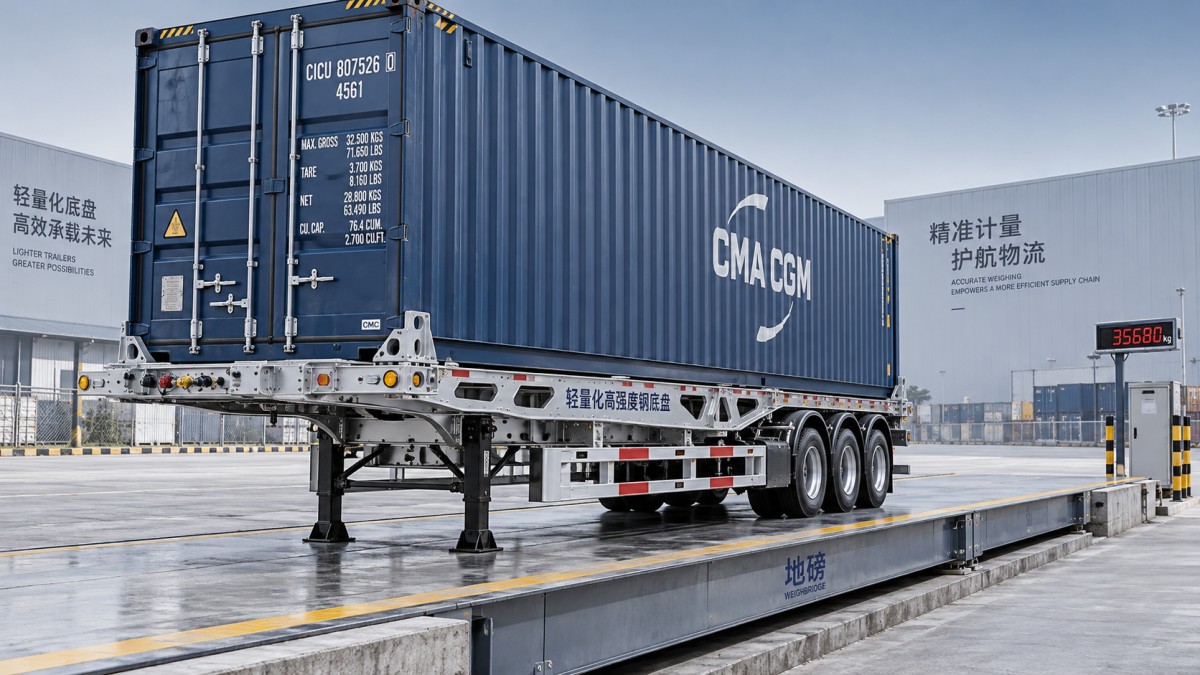
A side-view load diagram showing the kingpin, axle-group centre, container support points, and cargo centre of gravity makes this assessment easier to review. A static calculation establishes the expected reactions; weighing the configured combination checks the assumptions against the actual vehicle.
Container flexibility adds another complication. A chassis intended for different container lengths or positions needs a loading assessment for each approved configuration. Moving a container or adjusting a sliding assembly may improve distribution, but the arrangement must remain within the chassis design, locking provisions, dimensional rules, and applicable axle-spacing requirements.
The legal review should follow the actual route. Gross weight, individual axle, axle-group, and spacing requirements may interact, while bridges or restricted roads can impose lower limits. A chassis drawing or rated capacity cannot establish compliance across every country or route.
Where lightweight construction needs engineering evidence
A skeleton semi-trailer carries container loads through its corner supports and locking interfaces into the frame, suspension, and coupling. Reducing mass around those load paths requires more scrutiny than removing weight from lightly loaded brackets or accessories.
High-strength steel can support a lighter design, but its grade alone does not establish durability. Higher yield strength increases resistance to permanent deformation; it does not proportionally increase elastic stiffness. Thinner sections may therefore introduce greater deflection or local buckling sensitivity unless their geometry and reinforcement are designed accordingly.
Fatigue performance also depends on the complete detail: weld geometry, stress concentrations, joint transitions, fabrication quality, and the load cycles expected in service. A frame that passes a static strength assessment may still require further evidence for repeated operation over uneven roads, frequent yard manoeuvres, or sustained service near its rated load.
The supporting engineering package should address three connected questions:
- Strength and stability: Do the frame, support assemblies, and connections withstand the declared load cases without unacceptable yielding or buckling?
- Deflection and container restraint: Does deformation remain compatible with the intended support arrangement and secure engagement of the twist locks?
- Fatigue and service exposure: Do the assessment and validation represent the expected road conditions, load cycles, corrosion exposure, and maintenance practices?
Finite-element analysis is useful when its assumptions are visible. Evaluators should be able to identify the support conditions, applied loads, material properties, connection assumptions, and acceptance criteria. A coloured stress plot alone gives little basis for comparing two chassis.
Physical validation should complement the analysis where appropriate to the design and approval requirements. Its value depends on how closely the tested configuration represents the offered trailer and intended service. Changes to axle position, frame sections, container supports, or fitted equipment can affect the relevance of earlier results.
Compare the delivered specification and the working load
A meaningful tare comparison starts with equivalent equipment. Axles, suspension, tyres, landing gear, spare-wheel provision, underrun protection, container locks, and any extension mechanism should be identified. Otherwise, part of an apparent weight advantage may come from a different specification or omitted equipment.
Ask for the declared tare basis, its tolerance, and a weighing record for the delivered configuration. A nominal saving that is small relative to build variation or differences in fitted equipment is a weak basis for a payload commitment.
Container limits deserve equal attention. Check the actual unit’s marked maximum gross mass and empty mass, together with any relevant inspection and acceptance requirements. Reducing chassis tare cannot increase the container’s allowable gross mass or remove cargo-specific loading constraints.
The final comparison should bring together four items: the operating weight record, axle-load calculations for intended configurations, applicable vehicle and route limits, and structural evidence for the proposed duty. This gives the evaluator a defensible cargo allowance rather than a tare figure in isolation.
Commercial value follows from how often that allowance can be used. Dense, weight-limited container traffic offers a stronger case than volume-limited freight. Additional cargo must also justify any purchase premium and any differences in inspection, repair, or maintenance requirements. Empty-running benefits can be assessed separately, but should not be presented as proof of increased legal payload.
A lighter chassis earns its payload advantage when the delivered combination can carry more goods within every controlling limit, on the routes and load patterns the fleet actually uses. The decisive procurement figure is the supported increase in legal cargo for those conditions.
Leave A Reply

First class quality service and professional after-sales team.
Get in Touch
*We respect your confidentiality and all information are protected.