




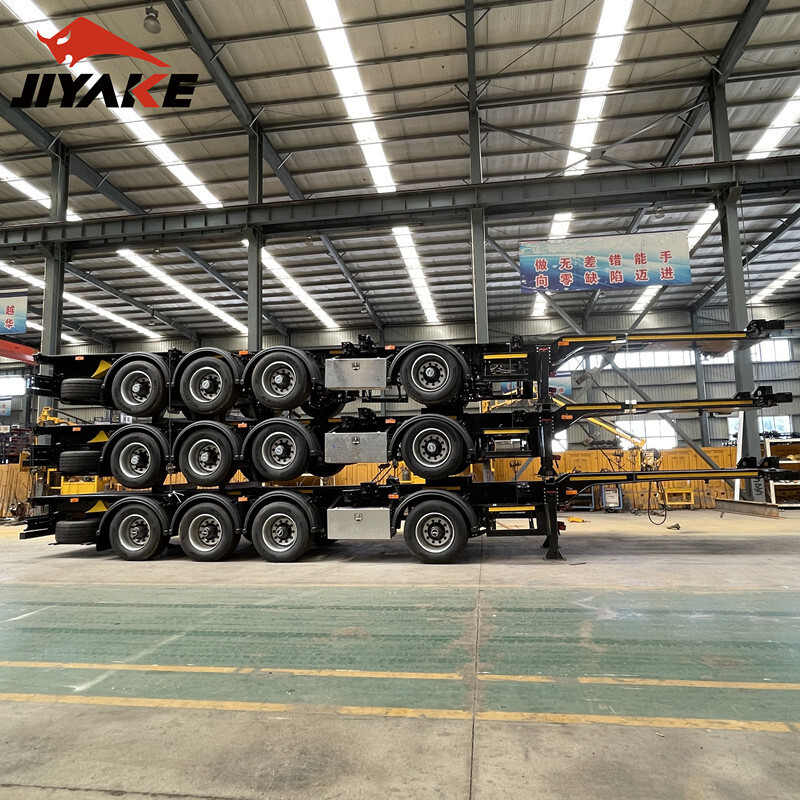
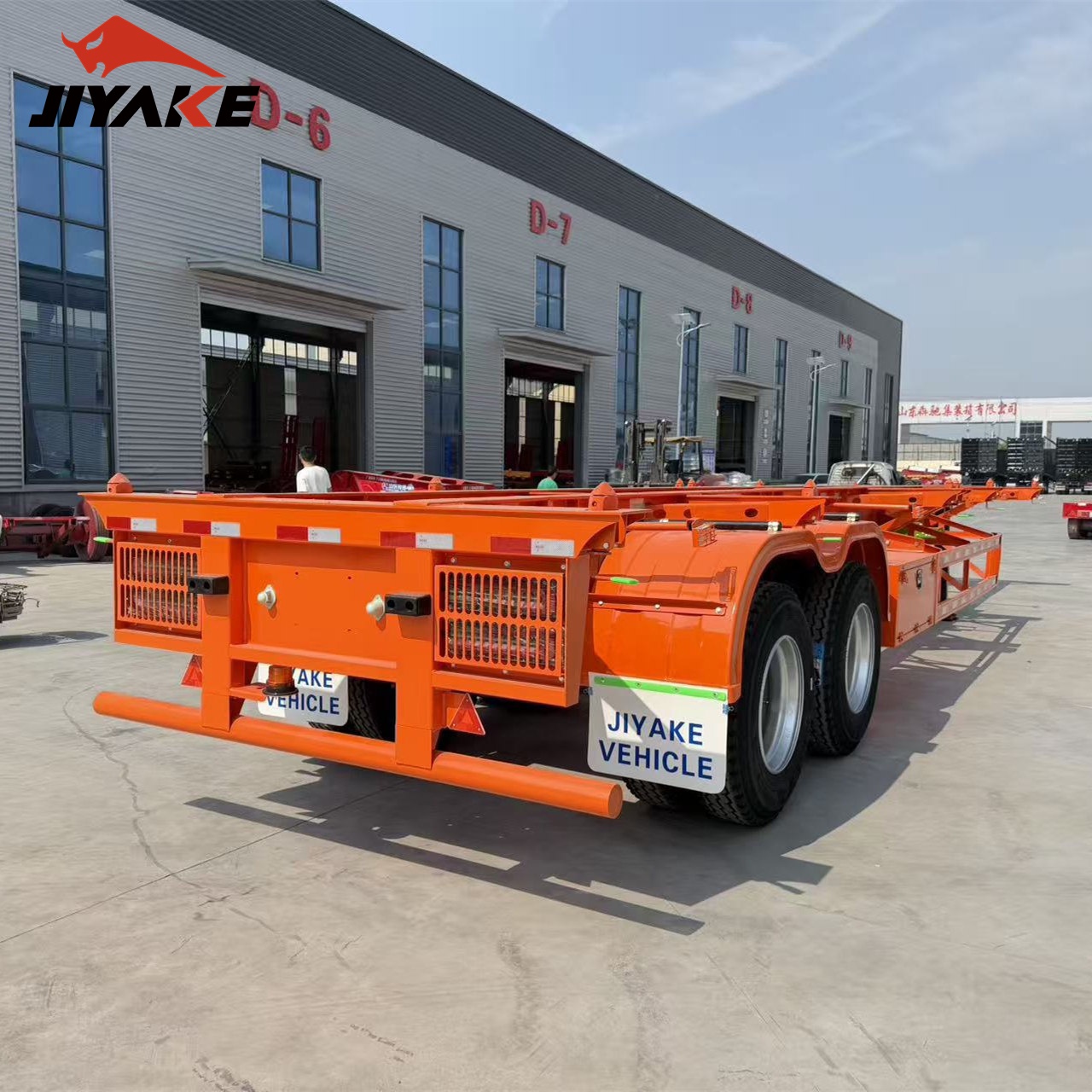

Choosing Skeleton Semi-Trailer Axle Layouts for Heavy 20ft Containers
A heavy 20ft container can push a skeleton semi-trailer beyond an axle-load limit while leaving plenty of nominal payload capacity unused. The problem is not simply how much the trailer carries, but where that weight enters the chassis and how it divides between the tractor and trailer axles. For technical evaluators, the right axle layout is the one that works with the actual container position, tractor specification, and operating route—not merely the one with the highest advertised capacity.
Before comparing quotations, establish whether “container weight” means cargo payload or the complete loaded container. Load calculations must include the container itself, trailer tare, and relevant operating equipment. The container’s permitted gross mass and corner-fitting condition also remain independent constraints.
Start with the load case, not the axle count
A 20ft container concentrates its load over a shorter section of chassis than a 40ft unit. Its four lower corner fittings transfer the load through the twistlock supports, so crossmember placement and local reinforcement matter as much as the main-beam specification. A chassis designed to accommodate several container lengths is not automatically approved for a heavy 20ft container at every locking position.
Ask the supplier to identify the approved heavy-container position on a dimensioned drawing. Then establish three boundaries:
- Structural capacity: the permitted load at that position, including twistlock supports, frame members, suspension attachments, and kingpin assembly.
- Running-gear capacity: axle, suspension, hub, wheel, and tire ratings, assessed together rather than separately.
- Legal capacity: permitted axle and axle-group loads, combination mass, spacing requirements, and any route restrictions.
The lowest applicable limit governs. Three axles rated at 13 tonnes each do not automatically create a legally usable 39-tonne axle group, nor do they establish the trailer’s payload rating.
Container position can change the decision
For an initial static assessment, treat the trailer as supported at the kingpin and at the effective center of its axle group. This simplified model reveals whether a proposed layout is plausible before detailed engineering begins.
If the container gross mass is W, the distance from kingpin to axle-group center is L, and the container’s longitudinal center of gravity is x behind the kingpin:
- Container contribution to trailer axle-group load = W × x ÷ L
- Container contribution to kingpin load = W − trailer axle-group contribution
Consider an illustrative 28-tonne loaded container with its center of gravity 4.8 m behind the kingpin and an 8.0 m support span. It contributes 16.8 tonnes to the trailer axle group and 11.2 tonnes to the kingpin. If the trailer’s measured tare reactions are 4.0 tonnes at the axle group and 2.0 tonnes at the kingpin, the combined static reactions become 20.8 and 13.2 tonnes respectively.
Move that container 0.8 m rearward and another 2.8 tonnes transfers to the trailer axles. Moving it forward reverses that transfer—but may overload the tractor’s drive axle group or fifth wheel.
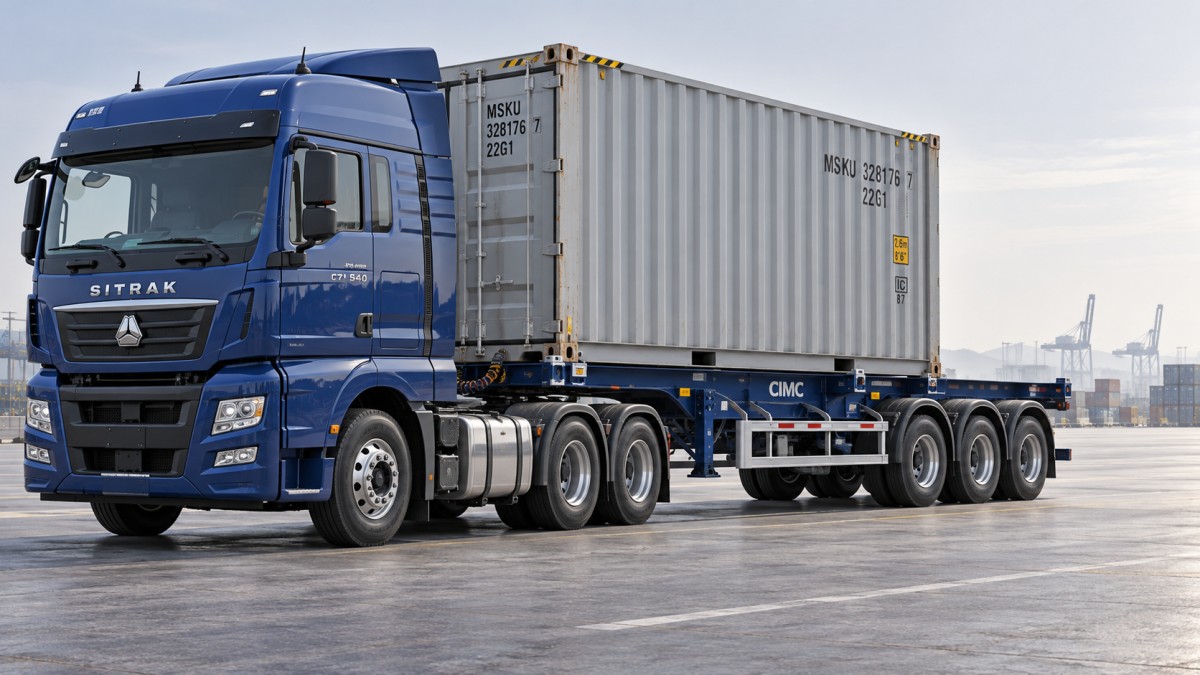
This calculation assumes a known cargo center of gravity and an effective axle-group support point. It does not prove equal loading across individual axles. Uneven cargo distribution, suspension geometry, road gradients, and dynamic inputs require further assessment. The kingpin reaction must also be resolved into tractor steer- and drive-axle loads using the tractor’s wheelbase and fifth-wheel position.
Comparing skeleton semi-trailer axle layouts
A tri-axle skeleton chassis is often a sensible starting point for heavy 20ft work, but it is not a universal answer. Adding an axle can increase tare and rolling resistance without increasing legal carrying capacity. Closely spaced fixed axles also experience tire scrub during tight turns—a recurring cost in congested terminals.
Check exactly how the jurisdiction defines an axle group. Wider spacing may alter the legal allowance, but it also changes chassis geometry and maneuverability. For a lift-axle proposal, request loaded and unloaded operating logic; lifting an axle redistributes load onto those remaining on the ground.
Suspension and tractor compatibility decide whether the layout works
Leaf-spring suspension offers a mechanically straightforward option, particularly where local workshops prioritize familiar components and repairs. Its load-sharing behavior depends on the equalizing arrangement, component condition, and installation geometry. Worn bushes or restricted equalizer movement can undermine the expected distribution.
Air suspension may provide useful ride-height control and load-sharing characteristics, but it requires suitable valves, plumbing, air supply, and maintenance support. Neither suspension type removes the need to verify individual axle loads. Braking, cornering, and uneven roads create conditions that a static average cannot describe.
The tractor should be specified alongside the trailer, not selected after the chassis is built. Confirm:
- Fifth-wheel vertical-load rating, mounting position, and coupling compatibility.
- Steer- and drive-axle loads at the proposed kingpin reaction.
- Loaded coupling height, tractor-to-trailer clearance, and landing-leg clearance during articulation.
- Brake-system compatibility and applicable ABS or EBS requirements.
- Gross combination rating and suitability for gradients, traction, and braking duty.
A stronger kingpin alone cannot correct an overloaded fifth-wheel installation. Likewise, a satisfactory total combination mass does not establish compliance at every axle.
Read supplier specifications as evidence, not conclusions
A related open-deck product can help benchmark components, provided it is not mistaken for a container-specific design. For example, Shandong Jiyake’s 3 Axle Flatbed Trailer lists a 40-tonne loading capacity, dimensions of 12,500 × 2,500 × 1,600 mm, three 13-tonne FUWA axles, leaf-spring suspension, and 12 container locks.
Those details provide a starting point for discussion, not proof of heavy-20ft suitability. An evaluator would still need the approved locking positions, tare reactions, concentrated-load assessment, and axle-load calculations. The listed 50 mm or 90 mm kingpin options must match the selected coupling system; they are not interchangeable procurement choices.
This distinction matters when comparing a flatbed’s cargo flexibility with a dedicated skeleton semi-trailer. Deck structure affects tare and load paths, so the capacity figures should not be transferred from one design to another.
Make the purchase conditional on a verified loading envelope
Rather than requesting only a maximum payload, ask for an operating envelope covering the heaviest expected container, realistic cargo-center variations, and each approved locking position. Require a dimensioned general arrangement, component ratings, tare assumptions, and predicted tractor and trailer axle loads.
For an export supplier such as Shandong Jiyake Automobile Sales Co., Ltd., which serves markets including Southeast Asia, Central Asia, and Africa, the destination rules and route conditions need to be explicit in the enquiry. Local parts availability and workshop capability should influence suspension and axle selection alongside carrying capacity.
Before acceptance, weigh the matched combination with a representative load, checking individual axles or groups as required locally. Compare the results with the calculations and retain the approved loading instructions. The strongest selection is not the chassis with the most axles: it is the configuration whose legal limits, structural capacity, and daily operating margins have all been demonstrated.
Leave A Reply

First class quality service and professional after-sales team.
Get in Touch
*We respect your confidentiality and all information are protected.