




Coastal Skeleton Semi-Trailer Maintenance: Where Corrosion Starts
Corrosion on a skeleton semi-trailer often starts at water traps and coating breaks: behind suspension brackets, beneath twist-lock housings, along weld edges, and inside accessible hollow sections. The most visible rust patch may not be the most serious defect. A small stain emerging from a loaded joint can deserve more attention than a broad area of light surface rust.
On coastal routes, salt deposits repeatedly become damp through spray, condensation, and humid air. Sheltered surfaces can stay contaminated even after exposed frame rails look clean. Effective maintenance therefore depends on finding where salt collects, exposing the underlying condition, and separating coating damage from deterioration that affects load-bearing parts.
Where to look before inspecting the open frame rails
Twist-lock housings and container support points
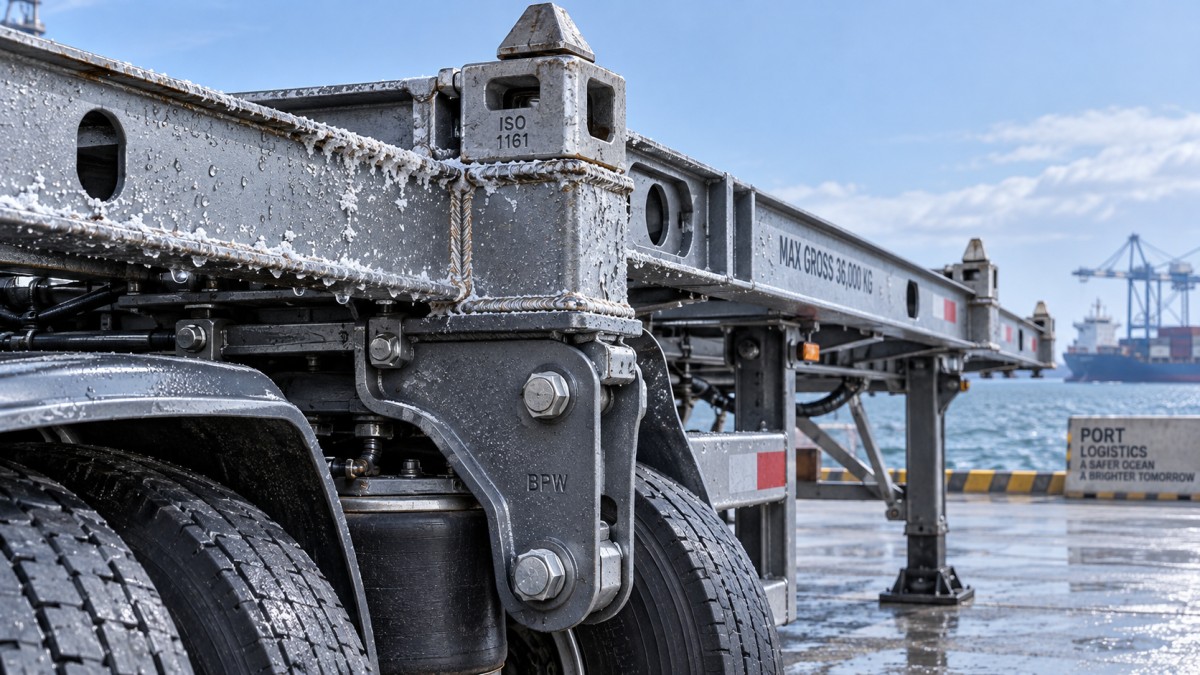
Container handling can chip paint around corner supports and twist-lock mounting plates. Dirt then accumulates beneath housings, around fasteners, and in narrow gaps between adjoining surfaces. These locations combine damaged protection with restricted drying.
Inspect the underside of each support as well as the visible top face. Look for lifted paint, rust bleeding from joints, swollen seams, and corrosion around mounting welds. Operate the locks according to their maintenance procedure and check engagement, retention, and abnormal movement. Stiff operation may come from contamination, wear, or corrosion; adding grease alone does not identify the cause.
Weld edges, crossmember connections, and overlapping plates
Sharp edges and uneven weld profiles can be difficult to coat consistently. Where a coating breaks, moisture can spread beneath nearby paint. Overlapping plates create another problem: a narrow crevice can hold salty water after surrounding surfaces have dried.
Follow weld toes and plate edges with a strong light. A rust trail emerging from a joint warrants closer inspection, especially if cleaning reveals a linear opening. Do not assume every line is a harmless paint crack. Corrosion and fatigue cracking can occur together at a stressed connection.
Suspension brackets and the structure above the axles
Road spray drives contamination behind hangers, gussets, and suspension mounting plates. Mud can hide the attachment welds and keep these areas damp. Inspect from several angles, including the inward-facing surfaces that a normal walk-around misses.
Check for flaking scale, pitting, displaced fasteners, cracks, or rust swelling between connected parts. Because these attachments transmit braking and road loads into the chassis, deterioration here deserves prompt assessment even when the affected area appears small.
Frame cavities, landing legs, and the coupling area
Not every container chassis has enclosed frame members. Where hollow sections are fitted, inspect through existing access points with a borescope when practical. Check designed drains for blockage, but do not drill new openings or assume a sealed section should be opened.
Landing-leg brackets, cross braces, and footplates collect splash and abrasive debris. At the front, examine the kingpin mounting structure and accessible surfaces around the upper coupling plate. Grease can obscure defects, so clean inspection areas as directed without leaving required lubrication surfaces unprotected.
Clean enough to reveal the defect
Before working underneath, park on firm, level ground, secure the vehicle against movement, and use suitable supports whenever lifting is necessary. Arrange container removal when it obstructs inspection of supports or frame connections. Air suspension and landing legs should not be treated as substitutes for appropriate maintenance supports.
Photograph suspicious areas before washing, since rust trails can show where contaminated water is escaping. Remove packed debris carefully, then wash with fresh water and a coating-compatible detergent where needed. Give particular attention to inward-facing brackets, ledges, and accessible drainage paths.
Pressure alone does not make a surface ready for painting. Soluble salt can remain after loose rust and mud disappear. Follow the repair coating system’s requirements for salt assessment and surface preparation. Repainting over contamination can lead to renewed corrosion beneath an apparently sound finish.
Avoid directing concentrated jets into electrical connectors, seals, hubs, or pneumatic components. Allow cleaned areas to dry, including crevices and sheltered surfaces. Standing water after washing is useful evidence: it may identify a blocked drain or a persistent collection point.
Decide whether the finding needs coating repair or structural assessment
Rust colour alone cannot establish remaining strength. The decision depends on the location, metal loss, cracking, deformation, and condition of the connection.
- Localized coating failure: Light oxidation with no apparent pitting, cracking, distortion, or connection damage may be suitable for preparation and coating repair after inspection.
- Uncertain remaining section: Pitting, layered scale, swollen joints, or recurring corrosion at the same location calls for further assessment. Thickness measurement may be needed, using suitable equipment and a valid reference thickness.
- Potential loss of structural or securing function: Cracks, perforation, significant deformation, loose structural attachments, or compromised twist-lock retention require the trailer to be withheld from service pending qualified assessment.
A universal acceptable rust depth is unsuitable for these decisions. Similar metal loss can have different consequences on an exposed nonstructural bracket and on a suspension attachment. Compare findings with the trailer manufacturer’s inspection and repair criteria, considering the component’s function.
Ultrasonic thickness measurements can help quantify accessible steel loss, but surface condition and measurement position affect the result. They also do not establish whether a crack is present. Suspected cracking may require a suitable nondestructive examination selected by a qualified inspector.
Repair the cause before restoring the finish
For repairable coating damage, remove contamination and corrosion products to the preparation grade required by the selected coating system. Feather sound coating edges and apply compatible primer and finish coats within the specified environmental and curing conditions. Edges, welds, and awkward recesses may need a stripe coat to achieve adequate coverage.
Keep coatings off friction surfaces, moving lock interfaces, identification markings, and other areas excluded by the component instructions. Lubricate mechanisms with the specified product after cleaning and inspection. Grease is useful at intended lubrication points, but smearing it over rust does not restore protection or demonstrate serviceability.
Where water enters a joint, establish why before sealing it. Applying sealant over an active wet crevice can conceal corrosion and restrict drying. Preserve designed drainage paths. Cavity protection may help suitable internal spaces after preparation, provided it is compatible with the existing protection system and leaves drains clear.
Structural welding needs an approved repair method that accounts for the steel grade, load path, and adjacent components. Welding a cover plate over corroded metal can hide the defect and introduce new moisture traps. Coating should follow an accepted structural repair, rather than conceal an unresolved condition.
Use repeat findings to set the maintenance schedule
Base inspection frequency on exposure and findings alongside the manufacturer’s maintenance schedule. Frequent salt spray, wet terminal storage, persistent mud, and repeated coating damage justify closer attention. Washing is especially useful after heavy salt exposure, but its value depends on reaching the sheltered areas where deposits remain.
Record the exact location, photographs before and after cleaning, observed defects, measurements, repair materials, and return-to-service decision. Use repeatable descriptions such as “left rear suspension hanger, inner weld” so the next inspection can compare the same surface.
If rust returns quickly beneath a twist-lock support, another paint touch-up is unlikely to resolve the underlying problem. Revisit retained contamination, inaccessible crevices, coating compatibility, and water entry. The next maintenance action should address what keeps that location wet and exposed.
Leave A Reply

First class quality service and professional after-sales team.
Get in Touch
*We respect your confidentiality and all information are protected.