





Air vs. Leaf Suspension: Is the 40ft Flatbed Trailer Price Gap Worth It?
A lower 40ft Flatbed Trailer Price can make a purchasing proposal easier to approve. A higher price can also be justified—if it prevents cargo losses, supports demanding contracts, or improves fleet utilization. The difficulty is knowing whether an air-suspension premium will deliver those benefits in your operation.
For commercial evaluators, the decision should follow the freight, route, and workshop network rather than a preference for newer technology. Air suspension offers advantages in ride control and height adjustment. Leaf suspension offers mechanical simplicity and often easier field repair. Neither automatically produces the lowest cost per trip.
Start with the freight, not the suspension specification
Consider two trailers working the same annual distance. One carries structural steel between a fabrication yard and construction sites. The other transports packaged machinery with vibration-sensitive components. Their mileage may match, but the financial consequences of a harsh ride can be very different.
For steel, well-designed leaf suspension may provide adequate performance without paying for additional pneumatic components. For machinery, air suspension may help reduce vibration exposure and strengthen the business case for a higher purchase price. However, packaging, tire pressure, driving speed, road condition, and load restraint still matter. Air suspension is not a substitute for proper cargo securing.
Before requesting quotations, identify your normal cargo, loading pattern, empty-running percentage, and delivery conditions. A trailer bought for an occasional sensitive shipment may carry an unnecessary premium throughout years of ordinary work.
What actually changes beneath the deck?
Leaf suspension uses steel spring assemblies to support the trailer and absorb road inputs. Designs vary, including multi-leaf and parabolic arrangements. Air suspension uses air springs supplied through a pneumatic system, normally working with height-control components and shock absorbers. Its performance depends on the complete installation, not simply the presence of air bags.
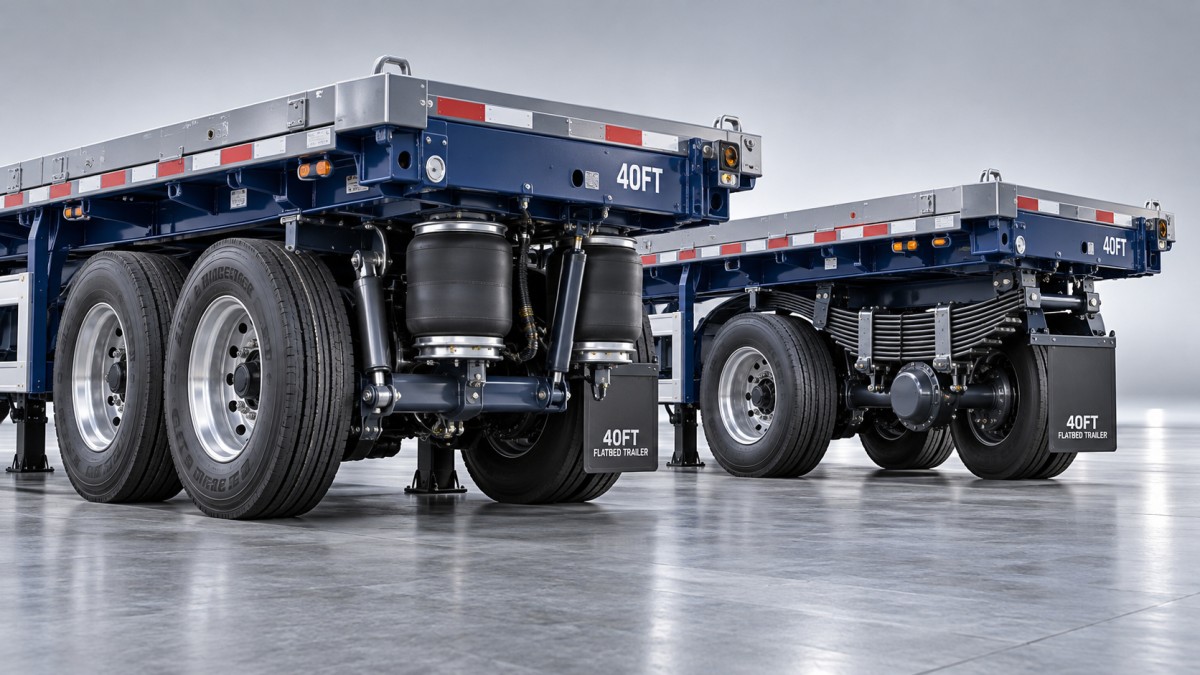
Do not assume air suspension increases legal payload. Permitted capacity depends on local regulations, axle ratings, tires, chassis design, and the approved vehicle configuration. Compare certified tare weights as well: suspension weight varies by design, so the payload effect must be checked on the actual quotation.
Making the 40ft Flatbed Trailer Price comparison fair
A suspension premium is meaningful only when the rest of the trailer is comparable. Two quotations described as “40ft flatbeds” may differ in chassis construction, axle brand, braking equipment, deck thickness, tires, landing gear, and corrosion protection. Those differences can obscure the true cost of choosing air instead of leaf suspension.
Ask suppliers for matched alternatives built around the same operating specification. The quotation should identify the suspension manufacturer and model, axle ratings, intended operating load, and included controls. Confirm whether a quoted lifting axle or loading-height function is actually supplied rather than merely available.
For imported equipment, separate the factory price from the delivered, operational cost. Freight, duties, inspection, registration, and initial spares can change the investment substantially. Compare both options on the same delivery basis and obtain written warranty terms, including exclusions and the process for claiming replacement components.
Be particularly cautious about an unusually cheap air-suspension option with unspecified components. A smaller premium is not attractive if replacement air springs or valves cannot be sourced when the trailer stops working.
Where the air-suspension premium can earn its keep
Cargo claims have a measurable cost
Machinery, finished products, and other shock-sensitive loads may benefit from improved ride isolation. The relevant question is not whether air suspension feels smoother, but whether it reduces an identifiable business exposure. Review damage reports, rejected deliveries, insurance deductibles, and customer requirements before assigning a financial benefit.
If a shipper specifies air-ride equipment, the premium may also enable access to work that a leaf-suspension trailer cannot accept. That opportunity should be supported by realistic contract prospects, not an assumption that higher-paying cargo will appear after purchase.
The trailer works frequently under changing loads
A flatbed moving between loaded and empty journeys can benefit from air suspension’s load-responsive behavior. Appropriate height control also helps maintain the suspension’s intended operating geometry. Yet lower tire wear or fuel consumption should not be treated as guaranteed savings: alignment, inflation, speed, loading, and maintenance can dominate those outcomes.
Workshop support is already in place
For a fleet that maintains air-suspended equipment, another trailer may add relatively little service complexity. Technicians, diagnostic routines, and stocked components already exist. For an operator introducing its first air-suspended trailer, training and spare-parts planning belong in the purchase budget.
When leaf suspension is the stronger commercial choice
Leaf suspension remains a rational investment for durable cargo, cost-sensitive work, and routes where straightforward repair matters more than refined ride characteristics. A familiar spring assembly that can be repaired locally may be more valuable than a technically capable system awaiting an imported component.
Rough-road service does not automatically rule out air suspension. Suitability depends on suspension travel, ground clearance, component protection, axle specification, and operating speed. However, severe routes combined with limited pneumatic-service support strengthen the case for a properly engineered leaf-spring configuration.
Fleet evaluators should also separate transport duties. A flatbed carrying fabricated equipment and a dump truck moving loose aggregate need different purchase criteria. For construction or mining material handling, the HOHAN 6X4 Dump Truck is a separate equipment option, with a high-strength-steel construction and hydraulic tipping system. Its suitability should be assessed against bulk-haul requirements rather than used as a direct alternative to a flatbed trailer.
Calculate the premium against evidence, not optimism
A practical ownership comparison can use this framework:
Net ownership cost = delivered purchase cost + maintenance + downtime + cargo-related losses − resale proceeds.
Use the same ownership period and expected utilization for both suspension options. Include financing costs where relevant. For downtime, count realistic lost contribution and recovery expenses rather than treating all missed revenue as lost profit.
Then test three scenarios: conservative, expected, and favorable. If air suspension pays back only when cargo claims fall dramatically and resale value remains unusually strong, the case is fragile. If confirmed customer requirements and existing damage costs justify the premium under conservative assumptions, it is more defensible.
Any break-even calculation should use the net annual benefit after additional maintenance and support costs. Where that benefit is zero or negative, there is no financial payback from operating savings alone.
What to request before approving the order
Ask the supplier for a matched specification sheet, maintenance schedule, replacement-parts list, and written confirmation of suitability for your load and routes. Request component identification and local availability information—not just assurances that parts are “easy to find.” Check loading and unloading procedures, especially where height adjustment may be used.
Shandong Jiyake Automobile Sales Co., Ltd. supplies semi-trailers and other heavy vehicles to more than 60 countries, including markets in Southeast Asia, Central Asia, and Africa. For buyers operating across varied conditions, that makes a route-specific discussion useful: explain the roads, cargo, workshop resources, and legal requirements before settling the specification.
The best 40ft Flatbed Trailer Price is not necessarily the lowest quotation. Choose air suspension when its capabilities address documented cargo or operating needs and service support is dependable. Choose leaf suspension when simplicity, repair access, and capital discipline deliver greater value. The right decision is the one your operating records can support—not the one with the longest equipment list.
Leave A Reply

First class quality service and professional after-sales team.
Get in Touch
*We respect your confidentiality and all information are protected.