




Recent Posts
 French Clients Visit JIYAKE Factory for Semi-Trailers and Used Trucks Inspection: Global Partners WelcomeOct 27, 2026
 Fuel Tanker Baffles and Rollover Risk: What Buyers Need to UnderstandOct 15, 2026
- Will a Fuel Tanker Trailer Fit Your Depot's Bottom-Loading System?Oct 15, 2026


Fuel Tanker Baffles and Rollover Risk: What Buyers Need to Understand
When assessing a fuel tanker trailer for sale, “fitted with baffles” is not enough to establish how it will behave on the road. Baffles can reduce liquid surge, but their effect depends on their orientation, openings, spacing, and the amount of fuel carried. A tanker with baffles can still roll over if cornering forces exceed the vehicle’s stability margin.
The useful purchasing question is whether the internal layout and complete vehicle configuration suit the intended loading pattern. A trailer making several deliveries needs assessment at intermediate load states, not just when leaving the terminal fully loaded.
Baffles and sealed compartments control different things
A baffle is an internal barrier with openings that allow liquid to pass through. It interrupts movement and dissipates some of the energy of sloshing. Because the liquid remains connected through those openings, a baffled section is not automatically a separate cargo compartment.
A sealed bulkhead divides the tank into distinct compartments. Each compartment confines its own liquid, allowing separate loading and discharge where the associated piping arrangement supports it. However, fuel can still slosh inside a partly filled compartment.
Ask for a drawing that distinguishes perforated baffles from liquid-tight bulkheads. The number of manholes does not establish the number of compartments, and a specification stating “multiple internal plates” does not explain their function.
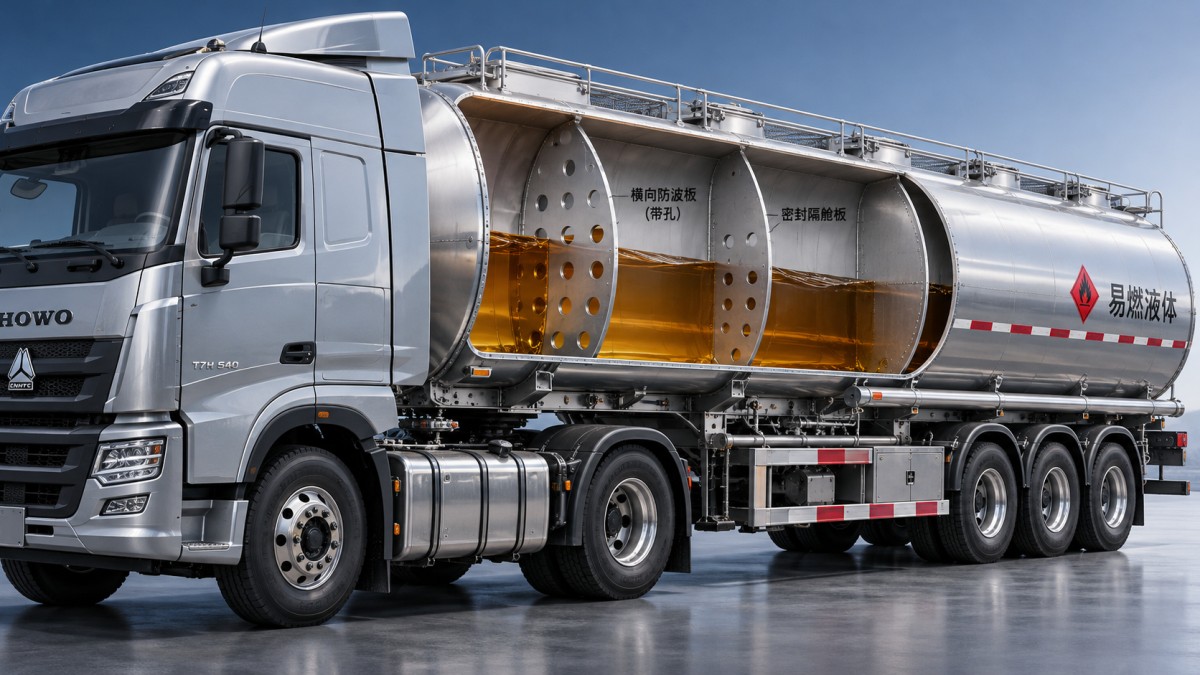
Baffle count alone is therefore a weak comparison. Two tanks with the same number of plates may have different flow paths, unsupported spans, and liquid response. Openings must also permit drainage and access for inspection, so simply making barriers more restrictive is not a complete design solution.
Why partial loads deserve separate assessment
In a partly filled tank, fuel has room to move across an exposed liquid surface. During cornering, the surface tilts and liquid shifts toward the outside of the turn. This movement changes the load distribution and can add to the overturning effect already produced by the vehicle’s mass and height.
During braking, liquid moves forward. Transverse baffles can moderate this surge, but they do not hold the fuel rigidly in place. A sudden steering correction while the liquid is still moving creates a different response from smooth braking in a straight line.
It is tempting to assume that less cargo always means less rollover risk. Lower cargo mass can reduce some loads, but partial filling also changes slosh behavior and the combined center of gravity. These effects do not follow a simple rule that applies to every tank. Equally, a nearly full tank may have less room for slosh while still carrying substantial mass at height.
There is no universal “safest percentage” that can be assigned from tank capacity alone. Permitted filling conditions must account for cargo expansion, the applicable transport requirements, and the tank’s approved operating envelope. Filling completely to eliminate free space is not an acceptable substitute for stability assessment.
Consider a delivery route that empties one compartment while leaving another partly full. The departure condition may distribute weight acceptably, yet a later condition may change kingpin load, axle loads, and liquid movement. The compartment discharge sequence belongs in the evaluation.
Rollover resistance comes from the complete vehicle
Baffles address one part of tanker behavior. Tank mounting height, cross-sectional shape, track width, suspension response, tires, chassis flexibility, and tractor compatibility also influence stability. A low tank profile may help reduce the center of gravity, but external appearance does not establish the loaded center of gravity.
Cornering demand increases rapidly with speed. On the same curve, a modest speed increase can consume a substantial part of the available stability margin. Adverse road camber, abrupt steering, soft shoulders, and uneven surfaces can reduce that margin further. Baffles cannot compensate for excessive entry speed or a wheel dropping off the road edge.
Electronic braking and roll stability functions, where fitted, can help manage certain developing situations. Their presence does not establish a safe speed for every bend, and their effectiveness depends on the system configuration, vehicle compatibility, and available tire grip.
For comparison purposes, keep the tractor, coupling height, suspension assumptions, and cargo conditions consistent. Otherwise, an apparently better stability result may reflect different test conditions rather than a better trailer design.
What the technical evidence should show
A useful supplier submission connects construction details to loading conditions and vehicle behavior. A general statement such as “anti-wave design” provides little basis for acceptance. Request evidence that answers these questions:
- What is inside the tank? General arrangement drawings should identify compartment boundaries, baffle orientation, plate geometry, openings, attachments, and drainage paths.
- Which loads were assessed? Loading schedules should cover relevant fuel densities, compartment combinations, partial fills, and delivery stages, with corresponding kingpin and axle loads.
- What supports the stability claim? Calculations, simulation, or test reports should identify the vehicle configuration, method, assumptions, and load states evaluated.
- How is the internal structure supported? Design information should address loads on baffles and their attachments, including repeated loading that can contribute to fatigue.
- What operating limits follow? Documentation should translate the assessment into permitted loading arrangements, discharge sequencing, and inspection requirements.
A static stability assessment can help explain resistance to overturning under defined conditions. It does not, by itself, describe transient liquid movement during an evasive maneuver. If a simulation is offered, examine whether it represents the liquid as moving fluid or merely as a fixed mass. Those approaches answer different questions.
Likewise, a report for a different tank length, suspension, mounting height, or compartment arrangement needs a documented basis for applying it to the offered trailer. The evidence should be traceable to the configuration being purchased.
Separate regulatory compliance from route suitability
Fuel transport requirements depend on the destination market, cargo classification, and tank design. The purchasing specification should identify the applicable dangerous goods framework and vehicle approval requirements, then connect each requirement to the relevant drawings, inspection records, and approval documents.
Tank integrity, braking compliance, and rollover performance are related but distinct subjects. Passing a leak test does not demonstrate dynamic stability. Similarly, a compliant tank design does not establish that every possible compartment loading sequence is suitable for operation.
For an international supplier such as Shandong Jiyake Automobile Sales Co., Ltd., the technical enquiry should name the destination country, intended fuels, tractor configuration, and delivery pattern. Manufacturing equipment and production capacity provide background; the decisive evidence is the documentation for the specific trailer configuration.
Make the loading plan part of the purchase specification
Before comparing quotations, prepare a loading matrix covering departure, intermediate deliveries, and return conditions. Include fuel density, compartment quantities, intended tractor, coupling height, and route features such as tight roundabouts or sustained bends. Ask each supplier to assess the same conditions.
Inspection access also deserves attention. Baffle attachments, internal welds, and drainage openings need an appropriate inspection and maintenance plan. Internal tank work requires controlled procedures for hazardous atmospheres and confined spaces; it is not a routine driver check.
Accept the trailer against a defined configuration and operating envelope. The supplier should show how the baffles function, which partial-load conditions were evaluated, and how the resulting limits will be communicated to loading staff and drivers. That gives “baffled tank” a practical meaning beyond a line in the sales specification.
Leave A Reply

First class quality service and professional after-sales team.
Get in Touch
*We respect your confidentiality and all information are protected.