




Recent Posts
 Which container sizes can a skeleton semi-trailer carry?Oct 30, 2026
 Ghanaian Client Visits JIYAKE to Inspect XCMG Truck Cranes: Expanding Partnerships in AfricaOct 27, 2026
 French Clients Visit JIYAKE Factory for Semi-Trailers and Used Trucks Inspection: Global Partners WelcomeOct 27, 2026
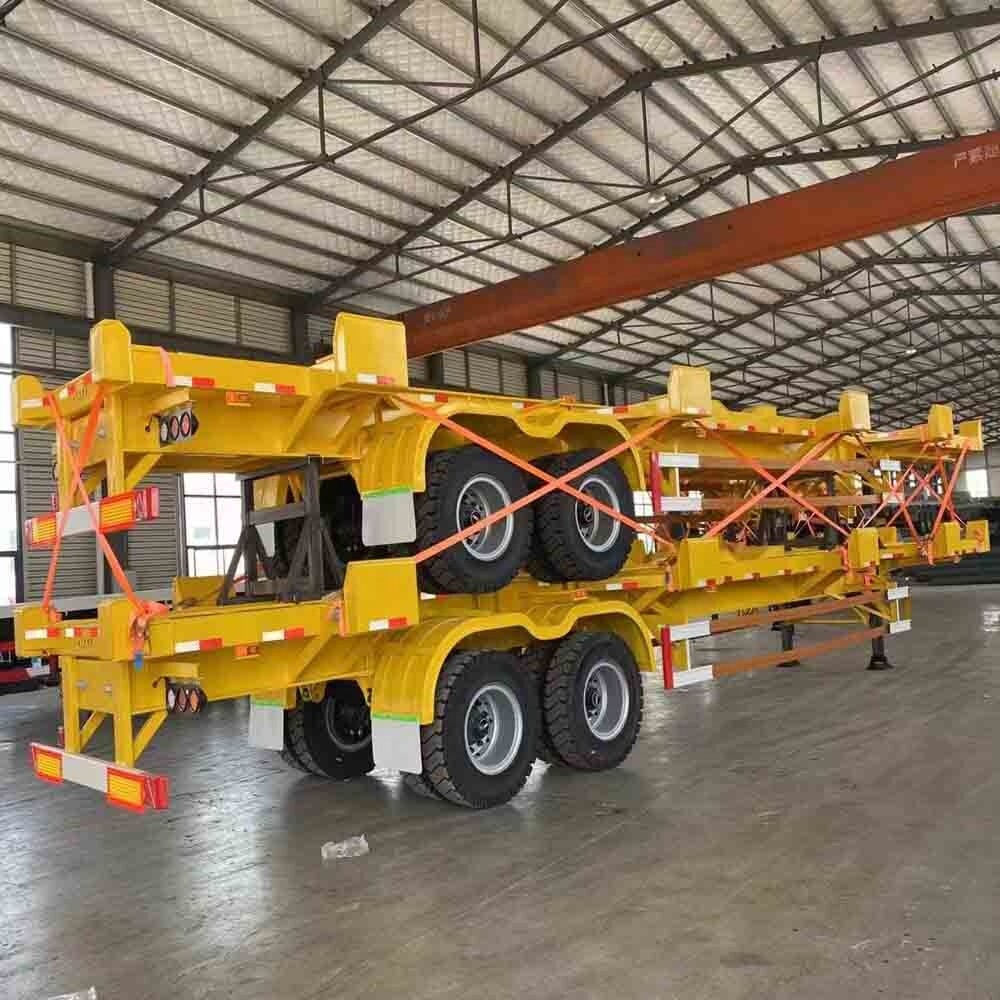


Which container sizes can a skeleton semi-trailer carry?
A skeleton semi-trailer can carry the container sizes for which its chassis and locking points are designed. Common arrangements accommodate a single 20-foot or 40-foot container; some can also carry a 45-foot container or two 20-foot containers. A trailer described as “40-foot” is not automatically compatible with every combination that fits within that length.
The answer depends on more than container length. Twist-lock positions, weight distribution, payload capacity and road regulations all determine whether a particular container can be carried safely and legally. These distinctions matter when comparing a skeleton semi-trailer for sale with the containers it is expected to transport.
Common container sizes and chassis configurations
Shipping-container lengths are nominal designations rather than exact measurements of the trailer frame. The following table shows common arrangements, but compatibility must be confirmed against the trailer’s approved loading configurations.
Special-purpose chassis can be built for other container lengths, including 30-foot units, but those arrangements should not be assumed from the trailer’s overall length. A manufacturer’s loading diagram is more informative than a length label alone.
Carrying a single 20-foot container
A 20-foot skeleton chassis is designed around one short container. Its compact frame places the container over a defined section of the trailer, with locks positioned to engage the container’s corner fittings. It is not a substitute for a 40-foot chassis when the load is a single 40-foot container.
A longer chassis may also have locks for a 20-foot container, but their position matters. The container might be carried in a central or another specified position, depending on the trailer design. That position affects how much load reaches the tractor’s coupling and the trailer axles.
Placing a heavy 20-foot container at one end of a long chassis simply because locks appear to be available can produce an unsuitable weight distribution. The intended position and permitted weight should be checked against the trailer manufacturer’s instructions, rather than inferred from the frame.
One 40-foot container versus two 20-foot containers
A 40-foot container uses the chassis’s outer container locking positions on a compatible 40-foot skeleton. This is a single load with one set of container corner fittings at each end.
Two 20-foot containers are different: they are separate loads, each of which must be secured to the trailer. The chassis therefore needs suitable locking positions at the inner ends as well as at the outer ends. A 40-foot frame with only the locks needed for one 40-foot container cannot be assumed to carry two 20-foot containers safely.
Weight distribution also changes. Two containers can have very different gross weights, even if they are the same size. Their individual positions affect coupling and axle loads, so a combination that is acceptable by total payload alone may still exceed an axle limit. Loading instructions and applicable road limits determine whether a particular pairing is suitable.
The same distinction applies to empty containers. Low weight does not remove the need for correctly positioned, engaged locks. Each container must be restrained as a separate unit.
Can a skeleton semi-trailer carry a 45-foot container?
Some skeleton semi-trailers are designed for 45-foot containers, including extendable models that change length to accommodate different loads. Others are fixed in a configuration intended for 45-foot equipment. In either case, the trailer must be approved for the specific container and loading position.
A 45-foot container should not be treated as a 40-foot container with a small overhang. Its usable locking arrangement depends on the container design as well as the chassis. Some 45-foot containers have additional fittings aligned with 40-foot positions, but their presence does not by itself establish that a particular trailer and route are suitable.
Overall vehicle length, rear overhang and route-specific rules can restrict operation. The tractor, chassis setting and container must be considered together, especially where local authorities or terminal operators impose dimensional limits.
Height and width: why length is not the whole answer
A chassis may have the correct locks for a container’s length while the loaded vehicle is still too tall for its route. A standard-height container is nominally 8 feet 6 inches high, while a high-cube container is nominally 9 feet 6 inches high. The trailer deck height and chassis geometry add to the container height when determining the overall height of the loaded combination.
For example, a 40-foot high-cube container can have a length-compatible locking arrangement on a 40-foot chassis, but that does not guarantee clearance under bridges or compliance with a local height limit. The relevant measurement is the loaded vehicle’s overall height, not the container height alone.
Width also deserves attention. Standard freight containers are generally nominally 8 feet wide, but some container types are wider. A chassis and its locks may support a wider unit, yet the resulting load can be subject to different road or terminal restrictions. Refrigerated containers and tank containers should likewise be assessed by their actual dimensions, fittings and operating requirements rather than by length designation alone.
Payload and container size are separate limits
Container dimensions describe the space and locking arrangement required; they do not establish how much weight the trailer can carry. The relevant figure is the container’s gross weight: the container’s own weight plus its cargo. For two containers, both gross weights contribute to the trailer’s load.
A trailer’s rated payload is only one part of the calculation. The tractor’s coupling capacity, the trailer’s axle ratings, tire ratings and legal axle loads can impose lower practical limits. Container position and cargo distribution inside the container also affect how the weight is transferred to the road.
As a result, a chassis that can physically accept a loaded 20-foot container is not necessarily rated to carry every 20-foot container at its maximum permitted gross weight. The container’s marking and shipping documentation should be compared with the trailer’s approved load rating and loading diagram.
It is also useful to distinguish a container chassis from a bulk-material vehicle. A HOHAN 6X4 Dump Truck is configured for tipping materials such as sand or gravel; its dump body and lifting mechanism do not provide the container-locking arrangement of a skeleton semi-trailer.
How to confirm compatibility
The most reliable reference is the chassis manufacturer’s specification or loading diagram showing each permitted container size, lock position and weight limit. For an extendable trailer, the document should identify the approved chassis setting for each load, not just the maximum extended length.
Check the container’s length, height, width and gross weight against that information. Then confirm that the route allows the resulting vehicle dimensions and axle loads. A container that fits the locks but exceeds a weight or height limit is not a suitable load for that trip.
Before loading, inspect the twist locks and their mounting points, and confirm that the locks engage the container’s corner fittings. Where a chassis offers several positions, use the position specified for the intended container and load. The practical answer to “which sizes can it carry?” is therefore a list of approved configurations—not simply the longest container that fits on the frame.
Leave A Reply

First class quality service and professional after-sales team.
Get in Touch
*We respect your confidentiality and all information are protected.